

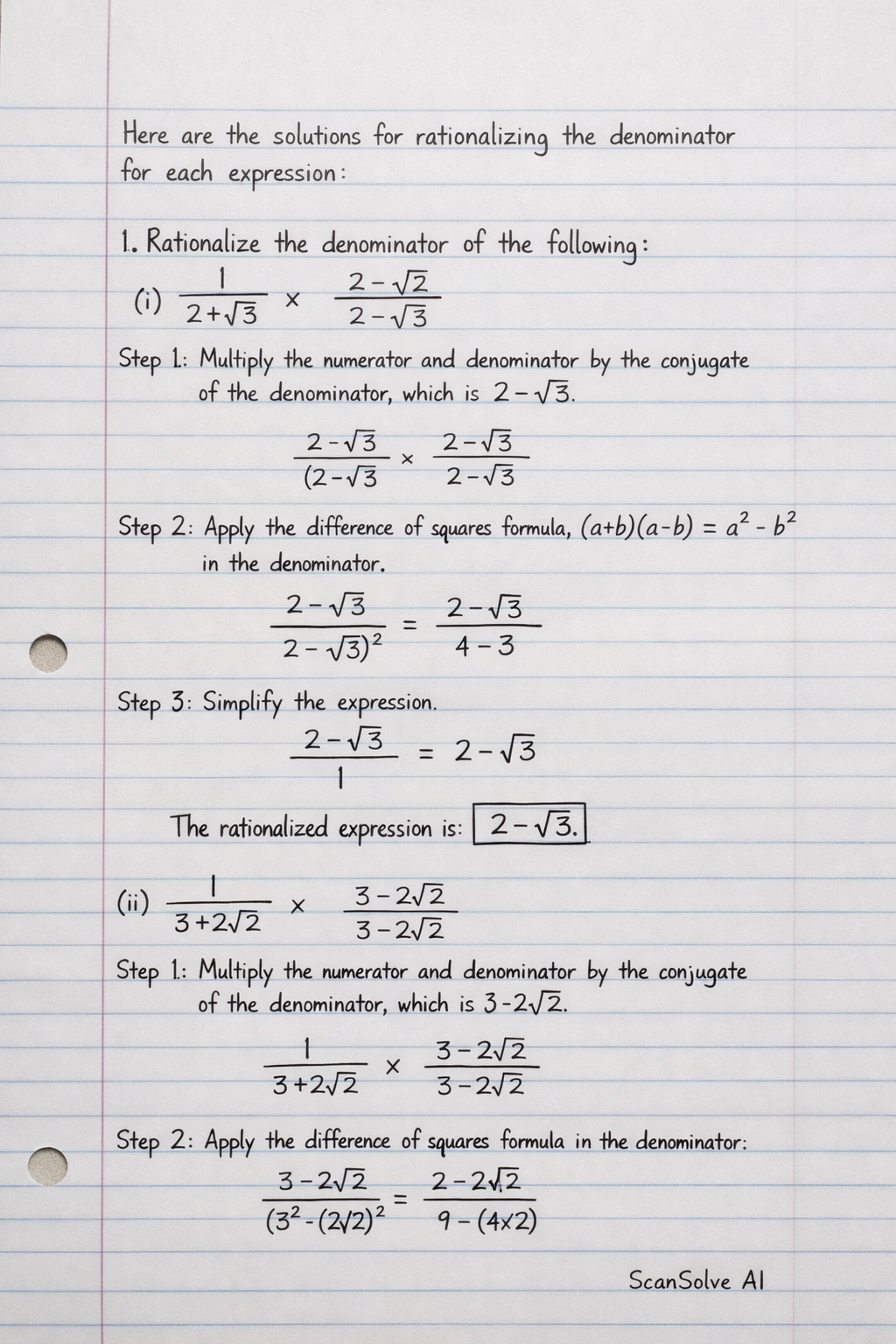
This mathematics problem involves applying core mathematical principles and formulas. Below you will find a complete step-by-step solution with detailed explanations for each step, helping you understand not just the answer but the method behind it.
ScanSolve AI Answer
Here are the solutions for rationalizing the denominator for each expression: 1. Rationalize the denominator of the following: i) (1)/(2+sqrt(3)) Step 1: Multiply the numerator and denominator by the conjugate of the denominator, which is 2-sqrt(3). (1)/(2+sqrt(3)) × 2-sqrt(3)2-sqrt(3) Step 2: Apply the difference of squares formula (a+b)(a-b) = a^2-b^2 in the denominator. 2-sqrt(3)(2)^2 - (sqrt(3))^2 = 2-sqrt(3)4-3 Step 3: Simplify the expression. 2-sqrt(3)1 = 2-sqrt(3) The rationalized expression is 2-sqrt(3). ii) (1)/(3+2sqrt(2)) Step 1: Multiply the numerator and denominator by the conjugate of the denominator, which is 3-2sqrt(2). (1)/(3+2sqrt(2)) × 3-2sqrt(2)3-2sqrt(2) Step 2: Apply the difference of squares formula in the denominator. 3-2sqrt(2)(3)^2 - (2sqrt(2))^2 = 3-2sqrt(2)9 - (4 × 2) Step 3: Simplify the expression. 3-2sqrt(2)9-8 = 3-2sqrt(2)1 = 3-2sqrt(2) The rationalized expression is 3-2sqrt(2). iii) (1)/(4sqrt(3)-5) Step 1: Multiply the numerator and denominator by the conjugate of the denominator, which is 4sqrt(3)+5. (1)/(4sqrt(3)-5) × 4sqrt(3)+54sqrt(3)+5 Step 2: Apply the difference of squares formula in the denominator. 4sqrt(3)+5(4sqrt(3))^2 - (5)^2 = 4sqrt(3)+5(16 × 3) - 25 Step 3: Simplify the expression. 4sqrt(3)+548-25 = 4sqrt(3)+523 The rationalized expression is 4sqrt(3)+523. iv) (16)/(2sqrt(3)+11) Step 1: Multiply the numerator and denominator by the conjugate of the denominator, which is 2sqrt(3)-sqrt(11). (16)/(2sqrt(3)+11) × 2sqrt(3)-sqrt(11)2sqrt(3)-sqrt(11) Step 2: Apply the difference of squares formula in the denominator. 16(2sqrt(3)-sqrt(11))(2sqrt(3))^2 - (sqrt(11))^2 = 16(2sqrt(3)-sqrt(11))(4 × 3) - 11 Step 3: Simplify the expression. 16(2sqrt(3)-sqrt(11))12-11 = 16(2sqrt(3)-sqrt(11))1 = 16(2sqrt(3)-sqrt(11)) = 32sqrt(3)-16sqrt(11) The rationalized expression is 32sqrt(3)-16sqrt(11). v) 9-sqrt(2)9+sqrt(2) Step 1: Multiply the numerator and denominator by the conjugate of the denominator, which is 9-sqrt(2). 9-sqrt(2)9+sqrt(2) × 9-sqrt(2)9-sqrt(2) Step 2: Expand the numerator using (a-b)^2 = a^2-2ab+b^2 and the denominator using (a+b)(a-b) = a^2-b^2. (9-sqrt(2))^2(9)^2 - (sqrt(2))^2 = 9^2 - 2(9)(sqrt(2)) + (sqrt(2))^281 - 2 Step 3: Simplify the expression. 81 - 18sqrt(2) + 279 = 83 - 18sqrt(2)79 The rationalized expression is 83 - 18sqrt(2)79. vi) sqrt(13)+sqrt(11)sqrt(13)-sqrt(11) Step 1: Multiply the numerator and denominator by the conjugate of the denominator, which is sqrt(13)+sqrt(11). sqrt(13)+sqrt(11)sqrt(13)-sqrt(11) × sqrt(13)+sqrt(11)sqrt(13)+sqrt(11) Step 2: Expand the numerator using (a+b)^2 = a^2+2ab+b^2 and the denominator using (a-b)(a+b) = a^2-b^2. (sqrt(13)+sqrt(11))^2(sqrt(13))^2 - (sqrt(11))^2 = (sqrt(13))^2 + 2(sqrt(13))(sqrt(11)) + (sqrt(11))^213 - 11 Step 3: Simplify the expression. 13 + 2sqrt(143) + 112 = 24 + 2sqrt(143)2 Step 4: Factor out 2 from the numerator and simplify. 2(12 + sqrt(143))2 = 12 + sqrt(143) The rationalized expression is 12 + sqrt(143). Last free one today — make it count tomorrow, or type /upgrade for unlimited.