
We read your photo as:
1 Solve for x 1.1.1 (2x−1)(x−1)=0 1.1.2 2x2−3x−1=0 (Correct to TWO decimal places) 1.1.3 x(2x+1)-3<=0 1.2 Solve for x and y
ScanSolve AI Answer
Answer
Step-by-step solution
8 stepsHere are the solutions for :
1.1.1
To solve , we set each factor equal to zero.
Set each factor to zero.
Solve for in each equation.
The solutions are or .
1.1.2
To solve , we use the quadratic formula .
Identify the coefficients $a, b, c$.
For , we have , , .
Substitute the values into the quadratic formula.
Calculate the two values for and round to two decimal places.
Rounding to two decimal places, we get or .
1.1.3
To solve the inequality , we first expand and rearrange it into standard quadratic form.
Expand and rearrange the inequality.
Find the roots of the corresponding quadratic equation .
We can factor the quadratic expression:
Setting each factor to zero gives the roots:
The roots are and .
Determine the interval where the inequality holds.
Since the coefficient of is positive (), the parabola opens upwards. The inequality means we are looking for the values of where the parabola is below or on the x-axis. This occurs between and including the roots.
Therefore, the solution is .
Try one yourself
A new problem that tests the same skill.
Still stuck on this one?
Ask a follow-up, and the answer starts from this question.
More Mathematics Questions
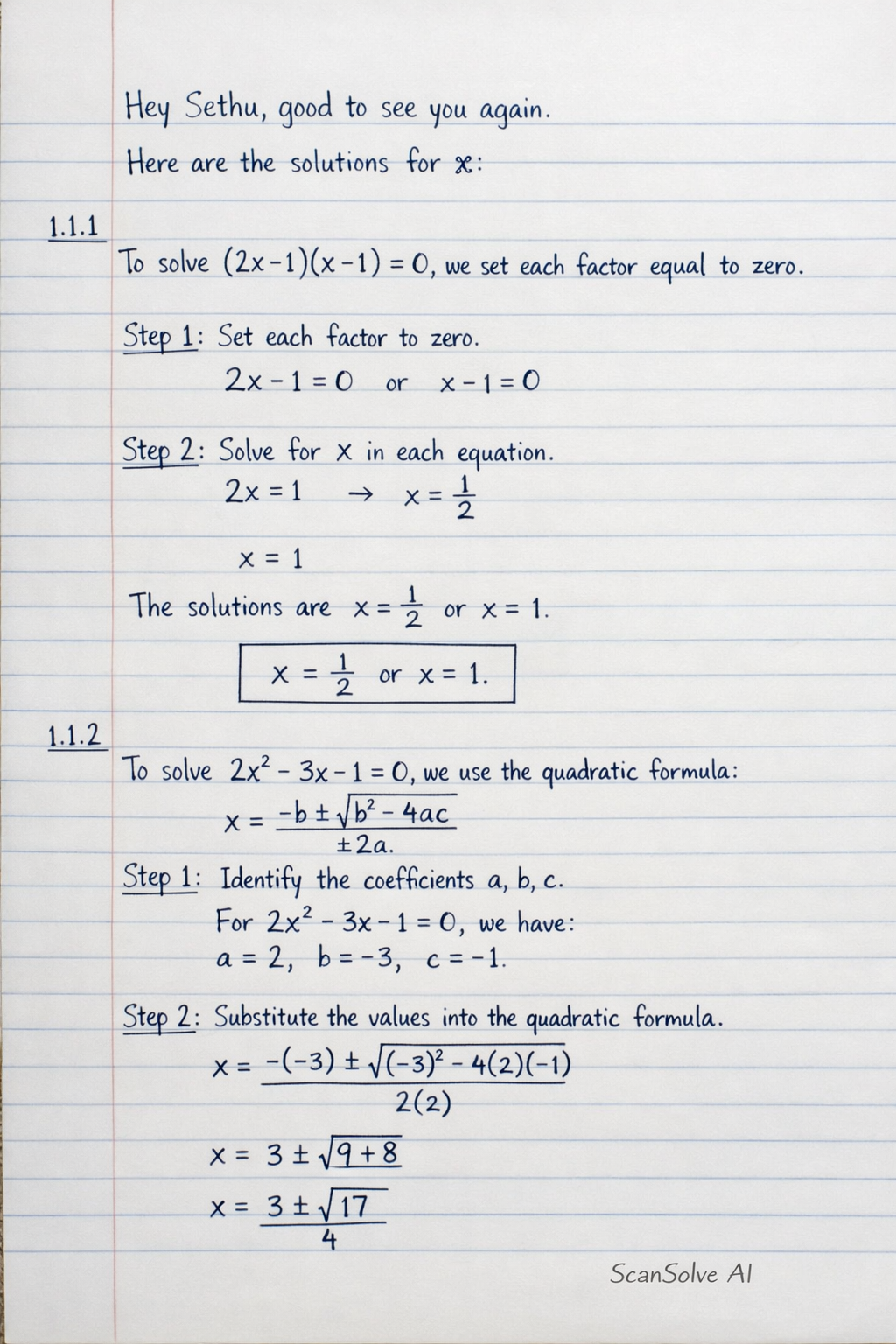
Handwritten Step-by-Step Solution
Get this as a handwritten image on WhatsApp — like a tutor wrote it for you.
Try on WhatsApp