
We read your photo as:
1 The following geometric patterns. A Geometric shape pattern. The number of units used to form the pattern are 1, 4, 9, 16, 25. Identify the next number in the sequence.
ScanSolve AI Answer
Step-by-step solution
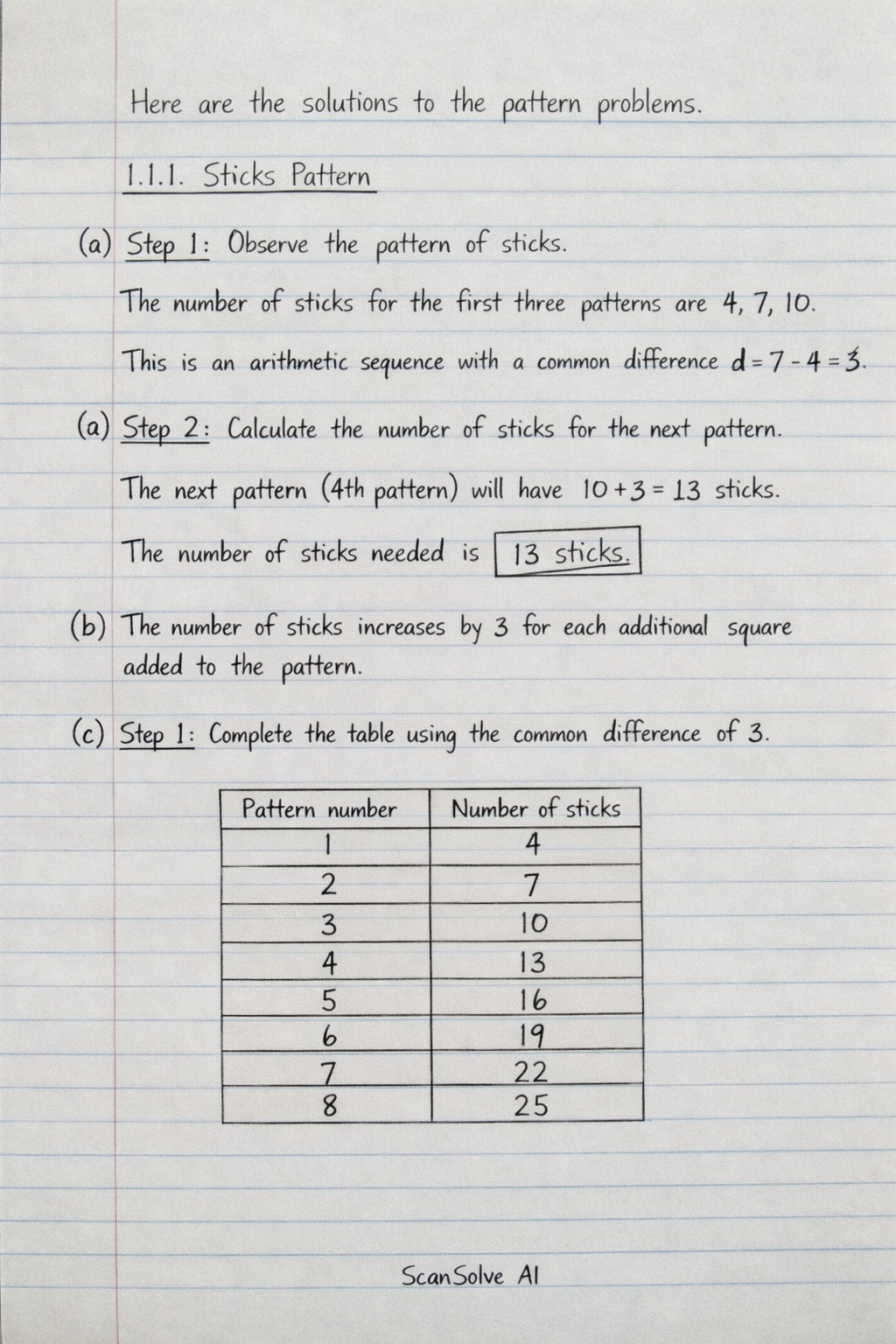
8 stepsHere are the solutions to the pattern problems.
1.1.1 Sticks Pattern
a) Step 1: Observe the pattern of sticks.
The number of sticks for the first three patterns are 4, 7, 10.
This is an arithmetic sequence with a common difference .
Calculate the number of sticks for the next pattern.
The next pattern (4th pattern) will have sticks.
The number of sticks needed is .b) The number of sticks increases by 3 for each additional square added to the pattern.
c) Step 1: Complete the table using the common difference of 3.
d) Step 1: Identify the first term () and common difference ().
, .Use the formula for the -th term of an arithmetic sequence, .
For the 18th pattern ():
Calculate the value.
The number of sticks needed for the 18th pattern is .
e) Step 1: Use the formula for the -th term of an arithmetic sequence, .
Substitute and .Simplify the expression.
The algebraic rule is .
1.1.2 Geometric shape pattern
a) Step 1: Analyze the pattern of dots.
Pattern 1 has dots.
Pattern 2 has dots.
Pattern 3 has dots.
Pattern 4 has dot.Determine the rule for the number of dots () in terms of the pattern number ().
The side length of the square is . So, .
Calculate the number of dots for the 8th term ().
Simplify the expression.
The number of dots in the 8th term is .
b) Step 1: Use the rule for the 10th term ().
Simplify the expression.
The 10th term of the pattern is .
c) Step 1: Based on the analysis in part (a), the algebraic rule is the square of .
The algebraic rule is .
Still stuck on this one?
Ask a follow-up, and the answer starts from this question.
More Mathematics Questions
Handwritten Step-by-Step Solution
Get this as a handwritten image on WhatsApp — like a tutor wrote it for you.
Try on WhatsApp