
We read your photo as:
Define the term triangle.
ScanSolve AI Answer
Step-by-step solution
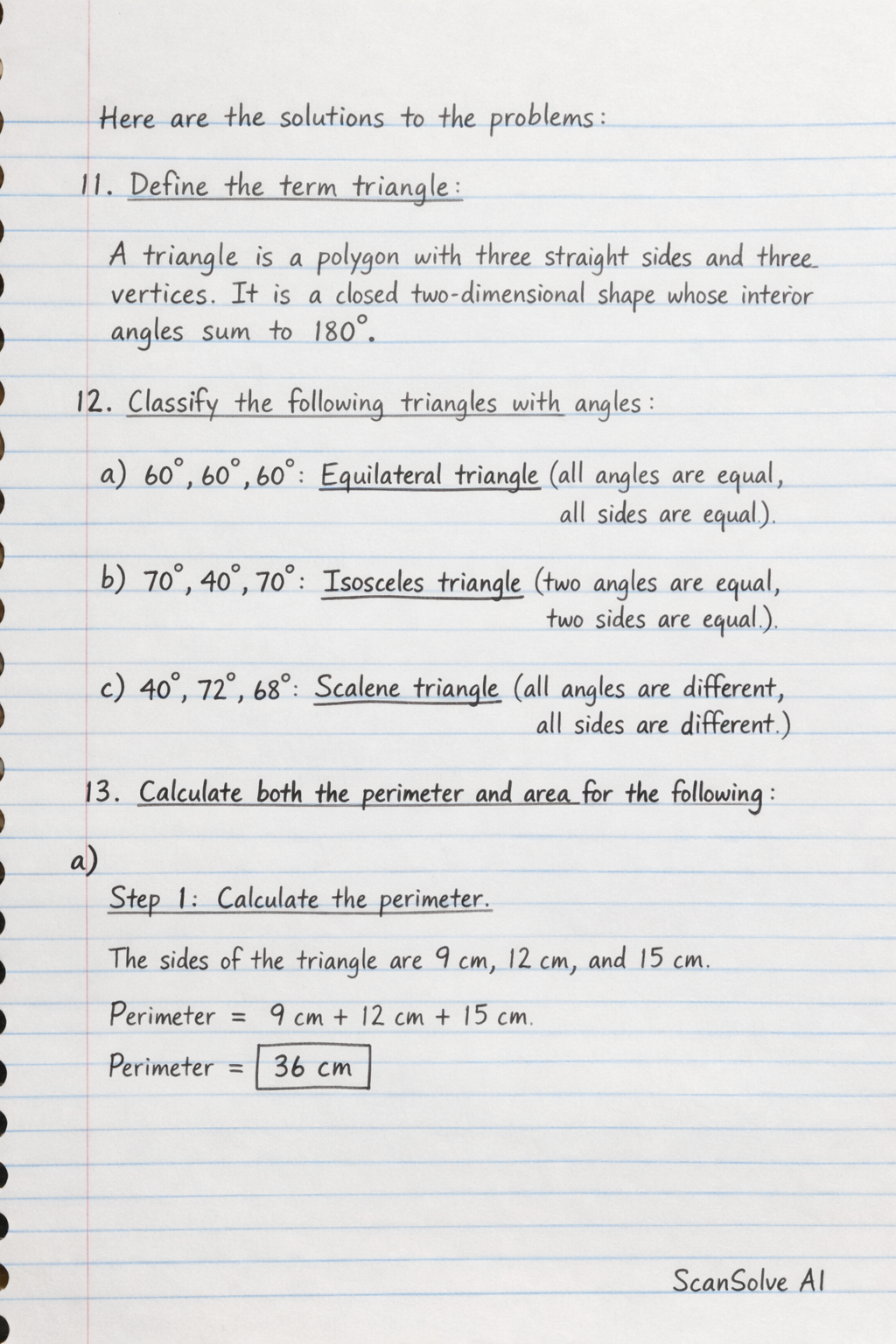
6 stepsHere are the solutions to the problems:
11. Define the term triangle.
A triangle is a polygon with three straight sides and three vertices. It is a closed two-dimensional shape whose interior angles sum to .
12. Classify the following triangles with angles:
a) : Equilateral triangle (all angles are equal, implying all sides are equal).
b) : Isosceles triangle (two angles are equal, implying two sides are equal).
c) : Scalene triangle (all angles are different, implying all sides are different).
13. Calculate both the perimeter and area for the following:
a)
Calculate the perimeter.
The sides of the triangle are , , and .
Calculate the area.
The base is and the height is .
b)
Calculate the area.
The base is and the height is .
Note: The perimeter cannot be calculated without the length of the third side. The given side is one of the non-base sides.
c)
The given side lengths are , , and .
According to the triangle inequality theorem, the sum of the lengths of any two sides of a triangle must be greater than the length of the third side.
Here, .
Since , a triangle cannot be formed with these dimensions.14. In the triangle below, angles at A and B are and respectively. Find the value of at C.
Find the interior angle at B.
The exterior angle at B is . The interior angle at B and the exterior angle at B are supplementary (they add up to ).
Use the sum of angles in a triangle.
The sum of the interior angles of a triangle is .
Solve for .
Still stuck on this one?
Ask a follow-up, and the answer starts from this question.
More Mathematics Questions
Handwritten Step-by-Step Solution
Get this as a handwritten image on WhatsApp — like a tutor wrote it for you.
Try on WhatsApp