
We read your photo as:
Ivolyum yeeobhjekthi Yintoni ivolum yesitakhi ngasinye?
Mathematics
ScanSolve AI Answer
Step-by-step solution
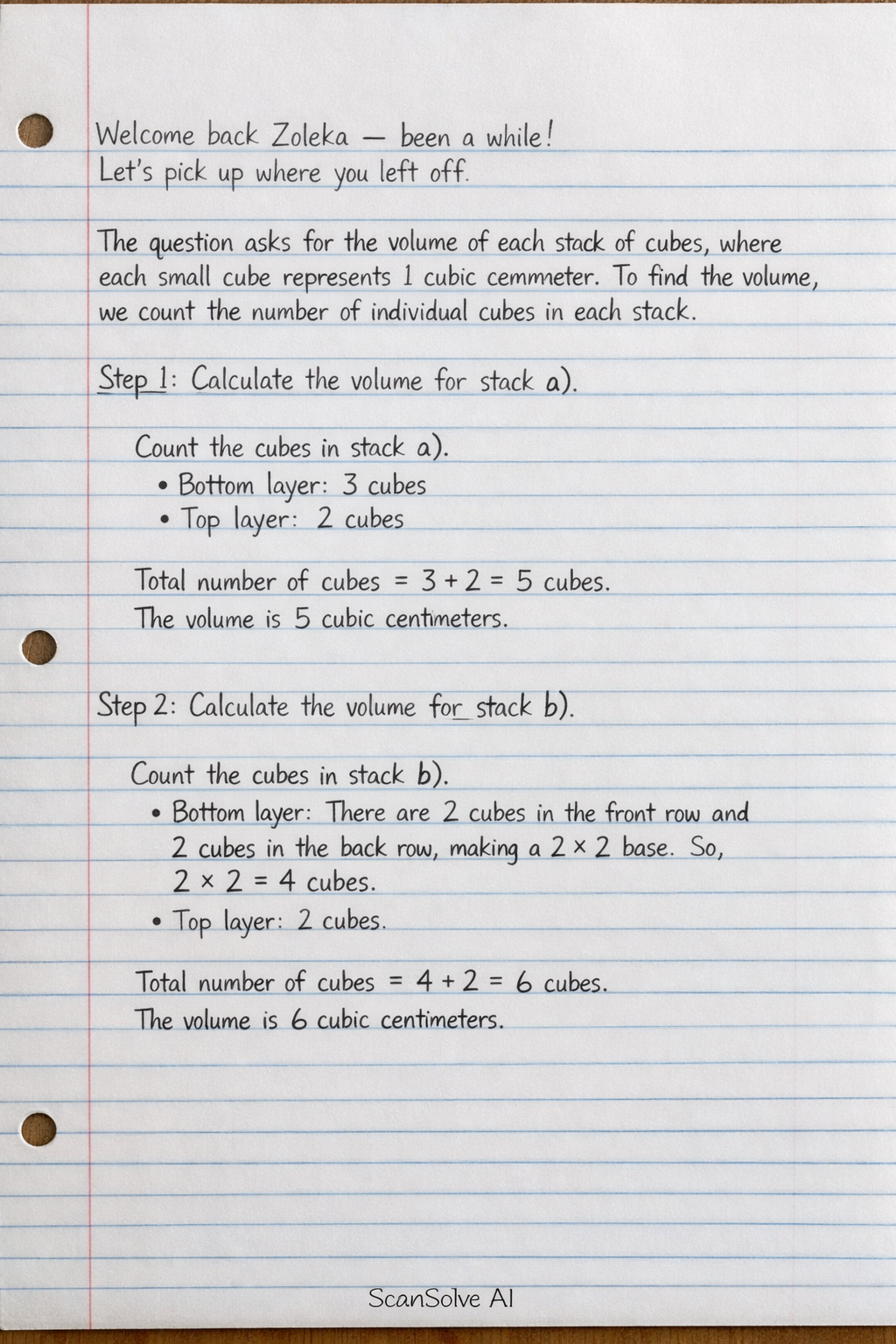
3 stepsThe question asks for the volume of each stack of cubes, where each small cube represents 1 cubic centimeter. To find the volume, we count the number of individual cubes in each stack.
Calculate the volume for stack a).
Count the cubes in stack a).
- Bottom layer: 3 cubes
- Top layer: 2 cubes Total number of cubes = cubes. The volume is 5 cubic centimeters.
Calculate the volume for stack b).
Count the cubes in stack b).
- Bottom layer: There are 2 cubes in the front row and 2 cubes in the back row, making a base. So, cubes.
- Top layer: 2 cubes Total number of cubes = cubes. The volume is 6 cubic centimeters.
Calculate the volume for stack c).
Count the cubes in stack c).
- Bottom layer: There are 3 cubes in the front row, 3 in the middle row, and 3 in the back row, making a base. So, cubes.
- Middle layer: There are 2 cubes in the front row and 2 cubes in the back row, making a layer. So, cubes.
- Top layer: 1 cube Total number of cubes = cubes. The volume is 14 cubic centimeters.
The volumes for each stack are:
a)
b)
c)
Was this helpful?
Still stuck on this one?
Ask a follow-up, and the answer starts from this question.
Got a different question?Ask your own question
More Mathematics Questions
QInhloso yombongo yintoni? Yintoni eyenziwa yinkwenkwe ezintlanu zokuqala, njengoko kuchaziwe…QYini igama lenkondlo ekhuluma ngoku fa? 11. Shono ukuthi lomusho olandelayo "isifanis impendulo…QNika igama lomlambo ekuthethwa ngawo kule ntshomi. 2. Yintoni le yayidunga-dunga ucwangco kule lali?…QWhat is Iviwe means in zuluQFunda ibali uze uphendule imibuzo. Waya nabani uJabu kumyezo wezilwanyana? Wahamba kunye Baya njani…
Handwritten Step-by-Step Solution
Get this as a handwritten image on WhatsApp — like a tutor wrote it for you.
Try on WhatsApp