This mathematics problem involves applying core mathematical principles and formulas. Below you will find a complete step-by-step solution with detailed explanations for each step, helping you understand not just the answer but the method behind it.
ScanSolve AI Answer
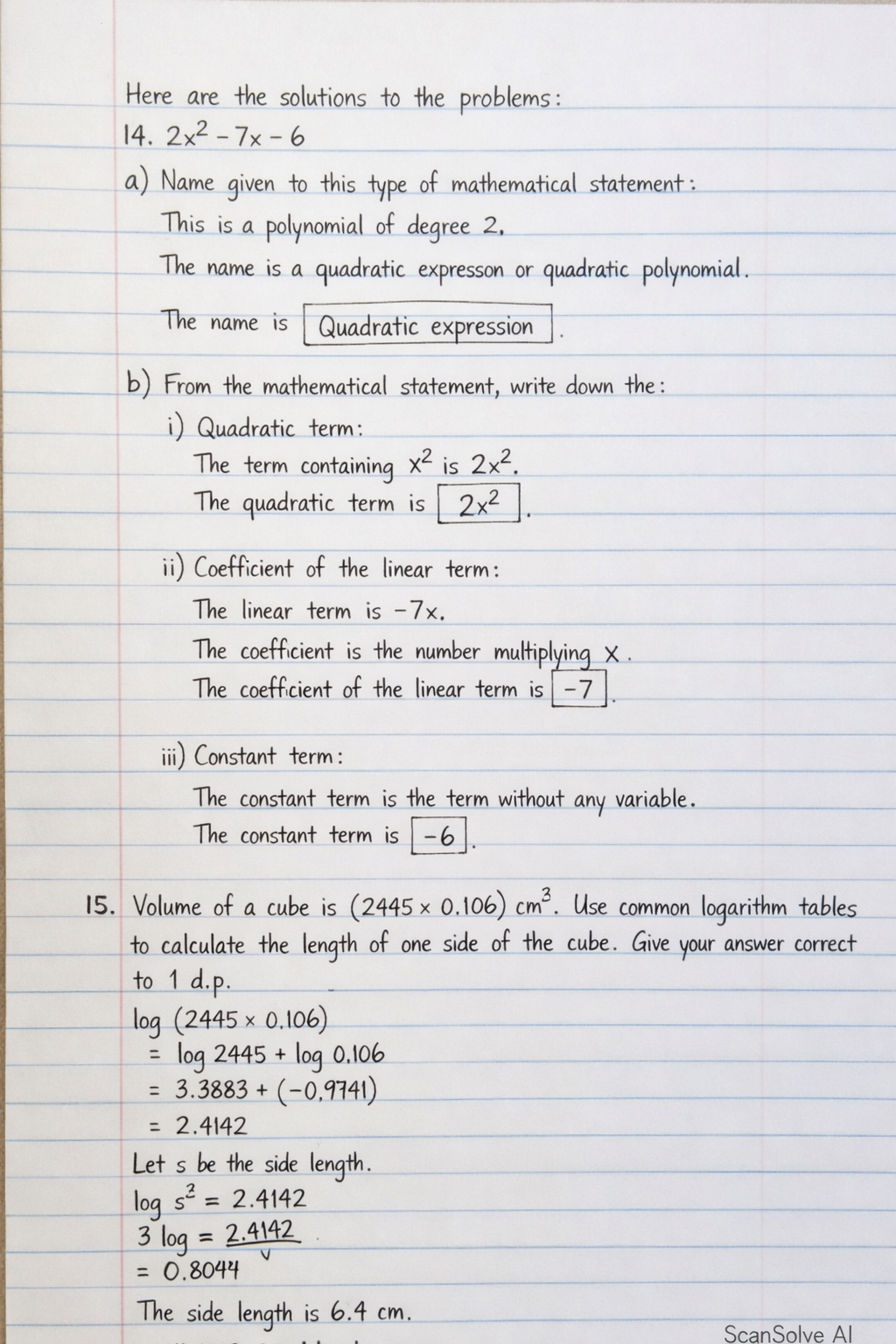
Here are the solutions to the problems:
14. Mathematical statement $2x^2 - 7x - 6$
a) Name given to this type of mathematical statement:
This is a polynomial of degree 2.
The name is a quadratic expression or quadratic polynomial.
The name is $\boxed{\text{Quadratic expression}}$.
b) From the mathematical statement, write down the:
i) Quadratic term:
The term containing $x^2$ is $2x^2$.
The quadratic term is $\boxed{2x^2}$.
ii) Coefficient of the linear term:
The linear term is the term containing $x$, which is $-7x$. The coefficient is the number multiplying $x$.
The coefficient of the linear term is $\boxed{-7}$.
iii) Constant term:
The constant term is the term without any variable.
The constant term is $\boxed{-6}$.
15. Volume of a cube is given as $(2445 \times 0.106) \text{ cm}^3$. Use common logarithm tables to calculate the length of one side of the cube. Give your answer correct to 1 d.p.
Let $V$ be the volume of the cube and $s$ be the length of one side.
We are given $V = 2445 \times 0.106 \text{ cm}^3$.
The formula for the volume of a cube is $V = s^3$.
So, $s^3 = 2445 \times 0.106$.
To find $s$, we take the cube root: $s = \sqrt[3]{2445 \times 0.106}$.
Step 1: Take the logarithm of both sides.
$$\log s = \log \left( (2445 \times 0.106)^{\frac{1}{3}} \right)$$
$$\log s = \frac{1}{3} \log (2445 \times 0.106)$$
$$\log s = \frac{1}{3} (\log 2445 + \log 0.106)$$
Step 2: Find the logarithms of $2445$ and $0.106$ using logarithm tables.
For $\log 2445$:
Characteristic = $3$ (since $2445$ has 4 digits, $4-1=3$).
Mantissa for $24$ under $4$ is $0.3874$. Mean difference for $5$ is $9$.
So, $\log 2445 = 3.3874 + 0.0009 = 3.3883$.
For $\log 0.106$:
Characteristic = $\bar{1}$ (since the first non-zero digit is in the first decimal place).
Mantissa for $10$ under $6$ is $0.0253$.
So, $\log 0.106 = \bar{1}.0253$.
Step 3: Add the logarithms.
$$\log (2445 \times 0.106) = 3.3883 + \bar{1}.0253$$
$$ = (3 + (-1)) + (0.3883 + 0.0253)$$
$$ = 2 + 0.4136$$
$$ = 2.4136$$
Step 4: Divide the sum by 3.
$$\log s = \frac{1}{3} (2.4136)$$
$$\log s = 0.804533...$$
We will use $0.8045$ for finding the antilog.
Step 5: Find the antilog of $0.8045$.
Antilog of $0.8045$:
Look up $0.80$ under $4$, which gives $6.368$.
The mean difference for $5$ (in the row for $80$) is $7$.
So, antilog $0.8045 = 6.368 + 0.007 = 6.375$.
Since the characteristic of $\log s$ is $0$ (from $0.8045$), the decimal point is after the first digit.
So, $s = 6.375$.
Step 6: Round the answer to 1 decimal place.
$s \approx 6.4$ cm.
The length of one side of the cube is $\boxed{6.4 \text{ cm}}$.
16. The population of a small village in Turkana grows at a rate modeled using indices. If the initial population $P$ triples every 5 years, use laws of indices to find how long it takes for the population to reach 9 times its original size.
Let the initial population be $P_0$.
The population triples every 5 years.
After $t$ years, the population $P(t)$ can be expressed as:
$$P(t) = P_0 \times (3)^{\frac{t}{5}}$$
We want to find the time $t$ when the population reaches 9 times its original size, i.e., $P(t) = 9P_0$.
Step 1: Set up the equation.
$$9P_0 = P_0 \times (3)^{\frac{t}{5}}$$
Step 2: Divide both sides by $P_0$.
$$9 = 3^{\frac{t}{5}}$$
Step 3: Express 9 as a power of 3.
$$3^2 = 3^{\frac{t}{5}}$$
Step 4: Equate the exponents.
Since the bases are the same, the exponents must be equal.
$$2 = \frac{t}{5}$$
Step 5: Solve for $t$.
$$t = 2 \times 5$$
$$t = 10$$
It takes $\boxed{10 \text{ years}}$ for the population to reach 9 times its original size.
14. Mathematical statement 2x^2 - 7x - 6
|Mathematics
14. Mathematical statement 2x^2 - 7x - 6
ScanSolve AI Answer
Here are the solutions to the problems:
14. Mathematical statement 2x2−7x−6
a) Name given to this type of mathematical statement:
This is a polynomial of degree 2.
The name is a quadratic expression or quadratic polynomial.
The name is Quadraticexpression.
b) From the mathematical statement, write down the:i) Quadratic term:
The term containing x2 is 2x2.
The quadratic term is 2x2.
ii) Coefficient of the linear term:
The linear term is the term containing x, which is −7x. The coefficient is the number multiplying x.
The coefficient of the linear term is −7.
iii) Constant term:
The constant term is the term without any variable.
The constant term is −6.
15. Volume of a cube is given as (2445×0.106)cm3. Use common logarithm tables to calculate the length of one side of the cube. Give your answer correct to 1 d.p.
Let V be the volume of the cube and s be the length of one side.
We are given V=2445×0.106cm3.
The formula for the volume of a cube is V=s3.
So, s3=2445×0.106.
To find s, we take the cube root: s=32445×0.106.
Step 1: Take the logarithm of both sides.
logs=log((2445×0.106)31)logs=31log(2445×0.106)logs=31(log2445+log0.106)
Step 2: Find the logarithms of 2445 and 0.106 using logarithm tables.
For log2445:
Characteristic = 3 (since 2445 has 4 digits, 4−1=3).
Mantissa for 24 under 4 is 0.3874. Mean difference for 5 is 9.
So, log2445=3.3874+0.0009=3.3883.
For log0.106:
Characteristic = 1ˉ (since the first non-zero digit is in the first decimal place).
Mantissa for 10 under 6 is 0.0253.
So, log0.106=1ˉ.0253.
Step 3: Add the logarithms.
log(2445×0.106)=3.3883+1ˉ.0253=(3+(−1))+(0.3883+0.0253)=2+0.4136=2.4136
Step 4: Divide the sum by 3.
logs=31(2.4136)logs=0.804533...
We will use 0.8045 for finding the antilog.
Step 5: Find the antilog of 0.8045.
Antilog of 0.8045:
Look up 0.80 under 4, which gives 6.368.
The mean difference for 5 (in the row for 80) is 7.
So, antilog 0.8045=6.368+0.007=6.375.
Since the characteristic of logs is 0 (from 0.8045), the decimal point is after the first digit.
So, s=6.375.
Step 6: Round the answer to 1 decimal place.
s≈6.4 cm.
The length of one side of the cube is 6.4cm.
16. The population of a small village in Turkana grows at a rate modeled using indices. If the initial population P triples every 5 years, use laws of indices to find how long it takes for the population to reach 9 times its original size.
Let the initial population be P0.
The population triples every 5 years.
After t years, the population P(t) can be expressed as:
P(t)=P0×(3)5t
We want to find the time t when the population reaches 9 times its original size, i.e., P(t)=9P0.
Step 1: Set up the equation.
9P0=P0×(3)5t
Step 2: Divide both sides by P0.
9=35t
Step 3: Express 9 as a power of 3.
32=35t
Step 4: Equate the exponents.
Since the bases are the same, the exponents must be equal.
2=5t
Step 5: Solve for t.
t=2×5t=10
It takes 10years for the population to reach 9 times its original size.
Need help with your own homework?
Get instant step-by-step solutions to any question. Free to start.