
We read your photo as:
Evaluate 15.47 x 0.085² / (254)¹/3 using log table.
ScanSolve AI Answer
Answers
2 partsStep-by-step solution
11 steps1. Evaluate using log table.
Let .
Taking the logarithm of both sides:
Step 1: Find the logarithms of the individual numbers using a log table.
- (which is )
Step 2: Substitute these values into the equation for .
Step 3: Convert the negative logarithm to characteristic-mantissa form and find the antilog.
Using an antilog table, the number corresponding to the mantissa 0.2467 is approximately 1.765.
The characteristic indicates that the decimal point is after three zeros.
The final answer is .
2. An arithmetic progression has 11 as its first term and the fourth term is 32. Find the sum of the first nine terms.
Step 1: Use the formula for the -th term of an arithmetic progression, , to find the common difference .
Given and .
Step 2: Use the formula for the sum of the first terms of an arithmetic progression, , to find .
The final answer is .
3. The third term of a GP is 24 and its seventh term is . Find: a) Its first term b) The sum of its first five terms.
Assumption: Based on common notation in such problems, the seventh term is interpreted as a mixed fraction , which is . If it was meant as a simple fraction , the common ratio would be irrational.
Step 1: Use the formula for the -th term of a geometric progression, , to set up equations for and .
Given and .
Step 2: Divide equation (2) by equation (1) to find the common ratio .
Divide both numerator and denominator by 8:
Part a· 1 step
Find its first term ()
Substitute into equation (1) to find .
The first term is .
Part b
Find the sum of its first five terms ()
Use the formula for the sum of the first terms of a geometric progression, (since ).
Since and :
The sum of its first five terms is .
4. Solve using factorisation.
Rearrange the quadratic equation into standard form .
Multiply by to make the leading coefficient positive:
Factor the quadratic expression.
We look for two numbers that multiply to and add to . These numbers are and 7.
Factor by grouping:
Set each factor equal to zero and solve for .
The solutions are .
5. Solve using completing the square.
Divide the entire equation by the coefficient of (which is 6).
Move the constant term to the right side of the equation.
Complete the square on the left side.
Take half of the coefficient of (), square it (), and add it to both sides of the equation.
Factor the left side as a perfect square and simplify the right side.
Take the square root of both sides.
Simplify .
Rationalize the denominator:
Isolate .
Combine the terms with a common denominator:
The solutions are .
Try one yourself
A new problem that tests the same skill.
Still stuck on this one?
Ask a follow-up, and the answer starts from this question.
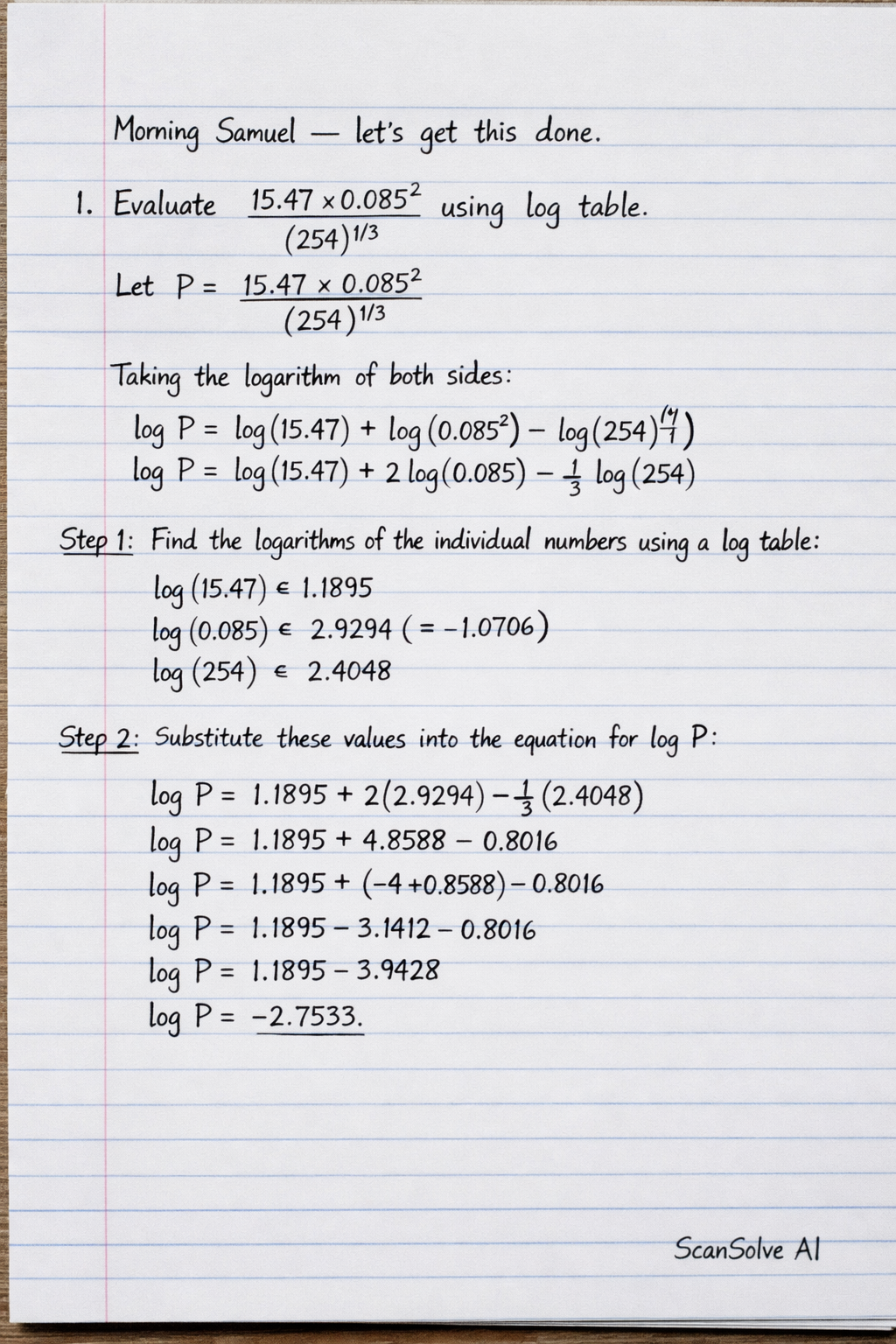
Handwritten Step-by-Step Solution
Get this as a handwritten image on WhatsApp — like a tutor wrote it for you.
Try on WhatsApp