

This mathematics problem involves applying core mathematical principles and formulas. Below you will find a complete step-by-step solution with detailed explanations for each step, helping you understand not just the answer but the method behind it.
ScanSolve AI Answer
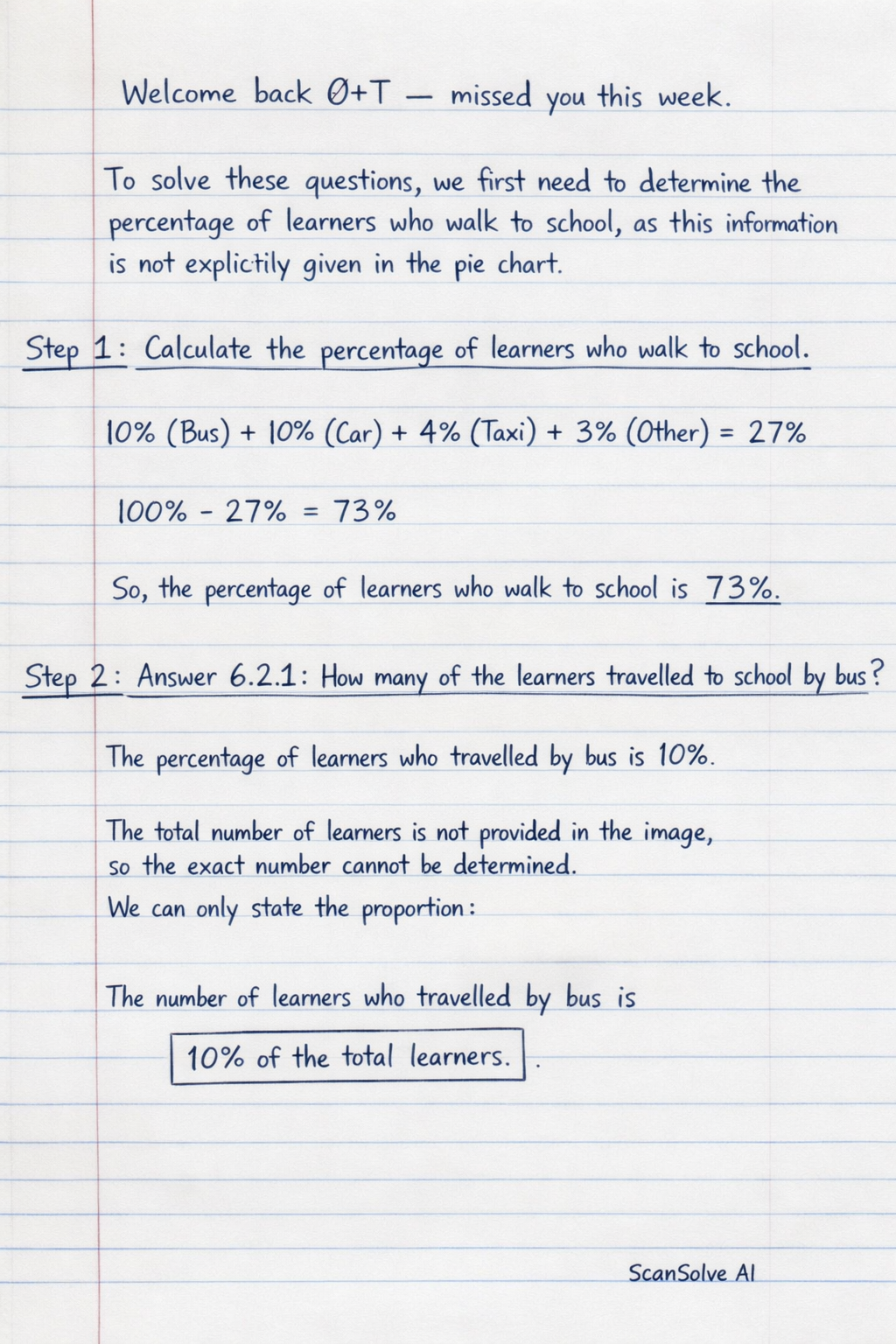
To solve these questions, we first need to determine the percentage of learners who walk to school, as this information is not explicitly given in the pie chart. Step 1: Calculate the percentage of learners who walk to school. The sum of the given percentages for other modes of transport is: 10\% (Bus) + 10\% (Car) + 4\% (Taxi) + 3\% (Other) = 27\% Since a pie chart represents 100\% of the total, the percentage of learners who walk to school is: 100\% - 27\% = 73\% Step 2: Answer 6.2.1: How many of the learners travelled to school by bus? From the pie chart, the percentage of learners who travelled by bus is 10\%. The total number of learners is not provided in the image, so the exact number cannot be determined. We can only state the proportion. The number of learners who travelled by bus is 10\% of the total learners. Step 3: Answer 6.2.2: How many more learners walk to school than travelling by bus? The percentage of learners who walk to school is 73\% (from Step 1). The percentage of learners who travelled by bus is 10\%. The difference in percentage is: 73\% - 10\% = 63\% The total number of learners is not provided in the image, so the exact number of more learners cannot be determined. We can only state the proportional difference. The number of learners who walk to school is 63\% more than those who travel by bus, relative to the total learners. Send me the next one 📸