
We read your photo as:
25, 22, 19,... There are 22 terms find the Sum of the AP. 2) An A.p has 15 terms and a Common difference of -3 find its last term its Sum is 120 3) 2, 4, 8, 16,... There are 16 terms find the Sum of the AP 4) 8, 12, 18,... There are 6 terms find the Sum of the G.P
ScanSolve AI Answer
Step-by-step solution
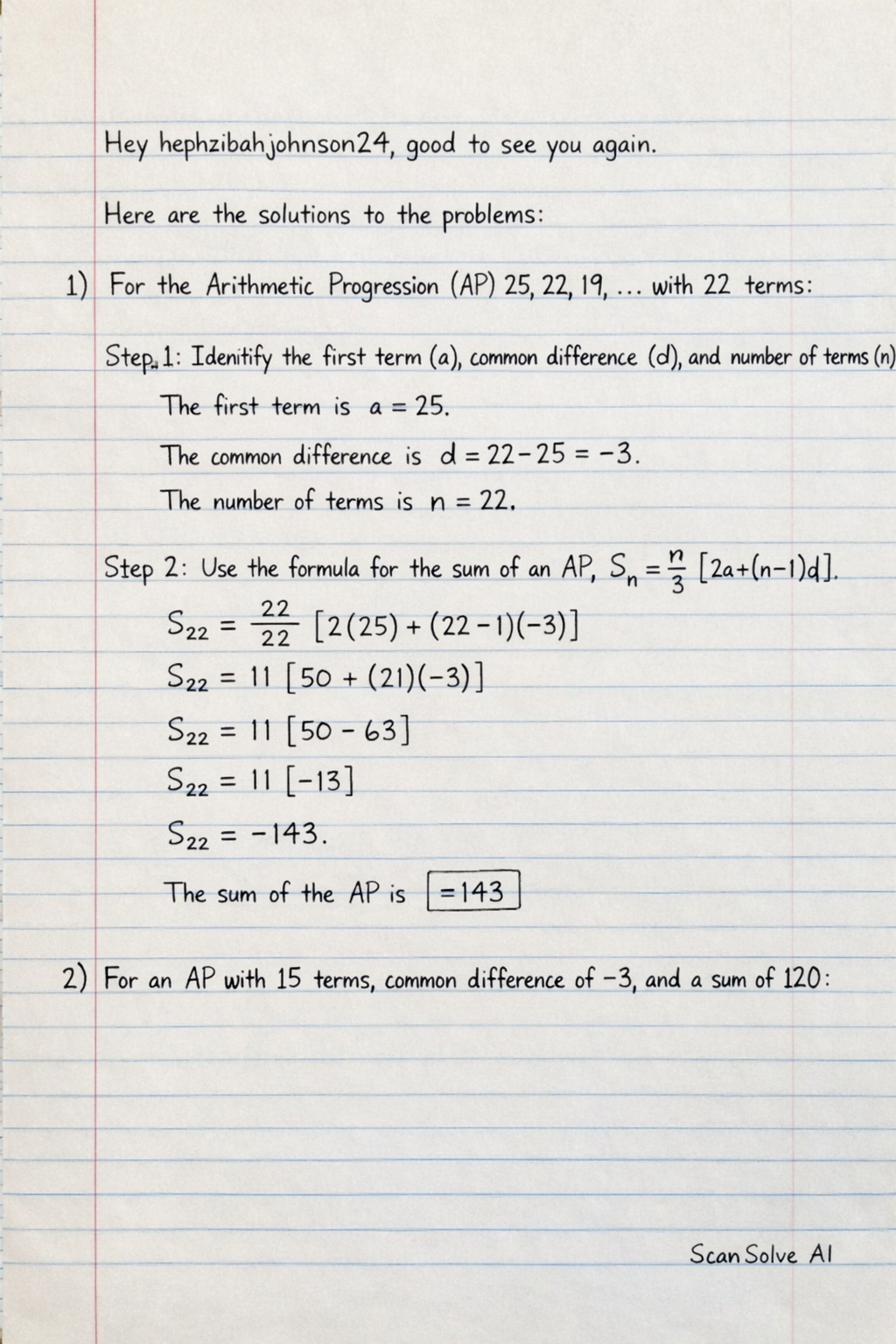
8 stepsHere are the solutions to the problems:
1) For the Arithmetic Progression (AP) 25, 22, 19, ... with 22 terms:
Identify the first term (), common difference (), and number of terms ().
The first term is .
The common difference is .
The number of terms is .Use the formula for the sum of an AP, .
The sum of the AP is .
2) For an AP with 15 terms, common difference of -3, and a sum of 120:
Identify the given values and use the sum formula to find the first term ().
Given , , .
The formula for the sum of an AP is .Multiply both sides by :
The first term is .
Use the formula for the -th term of an AP, , to find the last term ().
The last term is .
3) For the sequence 2, 4, 8, 16, ... with 16 terms:
Identify the type of progression and its parameters.
The sequence 2, 4, 8, 16, ... is a Geometric Progression (GP), not an AP, because each term is multiplied by a constant ratio to get the next term.
The first term is .
The common ratio is .
The number of terms is .Use the formula for the sum of a GP, (since ).
The sum of the GP is .
4) For the Geometric Progression (GP) 8, 12, 18, ... with 6 terms:
Identify the first term (), common ratio (), and number of terms ().
The first term is .
The common ratio is .
The number of terms is .Use the formula for the sum of a GP, (since ).
The sum of the GP is .
Still stuck on this one?
Ask a follow-up, and the answer starts from this question.
More Mathematics Questions
Handwritten Step-by-Step Solution
Get this as a handwritten image on WhatsApp — like a tutor wrote it for you.
Try on WhatsApp