This mathematics problem involves applying core mathematical principles and formulas. Below you will find a complete step-by-step solution with detailed explanations for each step, helping you understand not just the answer but the method behind it.
ScanSolve AI Answer
Alright Rajnish — let's do this.
Here's the solution for question 25 (a) and (b):
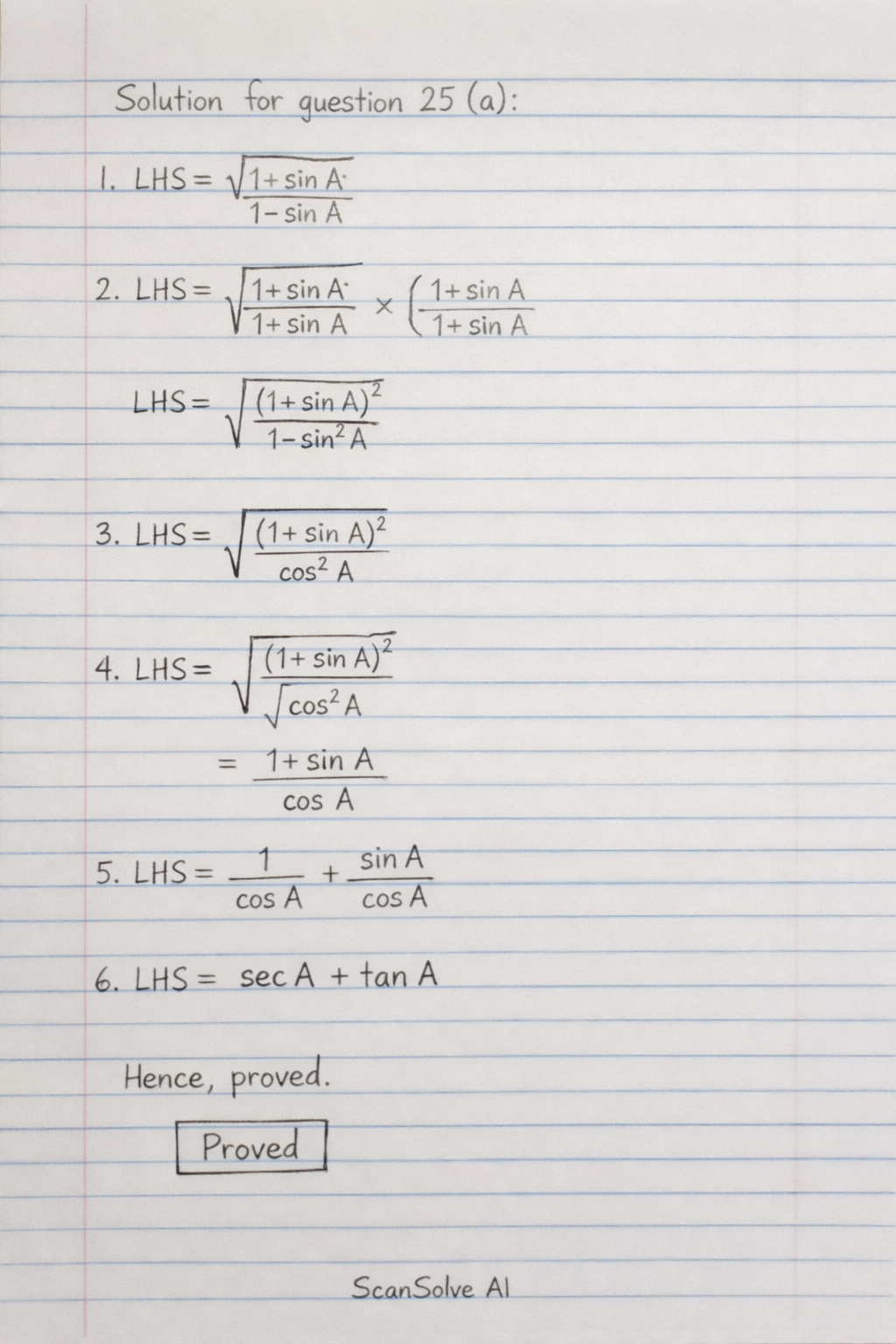
25 (a) Prove that $\sqrt{\frac{1+\sin A}{1-\sin A}} = \sec A + \tan A$
Step 1: Start with the Left Hand Side (LHS).
$$ \text{LHS} = \sqrt{\frac{1+\sin A}{1-\sin A}} $$
Step 2: Multiply the numerator and denominator inside the square root by the conjugate of the denominator, $(1+\sin A)$.
$$ \text{LHS} = \sqrt{\frac{1+\sin A}{1-\sin A} \times \frac{1+\sin A}{1+\sin A}} $$
$$ \text{LHS} = \sqrt{\frac{(1+\sin A)^2}{1^2 - \sin^2 A}} $$
Step 3: Use the identity $1 - \sin^2 A = \cos^2 A$.
$$ \text{LHS} = \sqrt{\frac{(1+\sin A)^2}{\cos^2 A}} $$
Step 4: Take the square root of the numerator and the denominator.
$$ \text{LHS} = \frac{\sqrt{(1+\sin A)^2}}{\sqrt{\cos^2 A}} $$
$$ \text{LHS} = \frac{1+\sin A}{\cos A} $$
Step 5: Separate the terms.
$$ \text{LHS} = \frac{1}{\cos A} + \frac{\sin A}{\cos A} $$
Step 6: Express in terms of $\sec A$ and $\tan A$.
$$ \text{LHS} = \sec A + \tan A $$
This is equal to the Right Hand Side (RHS).
$$ \text{LHS} = \text{RHS} $$
Hence, proved.
$\boxed{\text{Proved}}$
25 (b) Evaluate $\frac{3 \cos^2 30^\circ - 6 \operatorname{cosec}^2 30^\circ}{\tan^2 60^\circ}$
Step 1: Recall the values of the trigonometric functions.
$$ \cos 30^\circ = \frac{\sqrt{3}}{2} $$
$$ \operatorname{cosec} 30^\circ = \frac{1}{\sin 30^\circ} = \frac{1}{1/2} = 2 $$
$$ \tan 60^\circ = \sqrt{3} $$
Step 2: Substitute these values into the expression.
$$ \frac{3 \left(\frac{\sqrt{3}}{2}\right)^2 - 6 (2)^2}{(\sqrt{3})^2} $$
Step 3: Calculate the squares.
$$ \frac{3 \left(\frac{3}{4}\right) - 6 (4)}{3} $$
$$ \frac{\frac{9}{4} - 24}{3} $$
Step 4: Simplify the numerator.
$$ \frac{\frac{9}{4} - \frac{96}{4}}{3} $$
$$ \frac{-\frac{87}{4}}{3} $$
Step 5: Perform the division.
$$ -\frac{87}{4} \times \frac{1}{3} $$
$$ -\frac{87}{12} $$
Step 6: Simplify the fraction by dividing the numerator and denominator by 3.
$$ -\frac{29}{4} $$
The evaluated value is $\boxed{-\frac{29}{4}}$.
Send me the next one 📸
25 (a) Prove that sqrt((1+ A)/(1- A)) = A + A
|Mathematics
25 (a) Prove that sqrt((1+ A)/(1- A)) = A + A
ScanSolve AI Answer
Alright Rajnish — let's do this.
Here's the solution for question 25 (a) and (b):
25 (a) Prove that 1−sinA1+sinA=secA+tanA
Step 1: Start with the Left Hand Side (LHS).
LHS=1−sinA1+sinA
Step 2: Multiply the numerator and denominator inside the square root by the conjugate of the denominator, (1+sinA).
LHS=1−sinA1+sinA×1+sinA1+sinALHS=12−sin2A(1+sinA)2
Step 3: Use the identity 1−sin2A=cos2A.
LHS=cos2A(1+sinA)2
Step 4: Take the square root of the numerator and the denominator.
LHS=cos2A(1+sinA)2LHS=cosA1+sinA
Step 5: Separate the terms.
LHS=cosA1+cosAsinA
Step 6: Express in terms of secA and tanA.
LHS=secA+tanA
This is equal to the Right Hand Side (RHS).
LHS=RHS
Hence, proved.
Proved
25 (b) Evaluate tan260∘3cos230∘−6cosec230∘
Step 1: Recall the values of the trigonometric functions.
cos30∘=23cosec30∘=sin30∘1=1/21=2tan60∘=3
Step 2: Substitute these values into the expression.
(3)23(23)2−6(2)2
Step 3: Calculate the squares.
33(43)−6(4)349−24
Step 4: Simplify the numerator.
349−4963−487
Step 5: Perform the division.
−487×31−1287
Step 6: Simplify the fraction by dividing the numerator and denominator by 3.
−429
The evaluated value is −429.
Send me the next one 📸
Need help with your own homework?
Get instant step-by-step solutions to any question. Free to start.