We read your photo as:

(27x3)1/3 = ?

Mathematics

ScanSolve AI Answer

Step-by-step solution

43 steps

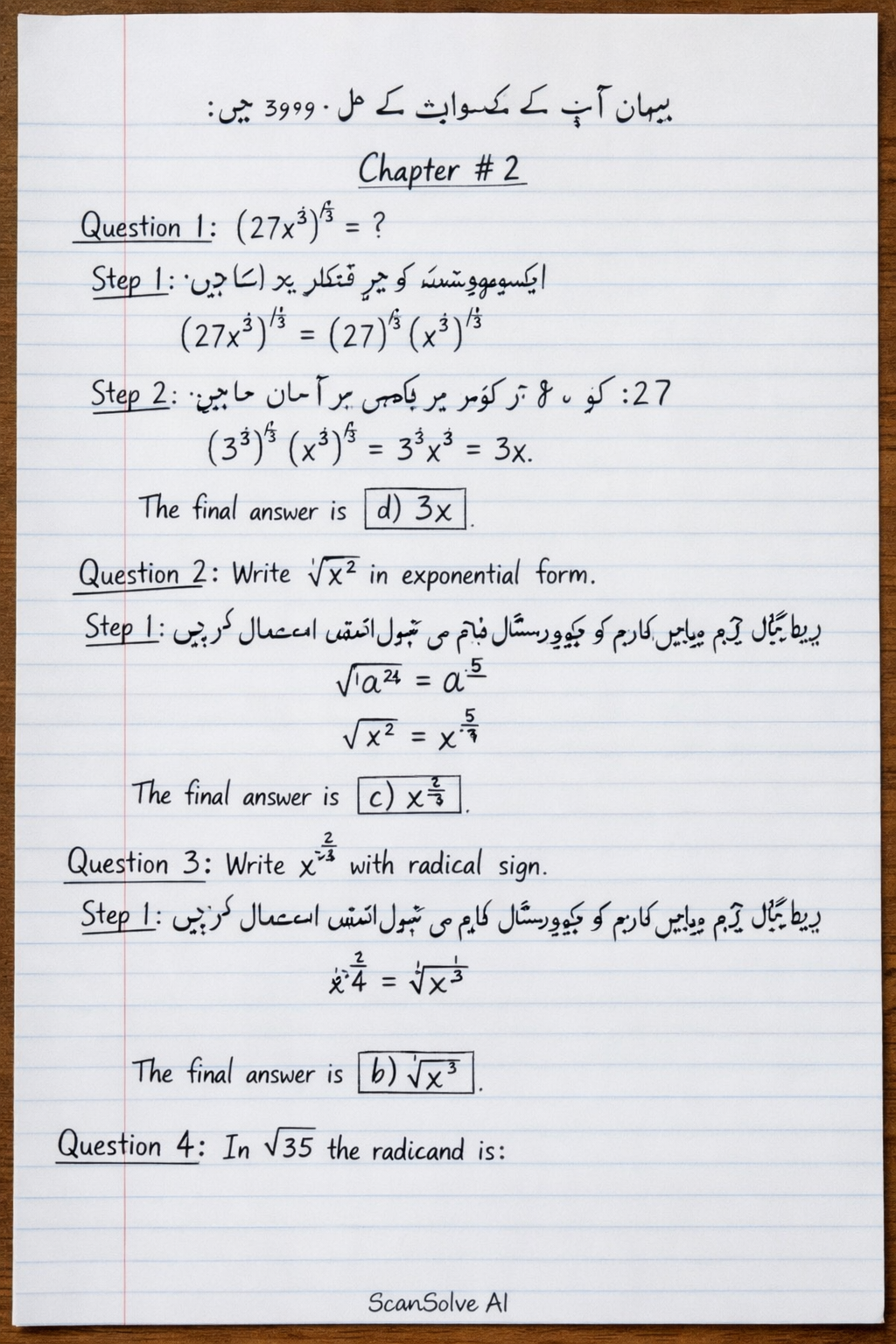
یہاں آپ کے سوالات کے حل موجود ہیں:

Chapter #2

Question 1: (27x3)1/3=?(27x^3)^{1/3} = ?

  1. ایکسپوننٹ کو ہر فیکٹر پر لگائیں۔

    (27x3)1/3=(27)1/3(x3)1/3(27x^3)^{1/3} = (27)^{1/3} (x^3)^{1/3}
  2. 27 کو 333^3 کے طور پر لکھیں اور ایکسپوننٹس کو آسان بنائیں۔

    (33)1/3(x3)1/3=33×13x3×13=31x1=3x(3^3)^{1/3} (x^3)^{1/3} = 3^{3 \times \frac{1}{3}} x^{3 \times \frac{1}{3}} = 3^1 x^1 = 3x

    The final answer is (d) 3x\boxed{\text{(d) } 3x}


    Question 2: Write x25\sqrt[5]{x^2} in exponential form.

  3. ریڈیکل فارم کو ایکسپونینشل فارم میں تبدیل کرنے کا اصول استعمال کریں

    amn=am/n\sqrt[n]{a^m} = a^{m/n}۔

    x25=x2/5\sqrt[5]{x^2} = x^{2/5}

    The final answer is (c) x2/5\boxed{\text{(c) } x^{2/5}}


    Question 3: Write x3/4x^{3/4} with radical sign.

  4. ایکسپونینشل فارم کو ریڈیکل فارم میں تبدیل کرنے کا اصول استعمال کریں

    am/n=amna^{m/n} = \sqrt[n]{a^m}۔

    x3/4=x34x^{3/4} = \sqrt[4]{x^3}

    The final answer is (b) x34\boxed{\text{(b) } \sqrt[4]{x^3}}


    Question 4: In 353\sqrt[3]{35} the radicand is

  5. ریڈیکینڈ وہ عدد یا اظہار ہوتا ہے جو ریڈیکل سائن کے نیچے ہوتا ہے۔

    In 353, the radicand is 35\text{In } \sqrt[3]{35}, \text{ the radicand is } 35

    The final answer is (c) 35\boxed{\text{(c) } 35}


    Question 5: (25/16)−1/2=?(25/16)^{-1/2} = ?

  6. منفی ایکسپوننٹ کو مثبت بنانے کے لیے فریکشن کو الٹا کریں۔

    (2516)−1/2=(1625)1/2\left(\frac{25}{16}\right)^{-1/2} = \left(\frac{16}{25}\right)^{1/2}
  7. 1/21/2 کے ایکسپوننٹ کا مطلب مربع جڑ (square root) ہے۔

    (1625)1/2=1625=1625=45\left(\frac{16}{25}\right)^{1/2} = \sqrt{\frac{16}{25}} = \frac{\sqrt{16}}{\sqrt{25}} = \frac{4}{5}

    The final answer is (b) 45\boxed{\text{(b) } \frac{4}{5}}


    Question 6: The conjugate of 5+4i5+4i is

  8. ایک کمپلیکس نمبر a+bia+bi کا کنجوگیٹ a−bia-bi ہوتا ہے، یعنی خیالی حصے کا نشان تبدیل کر دیا جاتا ہے۔

    The conjugate of 5+4i is 5−4i\text{The conjugate of } 5+4i \text{ is } 5-4i

    The final answer is (a) 5−4i\boxed{\text{(a) } 5-4i}


    Question 7: The value of i9i^9 is

  9. ii کی طاقتوں کا چکر 4 کے بعد دہرایا جاتا ہے (i1=i,i2=−1,i3=−i,i4=1i^1=i, i^2=-1, i^3=-i, i^4=1)۔ 9 کو 4 سے تقسیم کریں اور باقی (remainder) دیکھیں۔

    9÷4=2 with a remainder of 19 \div 4 = 2 \text{ with a remainder of } 1
  10. باقی کو ii کی طاقت کے طور پر استعمال کریں۔

    i9=i4×2+1=(i4)2⋅i1=(1)2⋅i=1⋅i=ii^9 = i^{4 \times 2 + 1} = (i^4)^2 \cdot i^1 = (1)^2 \cdot i = 1 \cdot i = i

    The final answer is (a) i\boxed{\text{(a) } i}


    Question 8: Every real number is

  11. حقیقی اعداد (real numbers) کا سیٹ کمپلیکس اعداد (complex numbers) کے سیٹ کا ایک ذیلی سیٹ ہے، جہاں خیالی حصہ صفر ہوتا ہے۔

    Every real number x can be written as x+0i, which is a complex number.\text{Every real number } x \text{ can be written as } x+0i, \text{ which is a complex number.}

    The final answer is (d) A complex number\boxed{\text{(d) A complex number}}


    Question 9: Real part of 2ab(i+i2)2ab(i+i^2) is

  12. i2=−1i^2 = -1 کا استعمال کرتے ہوئے بریکٹ کے اندر کے اظہار کو آسان بنائیں۔

    i+i2=i+(−1)=−1+ii+i^2 = i+(-1) = -1+i
  13. $2ab$ سے ضرب دیں۔

    2ab(−1+i)=−2ab+2abi2ab(-1+i) = -2ab + 2abi
  14. حقیقی حصہ وہ ٹرم ہے جس میں ii شامل نہیں ہوتا۔

    The real part is −2ab\text{The real part is } -2ab

    The final answer is (b) −2ab\boxed{\text{(b) } -2ab}


    Question 10: Imaginary part of −i(3i+2)-i(3i+2) is

  15. اظہار کو پھیلائیں (expand)۔

    −i(3i+2)=−3i2−2i-i(3i+2) = -3i^2 - 2i
  16. i2=−1i^2 = -1 کو تبدیل کریں۔

    −3(−1)−2i=3−2i-3(-1) - 2i = 3 - 2i
  17. خیالی حصہ ii کا کوایفیشینٹ (coefficient) ہوتا ہے۔

    The imaginary part is −2\text{The imaginary part is } -2

    The final answer is (b) −2\boxed{\text{(b) } -2}


    Question 11: Which of the following sets have the closure property w.r.t. addition?

  18. کلوزر پراپرٹی کا مطلب ہے کہ سیٹ کے کسی بھی دو عناصر کو جمع کرنے پر حاصل ہونے والا نتیجہ بھی اسی سیٹ میں ہو۔

    • (a) {0}\{0\}: 0+0=00+0=0۔ 0 سیٹ میں ہے، لہذا یہ بند (closed) ہے۔
    • (b) {0,1}\{0,1\}: 1+1=21+1=2۔ 2 سیٹ میں نہیں ہے، لہذا یہ بند نہیں ہے۔
    • (c) {1,2}\{1, \sqrt{2}\}: 1+1=21+1=2۔ 2 سیٹ میں نہیں ہے، لہذا یہ بند نہیں ہے۔
    • (d) {0,−1}\{0, -1\}: (−1)+(−1)=−2(-1)+(-1)=-2۔ −2-2 سیٹ میں نہیں ہے، لہذا یہ بند نہیں ہے۔ The final answer is (a) {0}\boxed{\text{(a) } \{0\}}

    Question 12: Name the property of real numbers used in −5−5×1=−5−5\frac{-5}{-\sqrt{5} \times 1} = \frac{-5}{-\sqrt{5}}.

  19. یہ ظاہر کرتا ہے کہ کسی بھی عدد کو 1 سے ضرب دینے سے اس کی قدر تبدیل نہیں ہوتی۔ یہ ضربی شناخت (Multiplicative Identity) کی خاصیت ہے۔

    The final answer is (b) Multiplicative Identity\boxed{\text{(b) Multiplicative Identity}}


    Question 13: If x,y,z∈Rx, y, z \in \mathbb{R} then x≤y  ⟹  xz≤yzx \leq y \implies xz \leq yz if z>0z>0.

  20. یہ بیان عدم مساوات (inequalities) کی ایک بنیادی خاصیت کو بیان کرتا ہے

    اگر آپ ایک عدم مساوات کے دونوں اطراف کو ایک مثبت عدد سے ضرب دیں تو عدم مساوات کا نشان تبدیل نہیں ہوتا۔
    The final answer is (a) x≤y  ⟹  xz≤yz\boxed{\text{(a) } x \leq y \implies xz \leq yz}


    Question 14: If a,b∈Ra, b \in \mathbb{R} then only one of a=ba=b or a<ba<b or a>ba>b holds is called...

  21. یہ خاصیت کہ دو حقیقی اعداد کے درمیان صرف ایک تعلق (برابر، چھوٹا، یا بڑا) ممکن ہے، ٹرائیکوٹومی پراپرٹی (Trichotomy property) کہلاتی ہے۔

    The final answer is (b) Trichotomy property\boxed{\text{(b) Trichotomy property}}


    Additional MCQ

    Question 15: A decimal representation which is non-terminating, non-recurring is called

  22. ایک غیر ختم ہونے والا اور غیر دہرایا جانے والا اعشاریہ (decimal) ایک غیر ناطق عدد (irrational number) کی تعریف ہے۔

    The final answer is (c) An irrational number\boxed{\text{(c) An irrational number}}


    Question 16: The union of the set of rational numbers and irrational numbers is known as set of

  23. ناطق اعداد (rational numbers) اور غیر ناطق اعداد (irrational numbers) کا اتحاد حقیقی اعداد (real numbers) کا سیٹ بناتا ہے۔

    The final answer is (c) Real number\boxed{\text{(c) Real number}}


    Question 17: 3⋅5\sqrt{3} \cdot \sqrt{5} is a ____ number.

  24. جڑوں کو ضرب دیں۔

    3⋅5=3×5=15\sqrt{3} \cdot \sqrt{5} = \sqrt{3 \times 5} = \sqrt{15}
  25. چونکہ 15 ایک مکمل مربع نہیں ہے، اس لیے 15\sqrt{15} ایک غیر ناطق عدد ہے۔

    The final answer is (b) Irrational\boxed{\text{(b) Irrational}}


    Question 18: a5b6=\sqrt{a^5 b^6} =

  26. ایکسپوننٹس کو الگ کریں تاکہ مربع جڑیں نکالی جا سکیں۔

    a5b6=a4⋅a1⋅b6\sqrt{a^5 b^6} = \sqrt{a^4 \cdot a^1 \cdot b^6}
  27. مربع جڑیں لیں۔

    a4⋅b6⋅a1=a4/2⋅b6/2⋅a=a2b3a\sqrt{a^4} \cdot \sqrt{b^6} \cdot \sqrt{a^1} = a^{4/2} \cdot b^{6/2} \cdot \sqrt{a} = a^2 b^3 \sqrt{a}

    The final answer is (b) a2b3a\boxed{\text{(b) } a^2 b^3 \sqrt{a}}


    Question 19: −83=\sqrt[3]{-8} =

  28. وہ عدد تلاش کریں جسے تین بار خود سے ضرب دینے پر −8-8 حاصل ہو۔

    (−2)×(−2)×(−2)=4×(−2)=−8(-2) \times (-2) \times (-2) = 4 \times (-2) = -8 So, −83=−2\text{So, } \sqrt[3]{-8} = -2

    The final answer is (c) −2\boxed{\text{(c) } -2}


    Question 20: The value of i10i^{10} is

  29. ii کی طاقتوں کا چکر 4 کے بعد دہرایا جاتا ہے (i4=1i^4=1)۔ 10 کو 4 سے تقسیم کریں اور باقی دیکھیں۔

    10÷4=2 with a remainder of 210 \div 4 = 2 \text{ with a remainder of } 2
  30. باقی کو ii کی طاقت کے طور پر استعمال کریں۔

    i10=i4×2+2=(i4)2⋅i2=(1)2⋅(−1)=1⋅(−1)=−1i^{10} = i^{4 \times 2 + 2} = (i^4)^2 \cdot i^2 = (1)^2 \cdot (-1) = 1 \cdot (-1) = -1

    The final answer is (c) −1\boxed{\text{(c) } -1}


    Question 21: The conjugate of 2+3i2+3i is

  31. ایک کمپلیکس نمبر a+bia+bi کا کنجوگیٹ a−bia-bi ہوتا ہے۔

    The conjugate of 2+3i is 2−3i\text{The conjugate of } 2+3i \text{ is } 2-3i

    The final answer is (a) 2−3i\boxed{\text{(a) } 2-3i}


    Question 22: Real part of (−1+−2)2(-1+\sqrt{-2})^2 is

  32. −2\sqrt{-2} کو آسان بنائیں۔

    −2=2⋅−1=2i\sqrt{-2} = \sqrt{2} \cdot \sqrt{-1} = \sqrt{2}i
  33. اظہار کو مربع کریں۔

    (−1+2i)2=(−1)2+2(−1)(2i)+(2i)2(-1+\sqrt{2}i)^2 = (-1)^2 + 2(-1)(\sqrt{2}i) + (\sqrt{2}i)^2 =1−22i+2i2= 1 - 2\sqrt{2}i + 2i^2 =1−22i+2(−1)= 1 - 2\sqrt{2}i + 2(-1) =1−22i−2= 1 - 2\sqrt{2}i - 2 =−1−22i= -1 - 2\sqrt{2}i
  34. حقیقی حصہ وہ ٹرم ہے جس میں ii شامل نہیں ہوتا۔

    The real part is −1\text{The real part is } -1

    The final answer is (a) −1\boxed{\text{(a) } -1}


    Question 23: Imaginary part of (−1+−2)2(-1+\sqrt{-2})^2 is

  35. پچھلے سوال (سوال 22) سے، ہم نے پایا کہ (−1+−2)2=−1−22i(-1+\sqrt{-2})^2 = -1 - 2\sqrt{2}i۔

  36. خیالی حصہ ii کا کوایفیشینٹ ہوتا ہے۔

    The imaginary part is −22\text{The imaginary part is } -2\sqrt{2}

    The final answer is (b) −22\boxed{\text{(b) } -2\sqrt{2}}


    Matrices Section

    Question 14: A square matrix A is called singular if

  37. ایک مربع میٹرکس A کو سنگولر (singular) کہا جاتا ہے اگر اس کا ڈیٹرمیننٹ (determinant) صفر ہو، یعنی ∣A∣=0|A|=0۔

    The final answer is (b) ∣A∣=0\boxed{\text{(b) } |A|=0}


    Question 15: A square matrix A is called non-singular if

  38. ایک مربع میٹرکس A کو نان-سنگولر (non-singular) کہا جاتا ہے اگر اس کا ڈیٹرمیننٹ صفر نہ ہو، یعنی ∣A∣≠0|A| \neq 0۔

    The final answer is (a) ∣A∣≠0\boxed{\text{(a) } |A| \neq 0}


    Question 16: (AB)−1=(AB)^{-1} =

  39. میٹرکس کے انورس کی خاصیت یہ ہے کہ دو میٹرکس کے حاصل ضرب کا انورس ان کے انورسز کے الٹے ترتیب میں حاصل ضرب کے برابر ہوتا ہے۔

    (AB)−1=B−1A−1(AB)^{-1} = B^{-1}A^{-1}

    The final answer is (b) B−1A−1\boxed{\text{(b) } B^{-1}A^{-1}}


    Question 17: Additive inverse of [1−20−1]\begin{bmatrix} 1 & -2 \\ 0 & -1 \end{bmatrix} is

  40. ایک میٹرکس کا ایڈیٹو انورس (additive inverse) حاصل کرنے کے لیے، اس کے ہر عنصر کو −1-1 سے ضرب دیں۔

    −[1−20−1]=[−1−(−2)−0−(−1)]=[−1201]-\begin{bmatrix} 1 & -2 \\ 0 & -1 \end{bmatrix} = \begin{bmatrix} -1 & -(-2) \\ -0 & -(-1) \end{bmatrix} = \begin{bmatrix} -1 & 2 \\ 0 & 1 \end{bmatrix}

    The final answer is (a) [−1201]\boxed{\text{(a) } \begin{bmatrix} -1 & 2 \\ 0 & 1 \end{bmatrix}}


    Question 18: If A is a matrix then its transpose is denoted by

  41. ایک میٹرکس A کا ٹرانسپوز (transpose) AtA^t یا A′A' سے ظاہر کیا جاتا ہے۔

    The final answer is (a) At\boxed{\text{(a) } A^t}


    Question 19: Which of the following is singular matrix?

  42. ایک سنگولر میٹرکس وہ ہوتا ہے جس کا ڈیٹرمیننٹ صفر ہو۔ ہر آپشن کے لیے ڈیٹرمیننٹ کا حساب لگائیں۔

    • (a) [1247]\begin{bmatrix} 1 & 2 \\ 4 & 7 \end{bmatrix}: ڈیٹرمیننٹ =(1)(7)−(2)(4)=7−8=−1≠0= (1)(7) - (2)(4) = 7 - 8 = -1 \neq 0
    • (b) [1001]\begin{bmatrix} 1 & 0 \\ 0 & 1 \end{bmatrix}: ڈیٹرمیننٹ =(1)(1)−(0)(0)=1−0=1≠0= (1)(1) - (0)(0) = 1 - 0 = 1 \neq 0
    • (c) [1236]\begin{bmatrix} 1 & 2 \\ 3 & 6 \end{bmatrix}: ڈیٹرمیننٹ =(1)(6)−(2)(3)=6−6=0= (1)(6) - (2)(3) = 6 - 6 = 0
    • (d) [2134]\begin{bmatrix} 2 & 1 \\ 3 & 4 \end{bmatrix}: ڈیٹرمیننٹ =(2)(4)−(1)(3)=8−3=5≠0= (2)(4) - (1)(3) = 8 - 3 = 5 \neq 0 صرف آپشن (c) کا ڈیٹرمیننٹ صفر ہے۔ The final answer is (c) [1236]\boxed{\text{(c) } \begin{bmatrix} 1 & 2 \\ 3 & 6 \end{bmatrix}}

    Question 20: If A=[abcd]A = \begin{bmatrix} a & b \\ c & d \end{bmatrix} then the det. A is:

  43. ایک 2×22 \times 2 میٹرکس [abcd]\begin{bmatrix} a & b \\ c & d \end{bmatrix} کا ڈیٹرمیننٹ ad−bcad - bc ہوتا ہے۔

    The final answer is (a) ad−bc\boxed{\text{(a) } ad - bc}


Was this helpful?

Still stuck on this one?

Ask a follow-up, and the answer starts from this question.

Got a different question?Ask your own question
Handwritten step-by-step solution preview

Handwritten Step-by-Step Solution

Get this as a handwritten image on WhatsApp — like a tutor wrote it for you.

Try on WhatsApp