
We read your photo as:
3 Differentiate the following with respect to x y = π ln x + 2.3⁵ˣ + 4/cotx + 2log₃x + 1/4x + 1/x⁶
ScanSolve AI Answer
Use the left and right arrow keys to trace the curve, up and down to jump between key points, and plus and minus to zoom.
| Point | x | y |
|---|
Step-by-step solution
11 stepsPart 2.2· 4 steps
Expand to THREE terms only with the aid of the binomial theorem.
Rewrite the expression in the standard binomial form .
The given expression is .
This can be rewritten as .
Here, , , and .
The binomial theorem states thatCalculate the first term ().
Calculate the second term ().
Calculate the third term ().
The expansion to three terms is:
Part 2.3· 3 steps
Differentiate the following with respect to .
Rewrite terms for easier differentiation.
Differentiate each term using the appropriate rules.
- For :
- For : Use the rule .
- For :
- For :
- For :
- For :
Combine all the differentiated terms.
The final answer is:
Part 2.4· 4 steps
Differentiate with the aid of the quotient rule.
Identify and for the quotient rule .
Let and .
Find the derivatives of and .
. Using the rule , we get:
Apply the quotient rule formula.
Simplify the expression.
Factor out from the numerator:
Cancel from the numerator and denominator:
The final answer is:
Still stuck on this one?
Ask a follow-up, and the answer starts from this question.
More Mathematics Questions
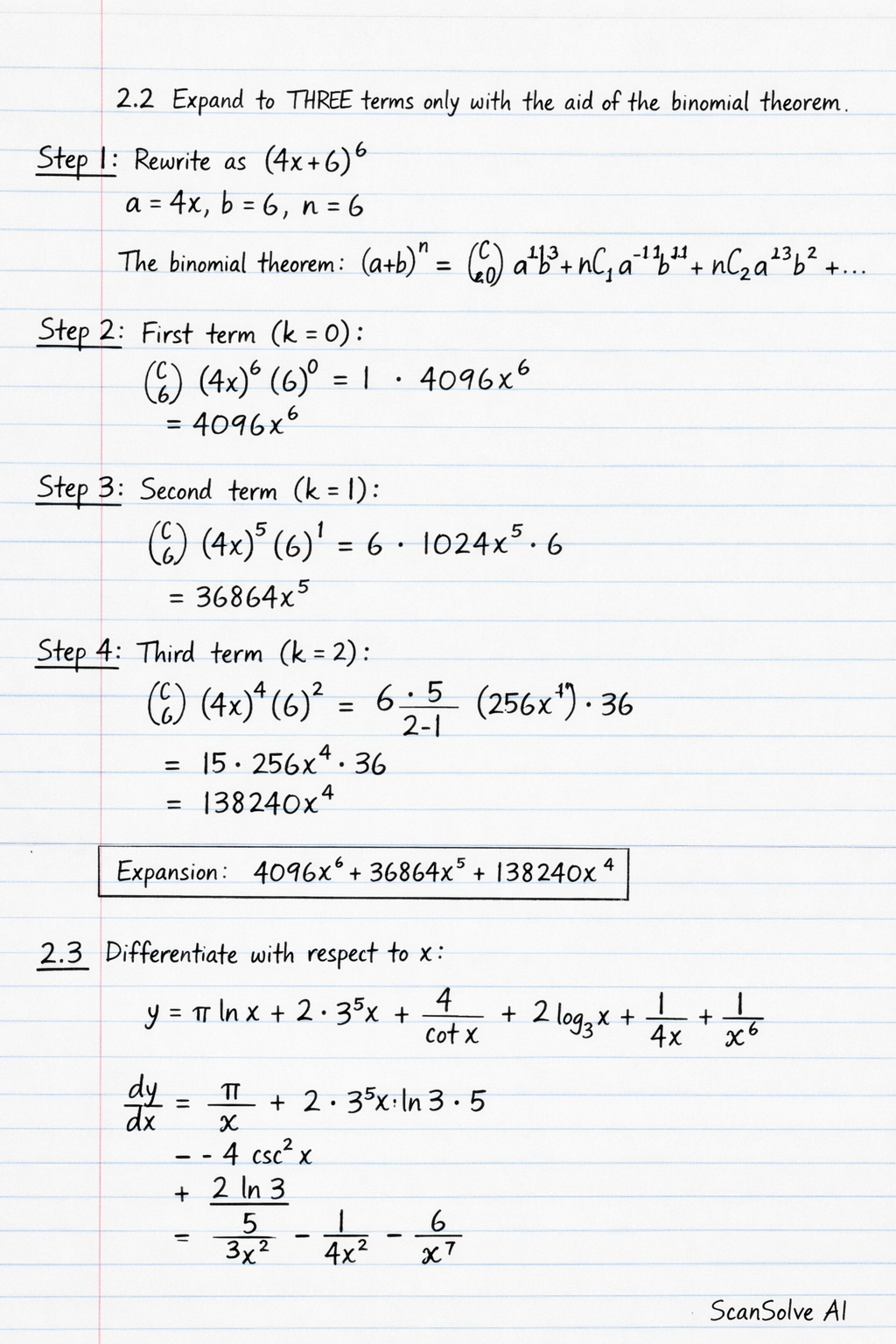
Handwritten Step-by-Step Solution
Get this as a handwritten image on WhatsApp — like a tutor wrote it for you.
Try on WhatsApp