
We read your photo as:
यदि 5 @ 2 ≠ 2 = 5 और 9 @ 4 ≠ 6 = 6 है, तो 7 @ 8 ≠ 4 = ?
Mathematics
ScanSolve AI Answer
Answer
Step-by-step solution
4 stepsAnalyze the given examples to find the pattern for the operators.
Given:
5 \text{ @ } 2 \text{ # } 2 = 59 \text{ @ } 4 \text{ # } 6 = 6
Let's assume that '@' represents multiplication () and '#' represents division ().
For the first example:This matches the given result.
Verify the assumed pattern with the second example.
For the second example:
This also matches the given result.
The pattern is consistent:A \text{ @ } B \text{ # } C = A \times B \div C.Apply the identified pattern to the expression to be solved.
The expression is
7 \text{ @ } 8 \text{ # } 4.
Using the pattern, this translates to:Calculate the final result.
First, perform the multiplication:
Next, perform the division:
The value of
7 \text{ @ } 8 \text{ # } 4is 14.
Was this helpful?
Try one yourself
A new problem that tests the same skill.
Still stuck on this one?
Ask a follow-up, and the answer starts from this question.
Got a different question?Ask your own question
More Mathematics Questions
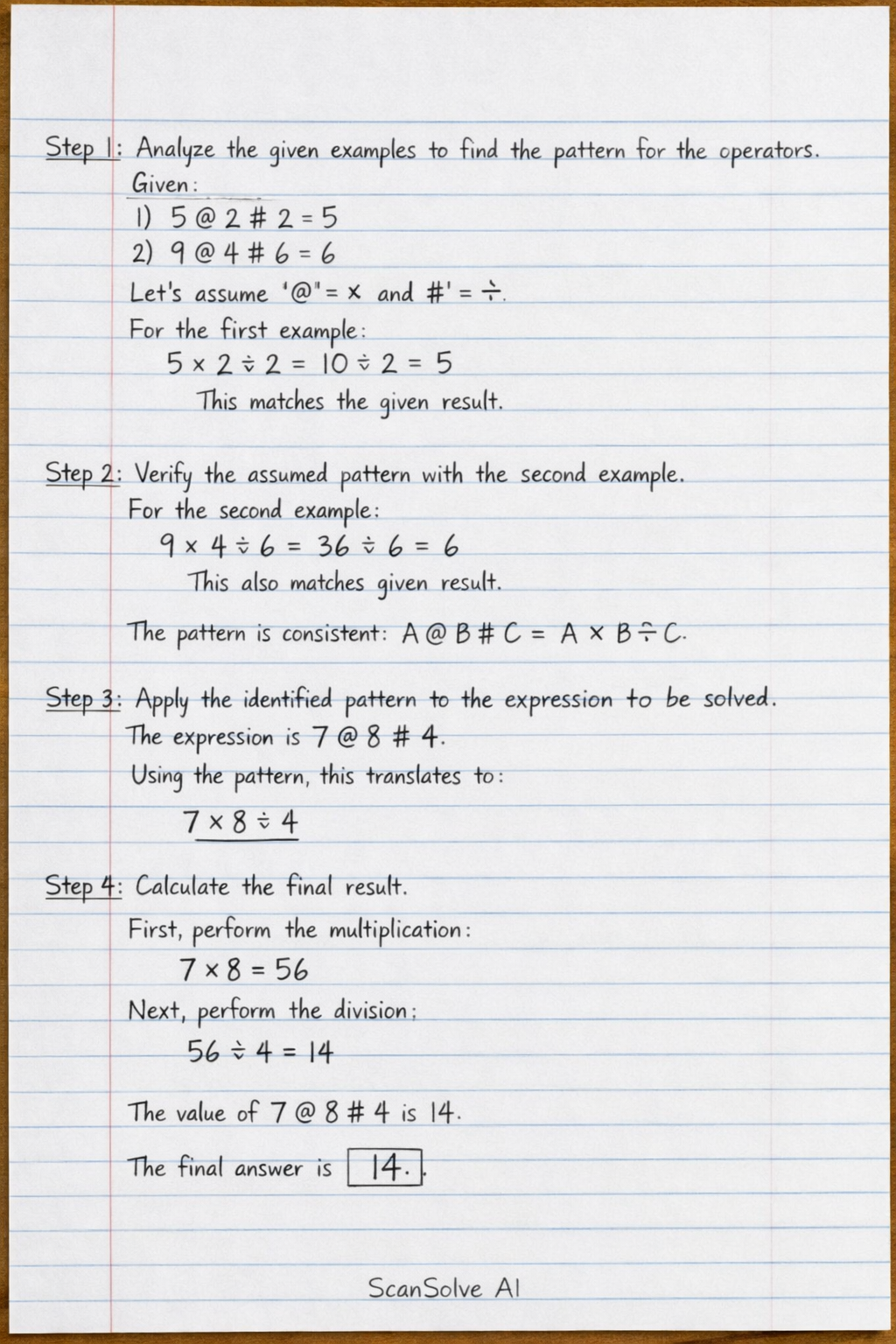
Handwritten Step-by-Step Solution
Get this as a handwritten image on WhatsApp — like a tutor wrote it for you.
Try on WhatsApp