
We read your photo as:
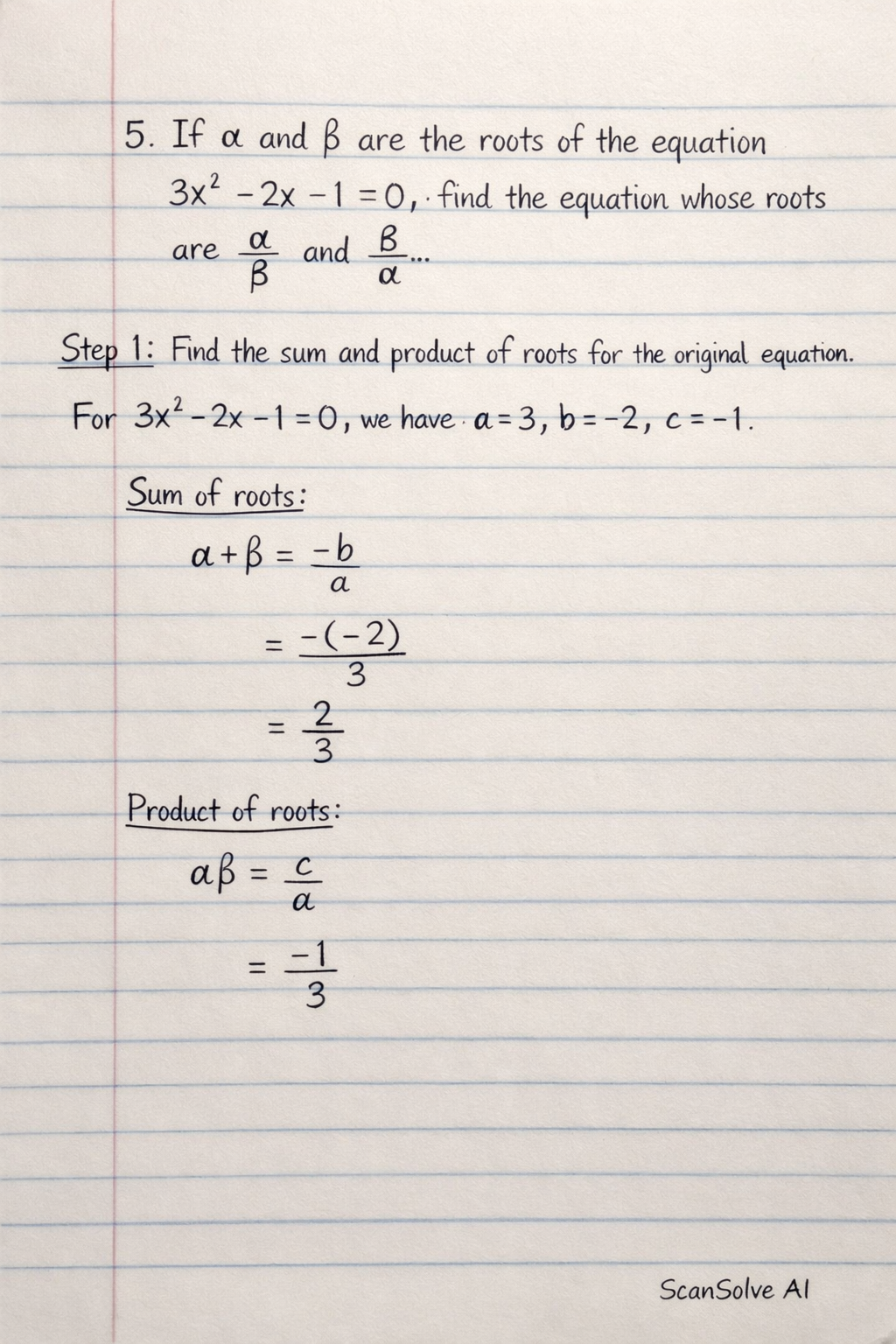
If alpha and beta are the roots of the equation 3x² − 2x − 1 = 0, find the equation whose roots are (alpha)/(beta) and (beta)/(alpha).
ScanSolve AI Answer
5. If and are the roots of the equation , find the equation whose roots are and .
-
Step 1: Find the sum and product of roots for the original equation. For , we have , , . Sum of roots:
Product of roots:
-
Step 2: Find the sum of the new roots. Let the new roots be and . The sum of the new roots is:
We know that .
Substitute the values from Step 1:
-
Step 3: Find the product of the new roots. The product of the new roots is:
-
Step 4: Form the new quadratic equation. A quadratic equation with roots and is given by . Substitute the values of and :
Multiply the entire equation by 3 to clear the denominator:
The equation is .
6. Without solving the equation, find the sum and product of the roots of .
-
Step 1: Identify coefficients. For a quadratic equation , the sum of roots is and the product of roots is . In , we have , , .
-
Step 2: Calculate the sum of the roots.
-
Step 3: Calculate the product of the roots.
The sum of the roots is and the product of the roots is .
7. The product of two consecutive integers is 132. Find the integers.
-
Step 1: Set up the equation. Let the first integer be . The next consecutive integer is . Their product is .
-
Step 2: Solve the quadratic equation.
Factor the quadratic equation:
This gives two possible values for :
-
Step 3: Determine the pairs of consecutive integers. If , the integers are 11 and . If , the integers are and . The integers are or .
8. The length of a rectangle exceeds its width by 5 units. If the area is 104 square units, find the dimensions.
-
Step 1: Define variables. Let the width of the rectangle be units. The length exceeds the width by 5 units, so units.
-
Step 2: Set up the area equation. The area of a rectangle is given by .
-
Step 3: Solve the quadratic equation.
Factor the quadratic equation:
This gives two possible values for :
-
Step 4: Determine the valid dimensions. Since the width of a rectangle cannot be negative, we discard . Therefore, the width is units. The length is units. The dimensions are .
9. Show that if , has a maximum value when .
-
Step 1: Understand the shape of the parabola. The equation represents a parabola. The sign of the coefficient determines the direction in which the parabola opens. If , the parabola opens upwards, and its vertex is a minimum point. If , the parabola opens downwards, and its vertex is a maximum point.
-
Step 2: Identify the vertex formula. The x-coordinate of the vertex of a parabola given by is always .
-
Step 3: Conclude based on the conditions. Given that , the parabola opens downwards. This means the highest point on the graph is the vertex. Therefore, the function attains its maximum value at the x-coordinate of its vertex, which is .
Still stuck on this one?
Ask a follow-up, and the answer starts from this question.
More Mathematics Questions
Handwritten Step-by-Step Solution
Get this as a handwritten image on WhatsApp — like a tutor wrote it for you.
Try on WhatsApp