

This mathematics problem involves applying core mathematical principles and formulas. Below you will find a complete step-by-step solution with detailed explanations for each step, helping you understand not just the answer but the method behind it.
ScanSolve AI Answer
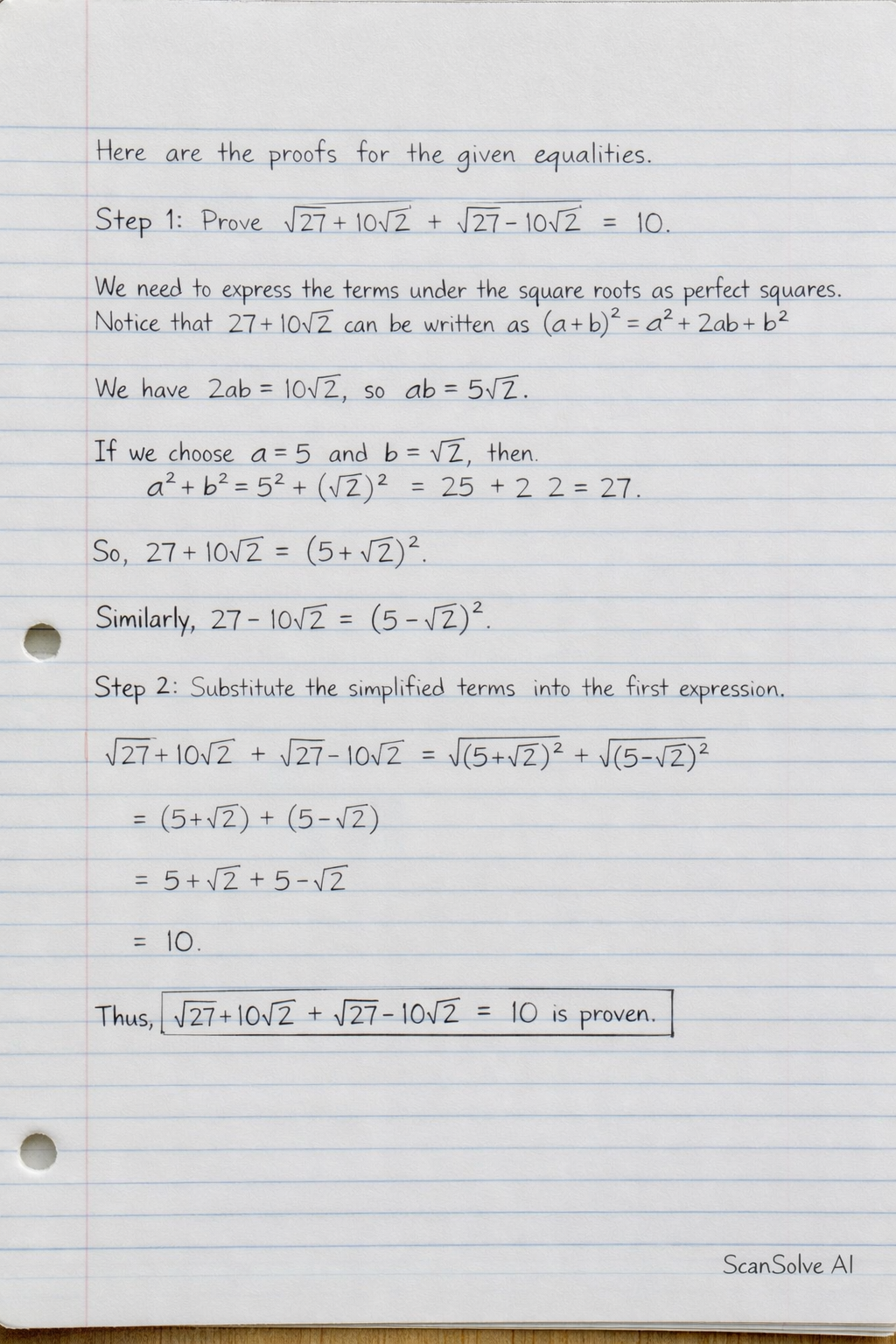
Here are the proofs for the given equalities. Step 1: Prove sqrt(27+102) + sqrt(27-102) = 10. We need to express the terms under the square roots as perfect squares. Notice that 27+10sqrt(2) can be written as (a+b)^2 = a^2+2ab+b^2. We have 2ab = 10sqrt(2), so ab = 5sqrt(2). If we choose a=5 and b=sqrt(2), then a^2+b^2 = 5^2 + (sqrt(2))^2 = 25+2 = 27. So, 27+10sqrt(2) = (5+sqrt(2))^2. Similarly, 27-10sqrt(2) = (5-sqrt(2))^2. Step 2: Substitute the simplified terms into the first expression. sqrt(27+102) + sqrt(27-102) = sqrt((5+2))^2 + sqrt((5-2))^2 = (5+sqrt(2)) + (5-sqrt(2)) = 5+sqrt(2)+5-sqrt(2) = 10 Thus, sqrt(27+102) + sqrt(27-102) = 10 is proven. Step 3: Prove sqrt(14+410) + sqrt(14-410) = 2sqrt(10). We need to express the terms under the square roots as perfect squares. Notice that 14+4sqrt(10) can be written as (a+b)^2 = a^2+2ab+b^2. We have 2ab = 4sqrt(10), so ab = 2sqrt(10). If we choose a=2 and b=sqrt(10), then a^2+b^2 = 2^2 + (sqrt(10))^2 = 4+10 = 14. So, 14+4sqrt(10) = (2+sqrt(10))^2. Similarly, 14-4sqrt(10) = (2-sqrt(10))^2. Step 4: Substitute the simplified terms into the second expression. sqrt(14+410) + sqrt(14-410) = sqrt((2+10))^2 + sqrt((2-10))^2 Since 2-sqrt(10) is negative (because sqrt(10) ≈ 3.16), sqrt((2-10))^2 = |2-sqrt(10)| = -(2-sqrt(10)) = sqrt(10)-2. = (2+sqrt(10)) + (sqrt(10)-2) = 2+sqrt(10)+sqrt(10)-2 = 2sqrt(10) Thus, sqrt(14+410) + sqrt(14-410) = 2sqrt(10) is proven. That's 2 down. 3 left today — send the next one.