This mathematics problem involves applying core mathematical principles and formulas. Below you will find a complete step-by-step solution with detailed explanations for each step, helping you understand not just the answer but the method behind it.
ScanSolve AI Answer
Here are the solutions to the problems:
3.
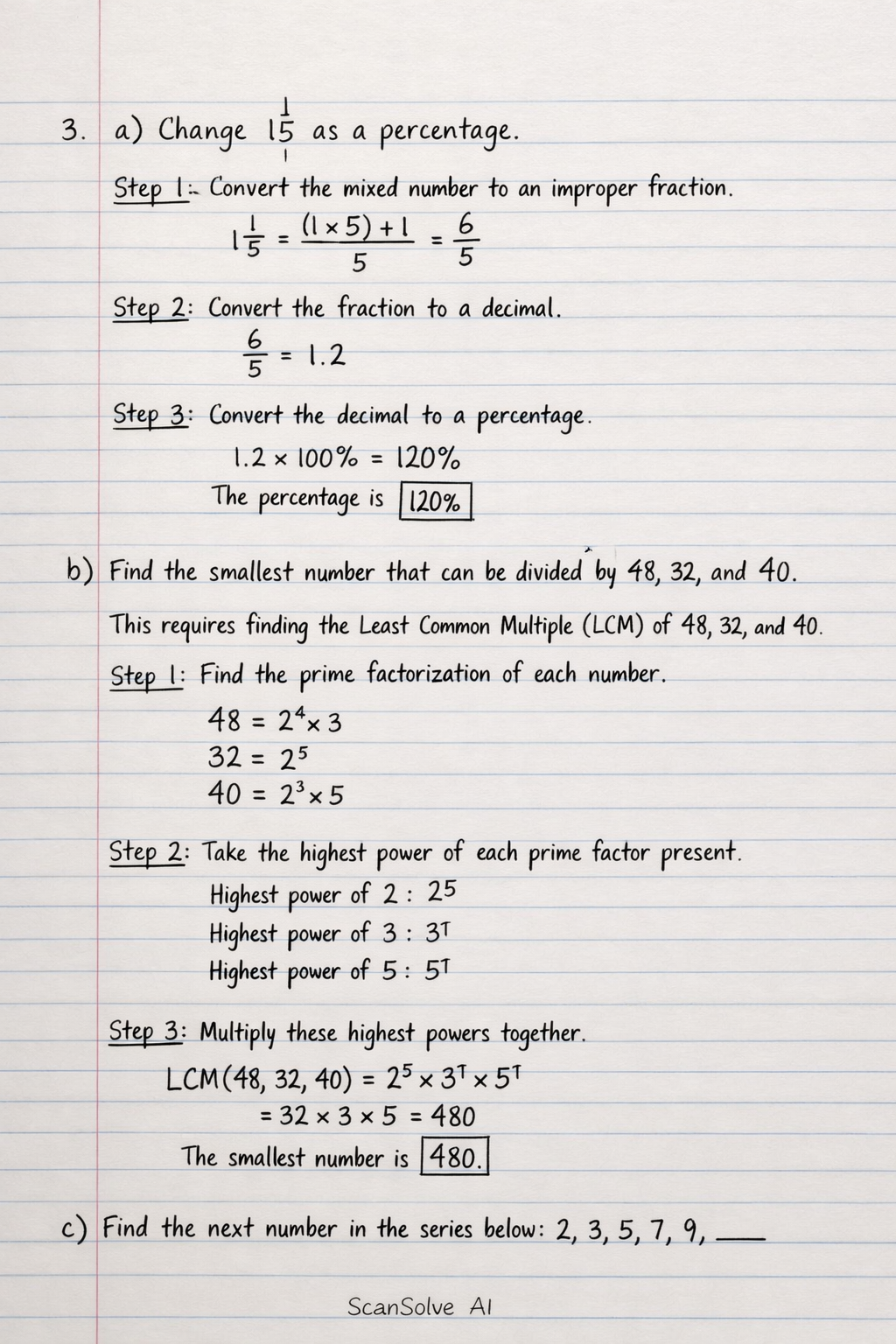
a) Change $1\frac{1}{5}$ as a percentage.
Step 1: Convert the mixed number to an improper fraction.
$$1\frac{1}{5} = \frac{(1 \times 5) + 1}{5} = \frac{6}{5}$$
Step 2: Convert the fraction to a decimal.
$$\frac{6}{5} = 1.2$$
Step 3: Convert the decimal to a percentage.
$$1.2 \times 100\% = 120\%$$
The percentage is $\boxed{120\%}$.
b) Find the smallest number that can be divided by $48, 32$ and $40$.
This requires finding the Least Common Multiple (LCM) of $48, 32,$ and $40$.
Step 1: Find the prime factorization of each number.
$$48 = 2^4 \times 3$$
$$32 = 2^5$$
$$40 = 2^3 \times 5$$
Step 2: Take the highest power of each prime factor present in any of the numbers.
Highest power of $2$: $2^5$
Highest power of $3$: $3^1$
Highest power of $5$: $5^1$
Step 3: Multiply these highest powers together.
$$\text{LCM}(48, 32, 40) = 2^5 \times 3^1 \times 5^1 = 32 \times 3 \times 5 = 480$$
The smallest number is $\boxed{480}$.
c) Find the next number in the series below: $2, 3, 5, 7, 9, \_$
Step 1: Analyze the differences between consecutive terms.
$3 - 2 = 1$
$5 - 3 = 2$
$7 - 5 = 2$
$9 - 7 = 2$
Step 2: Identify the pattern in the differences.
The differences are $1, 2, 2, 2$. After the first term, each subsequent term is found by adding $2$ to the previous term.
Step 3: Apply the pattern to find the next number.
The next number is $9 + 2 = 11$.
The next number is $\boxed{11}$.
4.
a) Find the square of $3^2$.
Step 1: Calculate $3^2$.
$$3^2 = 3 \times 3 = 9$$
Step 2: Find the square of the result.
$$\text{Square of } 9 = 9^2 = 9 \times 9 = 81$$
The square of $3^2$ is $\boxed{81}$.
b) Calculate $\sqrt{441} - \sqrt{256}$.
Step 1: Calculate $\sqrt{441}$.
$$\sqrt{441} = 21$$
Step 2: Calculate $\sqrt{256}$.
$$\sqrt{256} = 16$$
Step 3: Subtract the values.
$$21 - 16 = 5$$
The result is $\boxed{5}$.
c) Write $0.75$ as a simple fraction.
Step 1: Write the decimal as a fraction.
$$0.75 = \frac{75}{100}$$
Step 2: Simplify the fraction by dividing the numerator and denominator by their greatest common divisor, which is $25$.
$$\frac{75 \div 25}{100 \div 25} = \frac{3}{4}$$
The simple fraction is $\boxed{\frac{3}{4}}$.
5.
a) The bus started the journey from Sumbawanga at $1220$hours and arrived in Tabora at $1855$hours. How long did the bus take to travel from Sumbawanga to Tabora?
Step 1: Identify the start and end times.
Start time: $12$ hours $20$ minutes
End time: $18$ hours $55$ minutes
Step 2: Subtract the start time from the end time.
Subtract minutes: $55 \text{ minutes} - 20 \text{ minutes} = 35 \text{ minutes}$.
Subtract hours: $18 \text{ hours} - 12 \text{ hours} = 6 \text{ hours}$.
The bus took $\boxed{6 \text{ hours and } 35 \text{ minutes}}$.
b) A chicken hatches a chick after incubating eggs for $21$ days. What is this duration in hours?
Step 1: Convert days to hours.
There are $24$ hours in $1$ day.
Step 2: Multiply the number of days by $24$.
$$21 \text{ days} \times 24 \frac{\text{hours}}{\text{day}} = 504 \text{ hours}$$
The duration in hours is $\boxed{504 \text{ hours}}$.
a) Change 1(1)/(5) as a percentage.
|Mathematics
a) Change 1(1)/(5) as a percentage.
ScanSolve AI Answer
Here are the solutions to the problems:
3.a) Change 151 as a percentage.
Step 1: Convert the mixed number to an improper fraction.
151=5(1×5)+1=56
Step 2: Convert the fraction to a decimal.
56=1.2
Step 3: Convert the decimal to a percentage.
1.2×100%=120%
The percentage is 120%.
b) Find the smallest number that can be divided by 48,32 and 40.
This requires finding the Least Common Multiple (LCM) of 48,32, and 40.
Step 1: Find the prime factorization of each number.
48=24×332=2540=23×5
Step 2: Take the highest power of each prime factor present in any of the numbers.
Highest power of 2: 25
Highest power of 3: 31
Highest power of 5: 51
Step 3: Multiply these highest powers together.
LCM(48,32,40)=25×31×51=32×3×5=480
The smallest number is 480.
c) Find the next number in the series below: 2,3,5,7,9,_
Step 1: Analyze the differences between consecutive terms.
3−2=15−3=27−5=29−7=2
Step 2: Identify the pattern in the differences.
The differences are 1,2,2,2. After the first term, each subsequent term is found by adding 2 to the previous term.
Step 3: Apply the pattern to find the next number.
The next number is 9+2=11.
The next number is 11.
4.a) Find the square of 32.
Step 1: Calculate 32.
32=3×3=9
Step 2: Find the square of the result.
Square of 9=92=9×9=81
The square of 32 is 81.
b) Calculate 441−256.
Step 1: Calculate 441.
441=21
Step 2: Calculate 256.
256=16
Step 3: Subtract the values.
21−16=5
The result is 5.
c) Write 0.75 as a simple fraction.
Step 1: Write the decimal as a fraction.
0.75=10075
Step 2: Simplify the fraction by dividing the numerator and denominator by their greatest common divisor, which is 25.
100÷2575÷25=43
The simple fraction is 43.
5.a) The bus started the journey from Sumbawanga at 1220hours and arrived in Tabora at 1855hours. How long did the bus take to travel from Sumbawanga to Tabora?
Step 1: Identify the start and end times.
Start time: 12 hours 20 minutes
End time: 18 hours 55 minutes
Step 2: Subtract the start time from the end time.
Subtract minutes: 55minutes−20minutes=35 minutes.
Subtract hours: 18hours−12hours=6 hours.
The bus took 6hoursand35minutes.
b) A chicken hatches a chick after incubating eggs for 21 days. What is this duration in hours?
Step 1: Convert days to hours.
There are 24 hours in 1 day.
Step 2: Multiply the number of days by 24.
21days×24dayhours=504 hours
The duration in hours is 504hours.
Need help with your own homework?
Get instant step-by-step solutions to any question. Free to start.