

This English question involves literary analysis, grammar, or writing skills. The detailed response below provides a well-structured answer with supporting evidence and clear explanations.
ScanSolve AI Answer
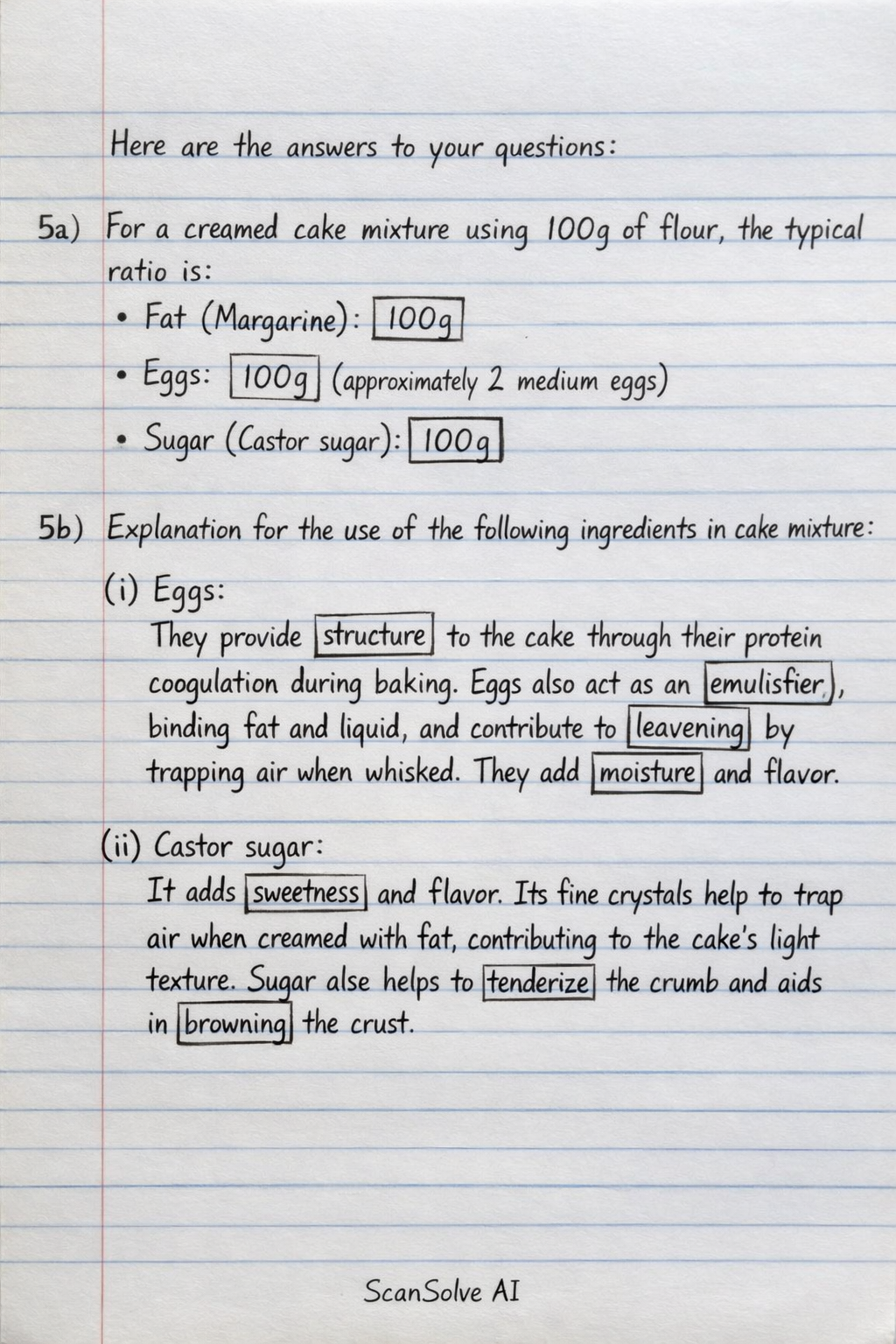
Here are the answers to your questions: 5 a) For a creamed cake mixture using 100g of flour, the typical ratio for the creaming method is equal parts fat, sugar, and flour by weight, and eggs by weight or volume to match. • Fat (Margarine): 100g • Eggs: 100g (approximately 2 medium eggs) • Sugar (Castor sugar): 100g b) Explanation for the use of the following ingredients in cake mixture: i) Eggs: They provide structure to the cake through their protein coagulation during baking. Eggs also act as an emulsifier, binding fat and liquid, and contribute to leavening by trapping air when whisked. They add moisture and flavor. ii) Castor sugar: It adds sweetness and flavor. Its fine crystals help to trap air when creamed with fat, contributing to the cake's light texture. Sugar also helps to tenderize the crumb and aids in browning the crust. iii) Margarine: It provides richness and flavor to the cake. As a fat, it tenderizes the crumb by shortening gluten strands. When creamed with sugar, it traps air, which is crucial for the cake's rise and light texture. c) Reasons for necessary steps: i) Preheat an oven when baking a cake: Preheating ensures that the cake starts baking at the correct, consistent temperature from the moment it enters the oven. This allows the leavening agents to activate immediately, resulting in an even rise (oven spring) and proper crust formation, preventing a dense or unevenly baked cake. ii) Grease and line a baking tin before placing a cake mixture into the tin: Greasing and lining prevent the cake mixture from sticking to the sides and bottom of the tin during baking. This ensures that the cake can be easily removed from the tin without tearing or breaking, maintaining its shape and appearance. d) Possible reasons for the following faults in cake making: i) A heavy texture: • Too much liquid or fat in the mixture. • Insufficient leavening agent (e.g., baking powder, baking soda) or expired leavening agent. • Overmixing the batter, which develops gluten too much, making the cake tough. • Underbaking, which prevents the cake from fully setting and rising. ii) A hard crust and dry crust: • Overbaking the cake, causing excessive moisture loss. • Baking at too high a temperature, which dries out the surface quickly. • Too much sugar in the recipe, which can lead to a very crisp crust. • Insufficient fat in the mixture, reducing tenderness and moisture retention. 6 a) i) Three microorganisms that cause food contamination: • Bacteria (e.g., Salmonella, E. coli, Listeria) • Viruses (e.g., Norovirus, Hepatitis A) • Fungi (e.g., Molds, some yeasts) ii) Two different types of food most likely to be contaminated by microorganisms, with reasons: • Raw meat and poultry: These foods are highly susceptible to contamination because they often naturally carry bacteria like Salmonella, Campylobacter, and E. coli from the animal's gut. Their high protein and moisture content also provide an ideal environment for rapid microbial growth if not handled or stored correctly. • Dairy products (especially unpasteurized milk and soft cheeses): Dairy products are rich in nutrients and moisture, making them excellent breeding grounds for bacteria such as Listeria monocytogenes and E. coli. If not properly pasteurized or handled hygienically, these microorganisms can multiply quickly and cause illness. b) i) Two possible reasons for the increase in the number of cases of food poisoning in Zambia: • Poor hygiene practices: Inadequate handwashing, unsanitary food preparation surfaces, and improper cleaning of utensils can easily transfer harmful microorganisms to food. • Inadequate food storage and handling: Lack of proper refrigeration, leaving cooked food at unsafe temperatures for extended periods, and cross-contamination between raw and cooked foods contribute significantly to bacterial growth and toxin production. ii) Precautions that a housewife should bear in mind when preparing and cooking food to prevent food contamination: • Wash hands thoroughly with soap and water before, during, and after handling food, especially raw meat, poultry, and fish. • Separate raw and cooked foods to prevent cross-contamination. Use separate cutting boards, utensils, and plates for raw and cooked items. • Cook food to the correct internal temperature to kill harmful bacteria. Use a food thermometer to ensure meats are cooked safely. • Chill food promptly by refrigerating perishable foods within two hours of cooking (or one hour if the ambient temperature is above 32^). Store food at safe temperatures (below 5^). • Clean and sanitize all food preparation surfaces, utensils, and equipment regularly. • Wash fruits and vegetables under running water before eating, cutting, or cooking, even if they are to be peeled.