
We read your photo as:
A group of 30 learners has the following shoe sizes: 6, 4, 7, 5, 5, 6, 4, 5, 4, 6, 7, 7, 5, 6, 4, 6, 7, 5, 6, 4, 7, 5, 4, 6, 5, 5, 4, 6, 7, 5. Construct a frequency distribution table. What size shoul
ScanSolve AI Answer
Answer
Step-by-step solution
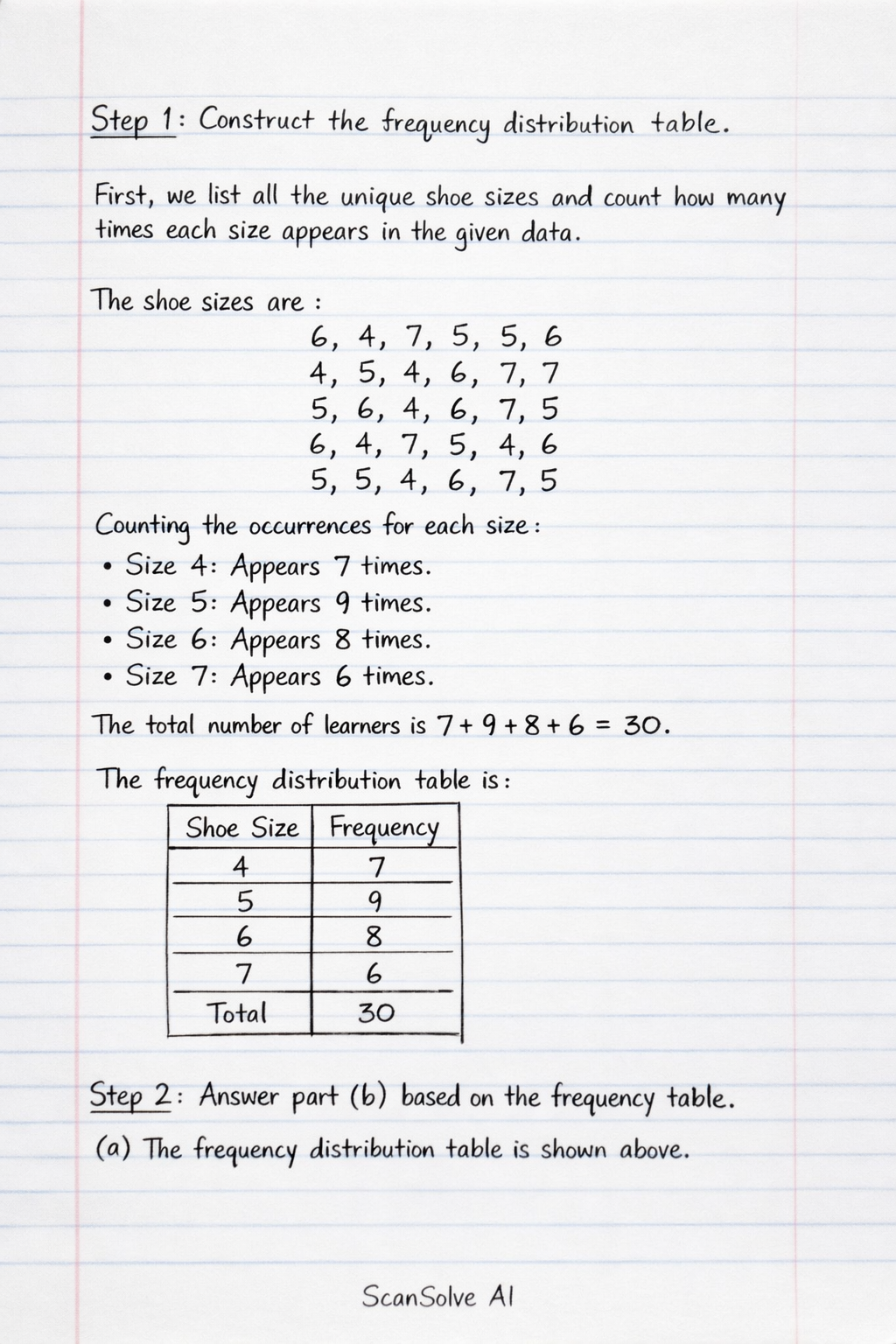
3 stepsConstruct the frequency distribution table.
First, we list all the unique shoe sizes and count how many times each size appears in the given data.
The shoe sizes are:
6, 4, 7, 5, 5, 6
4, 5, 4, 6, 7, 7
5, 6, 4, 6, 7, 5
6, 4, 7, 5, 4, 6
5, 5, 4, 6, 7, 5Counting the occurrences for each size:
- Size 4: Appears 7 times.
- Size 5: Appears 9 times.
- Size 6: Appears 8 times.
- Size 7: Appears 6 times.
The total number of learners is .
The frequency distribution table is:
Answer part (b) based on the frequency table.
a) The frequency distribution table is shown above.
b)
- (i) The size that should be purchased in large quantities is the one with the highest frequency. From the table, size 5 has the highest frequency (9).
- Size 5
- (ii) The reason is that size 5 is the mode (most frequent) shoe size among the learners.
- (iii) The size that will be purchased in less quantities is the one with the lowest frequency. From the table, size 7 has the lowest frequency (6).
- Size 7
- (iv) The reason is that size 7 is the least frequent shoe size among the learners.
- (i) The size that should be purchased in large quantities is the one with the highest frequency. From the table, size 5 has the highest frequency (9).
Calculate the mean shoe size and round to the nearest whole number.
The mean shoe size is calculated by summing the product of each shoe size and its frequency, then dividing by the total frequency.
Rounding to the nearest whole number:
Try one yourself
A new problem that tests the same skill.
Still stuck on this one?
Ask a follow-up, and the answer starts from this question.
More Mathematics Questions
Handwritten Step-by-Step Solution
Get this as a handwritten image on WhatsApp — like a tutor wrote it for you.
Try on WhatsApp