
We read your photo as:
A learner in your Grade 6 mathematics classroom says: "Fractions are confusing because they are not whole numbers." Explain by proving practical examples how you would teach fractions using the following: Measurement, Money, Classroom resources.
Mathematics
ScanSolve AI Answer
Here's how to teach fractions using practical examples to a Grade 6 learner who finds them confusing because they are not whole numbers:
The learner's confusion stems from the idea that numbers must be "whole." I would start by explaining that fractions are simply ways to represent parts of a whole, or even multiple wholes, and that these parts are just as real and useful as whole numbers.
-
Measurement
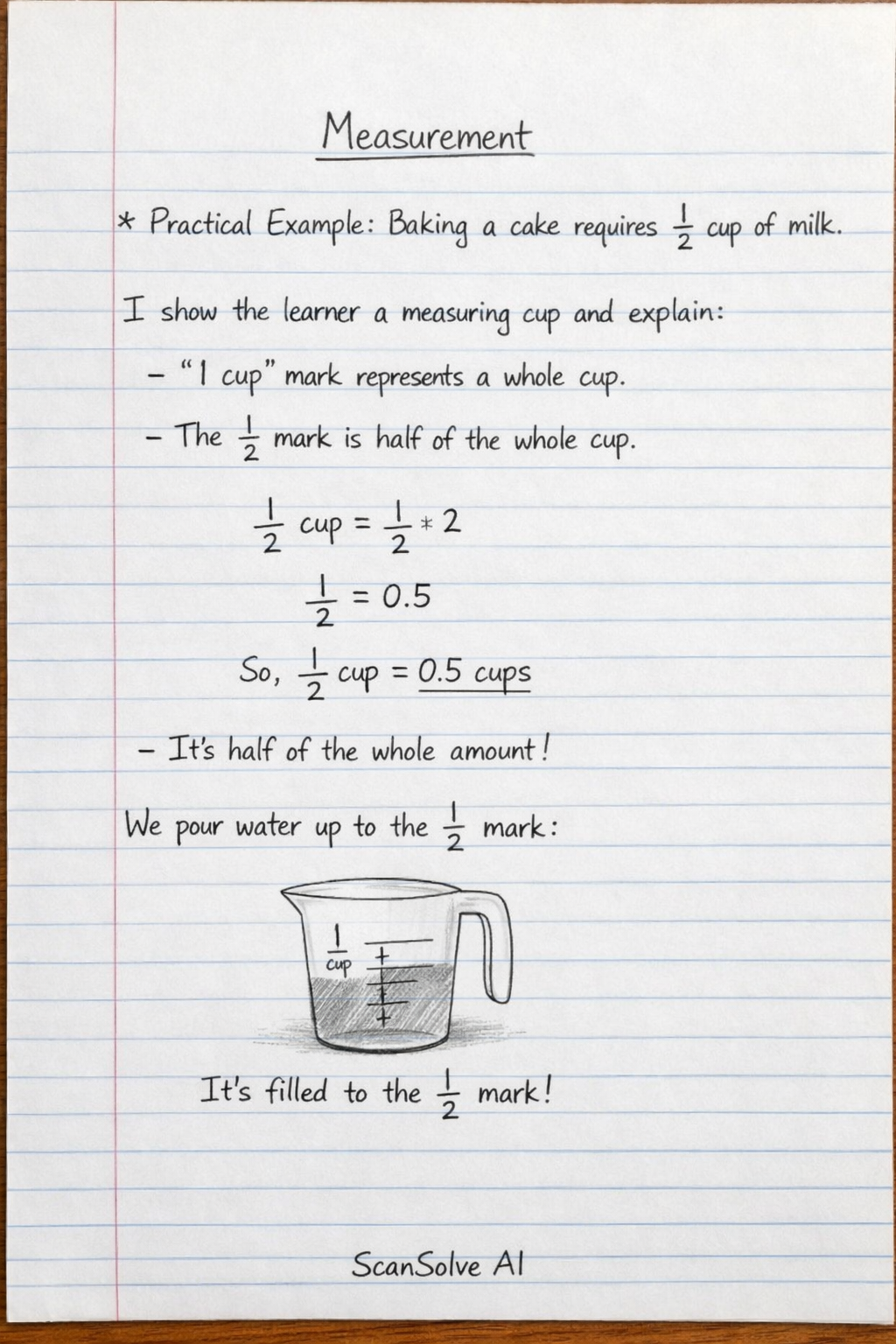
- Practical Example: Baking a cake requires cup of milk. I would show the learner a measuring cup and explain that the "1 cup" mark represents a whole cup. Then, I would point to the mark and demonstrate how it's exactly half of the whole cup. We could pour water up to the mark to physically show that it's a part of the whole.
- Explanation: This helps the learner see that a fraction like isn't "not a number," but rather a specific quantity that is less than a whole unit, used commonly in everyday tasks like cooking. We can also measure lengths, for example, a ribbon that is meters long, showing that fractions can also be combined with whole numbers.
-
Money
- Practical Example: Imagine we have R100 and want to share it equally among 4 friends. Each friend would get R25. I would explain that R25 is of the total R100. Similarly, if we have a R1 coin, 50 cents is of that R1.
- Explanation: Money provides a tangible way to understand fractions. Learners are familiar with cents as parts of a rand. This shows that fractions are essential for dividing and distributing quantities, even when dealing with amounts that aren't whole units of currency.
-
Classroom resources
- Practical Example: Using a set of fraction circles or fraction strips. I would take a whole circle (representing 1) and then show how it can be divided into equal parts, such as halves, thirds, or quarters. For instance, I would place two pieces next to a piece to visually demonstrate that .
- Explanation: These visual aids allow the learner to physically manipulate and see fractions as parts of a whole. They can compare different fractional pieces to understand equivalence and how fractions combine, making the abstract concept of "parts of a whole" concrete and understandable.
Was this helpful?
Still stuck on this one?
Ask a follow-up, and the answer starts from this question.
Got a different question?Ask your own question
More Mathematics Questions
QDraft a note as teaching guide on how to teach basic 5 learners decimal fractions to understandQHow to Teach addition of fractionsQPlease fill in the following lesson plan template for a 6th grade math class on equivalent…QA Grade 5 learner can calculate correctly but struggles to explain how answers are obtained. Develop…QDescribe how you would help your learners in a primary class to multiply the following using number…
Browse by topic:Pre-Algebra
Handwritten Step-by-Step Solution
Get this as a handwritten image on WhatsApp — like a tutor wrote it for you.
Try on WhatsApp