
We read your photo as:
A man bought a thousand eggs. He sold twelve dozen eggs and then sold fifteen dozen eggs. How many eggs did he have left?
Mathematics
ScanSolve AI Answer
Answer
Step-by-step solution
5 stepsDetermine the total number of eggs bought.
The man bought a thousand eggs.
Total eggs bought = 1000 eggs.Calculate the number of eggs sold in the first instance.
He sold twelve dozen eggs. Since one dozen equals 12 eggs:
Eggs sold first =Calculate the number of eggs sold in the second instance.
He then sold fifteen dozen eggs.
Eggs sold second =Calculate the total number of eggs sold.
Total eggs sold = Eggs sold first + Eggs sold second
Calculate the number of eggs left.
Eggs left = Total eggs bought - Total eggs sold
The man had left.
Was this helpful?
Try one yourself
A new problem that tests the same skill.
Still stuck on this one?
Ask a follow-up, and the answer starts from this question.
Got a different question?Ask your own question
More Mathematics Questions
QA man bought a tray of eggs at shs. 300 per egg, on the way x eggs broke. He sold the remaining eggs…QA shopkeeper had 500 eggs. 3/25 of them were broken. 1/5 of the total eggs were kept for guests. How…QA store keeper bought 200 eggs for N2000. 20 eggs were broken. If he made a profit of 20% from the…QTom has 5 apples, gives away 2, buys 3 dozen more. How many apples now?QA man sold 24 mangoes from his basket and then had 33 mangoes left. How many mangoes were there in…
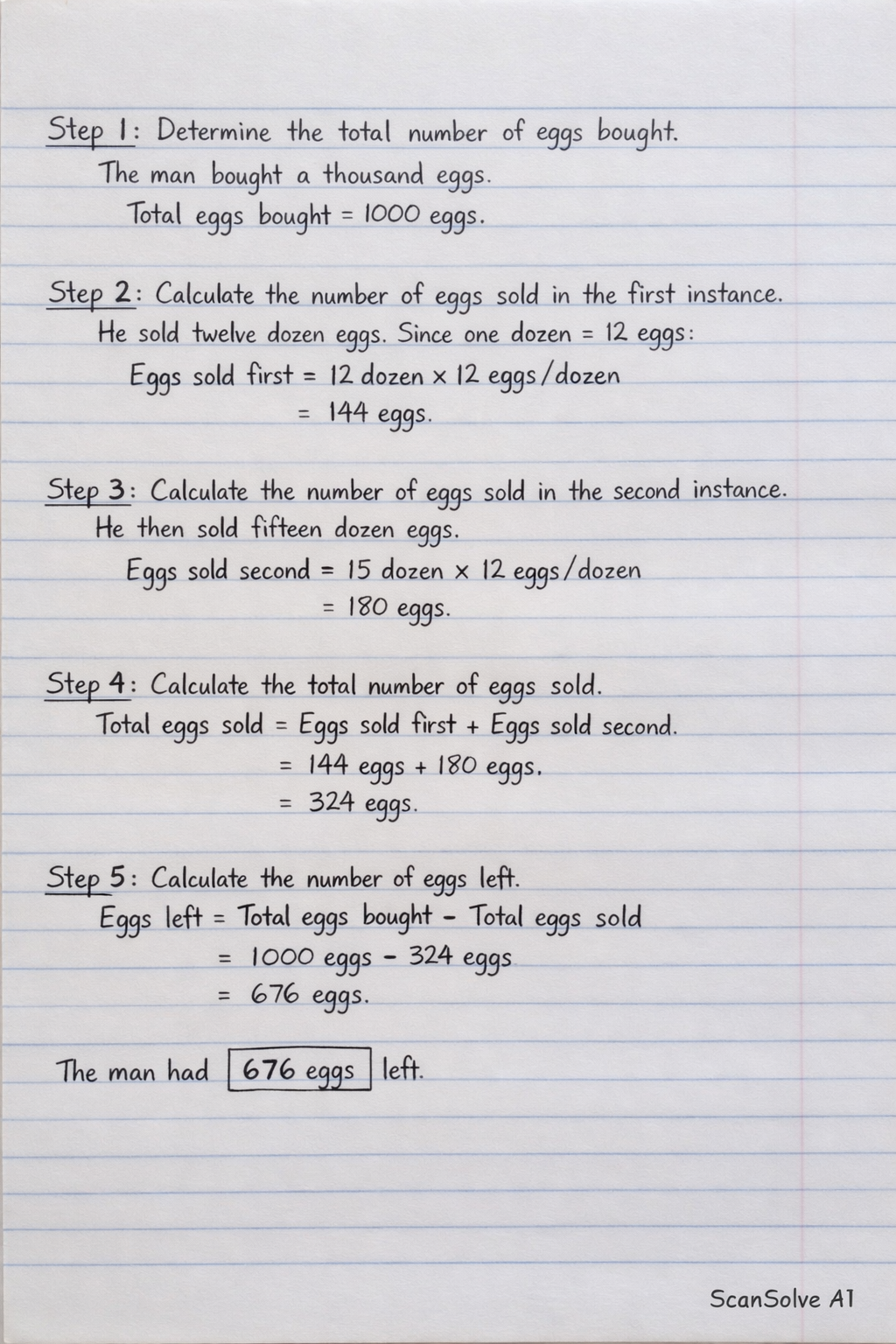
Handwritten Step-by-Step Solution
Get this as a handwritten image on WhatsApp — like a tutor wrote it for you.
Try on WhatsApp