
We read your photo as:
A man walks 5m due north, then 5m due east. What is the distance from the starting point to the end point?
Mathematics
ScanSolve AI Answer
Answer
Step-by-step solution
4 stepsHere's how to solve this problem:
The problem describes a right-angled triangle where:
- The height of the pole is one leg, m.
- The length of the wire is the hypotenuse, m.
- The distance from the pole to the point where the wire is fixed to the ground is the other leg, .
Apply the Pythagorean theorem, which states that in a right-angled triangle, the square of the hypotenuse () is equal to the sum of the squares of the other two sides ( and ).
Substitute the given values:
Calculate the squares of the known values.
Isolate by subtracting 144 from both sides of the equation.
Take the square root of both sides to find the value of .
The distance from the pole to the point where the wire is fixed to the ground is .
Was this helpful?
Try one yourself
A new problem that tests the same skill.
Still stuck on this one?
Ask a follow-up, and the answer starts from this question.
Got a different question?Ask your own question
More Mathematics Questions
QA man walks 5 km due north and then 4 km due west. What is his bearing from the starting point?QA person walks 6.0 m East, then 10.0 m N30°E. What is the magnitude of their total displacement?QSonu walked 25 m towards south and then took a left turn and walked 45 m. Again he took a left turn…QA man moves 4 km southward, then 4 km westward and finally 4 km northward. The displacement of the…QA man travels 5 km due east of a town A to town B, and then travels 7 km on a bearing of 162° from B…
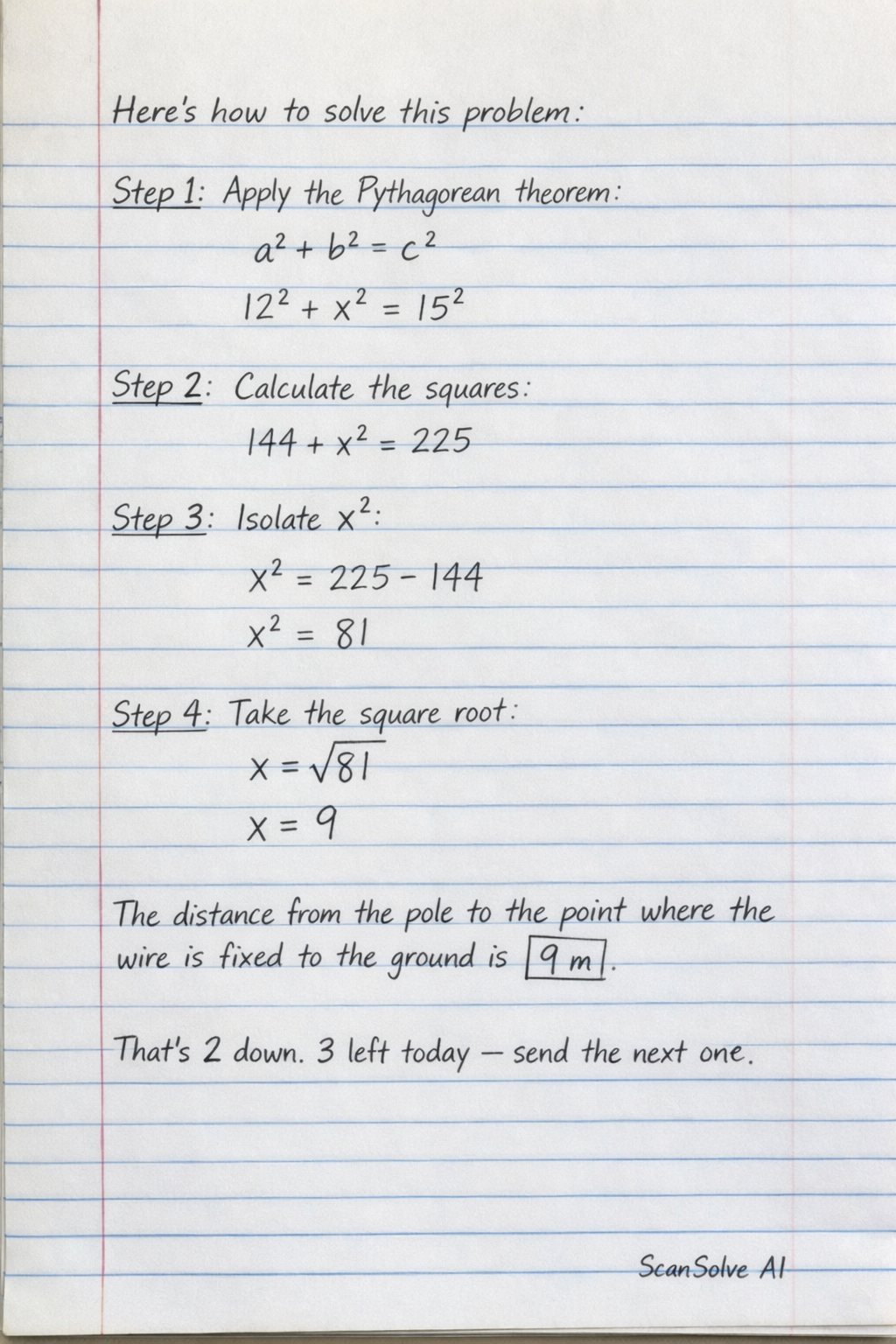
Handwritten Step-by-Step Solution
Get this as a handwritten image on WhatsApp — like a tutor wrote it for you.
Try on WhatsApp