
We read your photo as:
A school has 132 football players and 108 netball players. They want to form teams of equal size for both sports. What is the largest possible number of players per team? How many teams can be formed
ScanSolve AI Answer
Step-by-step solution
7 stepsHere's the solution for Item 1:
Item 1:
a)
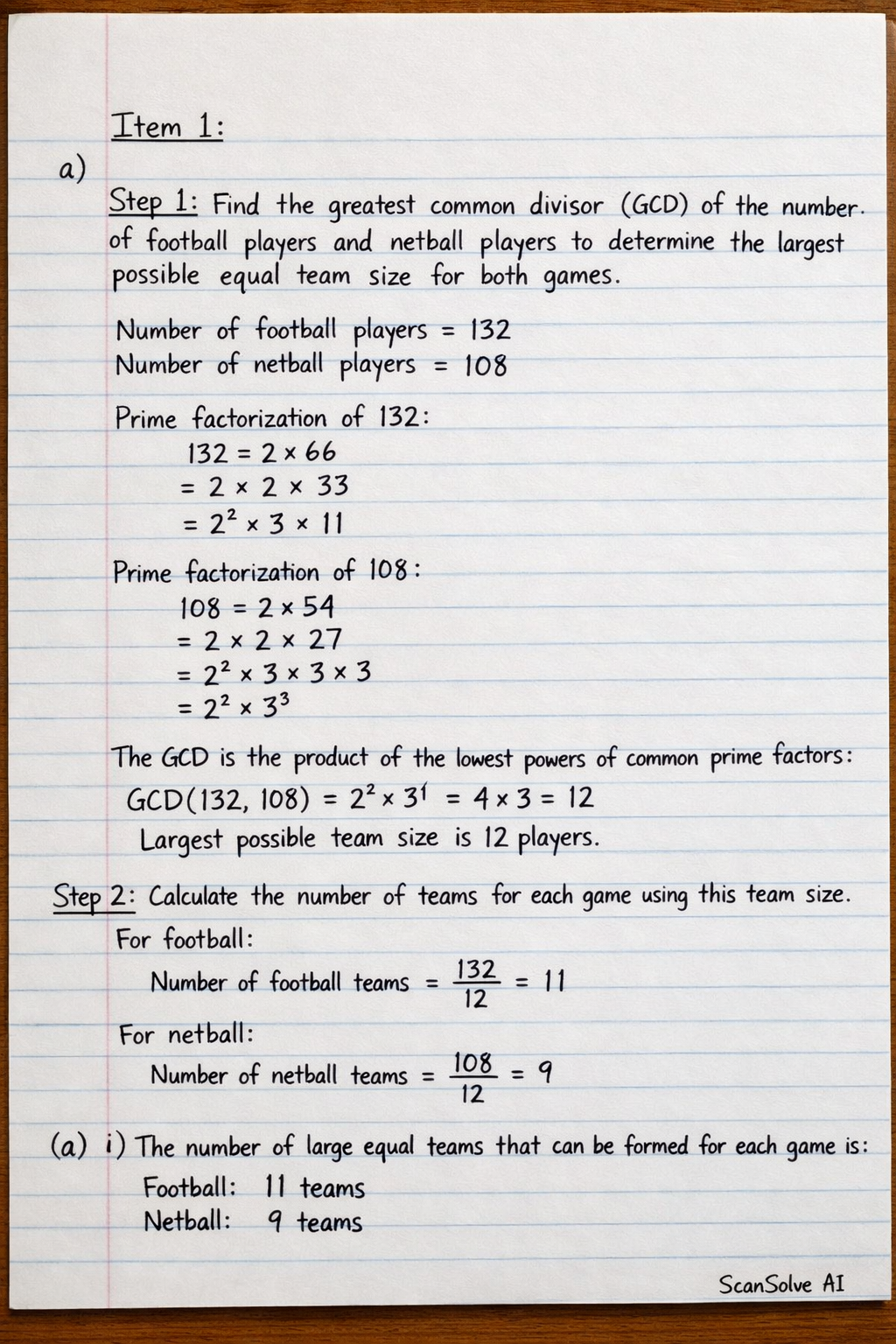
Find the greatest common divisor (GCD) of the number of football players and netball players to determine the largest possible equal team size for both games.
Number of football players = 132
Number of netball players = 108Prime factorization of 132:
Prime factorization of 108:
The GCD is the product of the lowest powers of common prime factors:
The largest possible team size is 12 players.
Calculate the number of teams for each game using this team size.
For football:
For netball:
a) i) The number of large equal teams that can be formed for each game is:
Football: 11 teams
Netball: 9 teamsa) ii) The number of players in a netball team will be the largest common team size:
12 playersb)
Determine which box size (8 or 9) can pack 1,260 medals evenly.
Check divisibility by 8:
Since the result is not a whole number, 1,260 medals cannot be packed evenly in boxes of 8.
Check divisibility by 9
Sum of digits of 1260: . Since 9 is divisible by 9, 1260 is divisible by 9.
Since the result is a whole number, 1,260 medals can be packed evenly in boxes of 9.
b) They should use boxes of 9 because 1,260 is perfectly divisible by 9 (140 boxes), while it is not divisible by 8.
c)
Calculate the number of bottles for the committee and players.
Total water bottles = 1,600.
Fraction for committee = .
Number of bottles for committee = bottles.Fraction for players = 0.58.
Number of bottles for players = bottles.Calculate the fraction of bottles for volunteers.
Fraction for volunteers =
Find a common denominator for 6 and 100, which is 300.
Fraction for volunteers =
Calculate the number of bottles for volunteers and round to the nearest hundred.
Number of bottles for volunteers = bottles.
Rounding to the nearest hundred, 405.33 is closer to 400.c) The volunteers will receive approximately 400 water bottles.
Still stuck on this one?
Ask a follow-up, and the answer starts from this question.
More Mathematics Questions
Handwritten Step-by-Step Solution
Get this as a handwritten image on WhatsApp — like a tutor wrote it for you.
Try on WhatsApp