
We read your photo as:
A set of numbers is given as 8, 9, x, (x,3), 15. The mean of these numbers is 11. Find the value of x and the standard deviation.
ScanSolve AI Answer
Answer
Step-by-step solution
5 stepsThe notation "(x,3)" in a list of numbers is ambiguous. We will assume it represents a single data point, .
Part a· 3 steps
Value of
Write down the given numbers and the mean.
The numbers are .
The mean () is 11.
The number of terms () is 5.Use the formula for the mean.
The mean is calculated as the sum of all terms divided by the number of terms:
Solve the equation for .
Multiply both sides by 5:
Subtract 35 from both sides:
Divide by 2:
The value of is .
Part b· 2 steps
Standard Deviation
List the actual numbers in the data set.
Substitute into the list of numbers:
The data set is:
The mean () is 11.
Calculate the variance ().
The variance is the average of the squared differences from the mean. The formula for population variance is .
First, calculate the deviations from the mean and their squares :- For :
- For : $(9 - 1
Try one yourself
A new problem that tests the same skill.
Still stuck on this one?
Ask a follow-up, and the answer starts from this question.
More Mathematics Questions
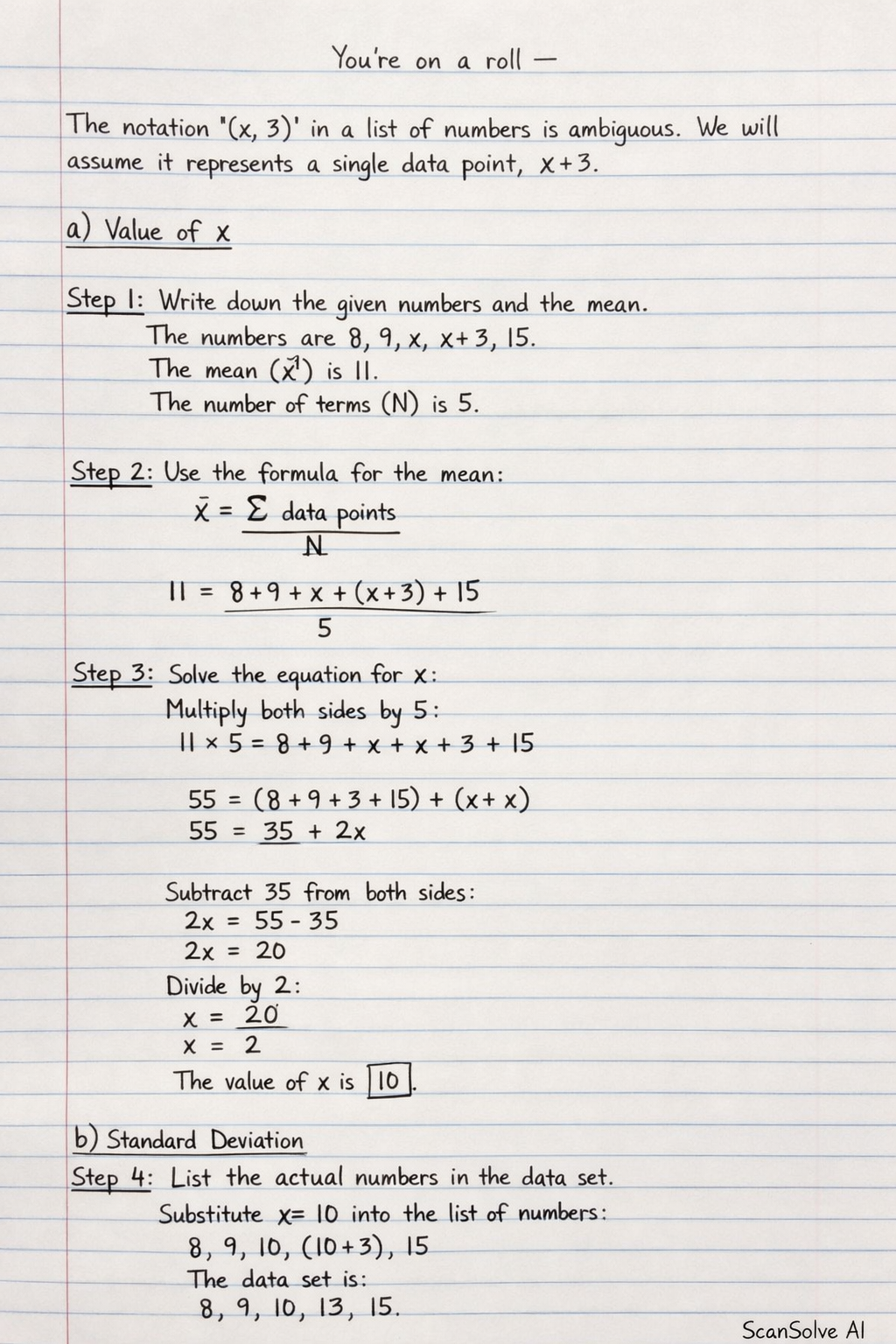
Handwritten Step-by-Step Solution
Get this as a handwritten image on WhatsApp — like a tutor wrote it for you.
Try on WhatsApp