
We read your photo as:
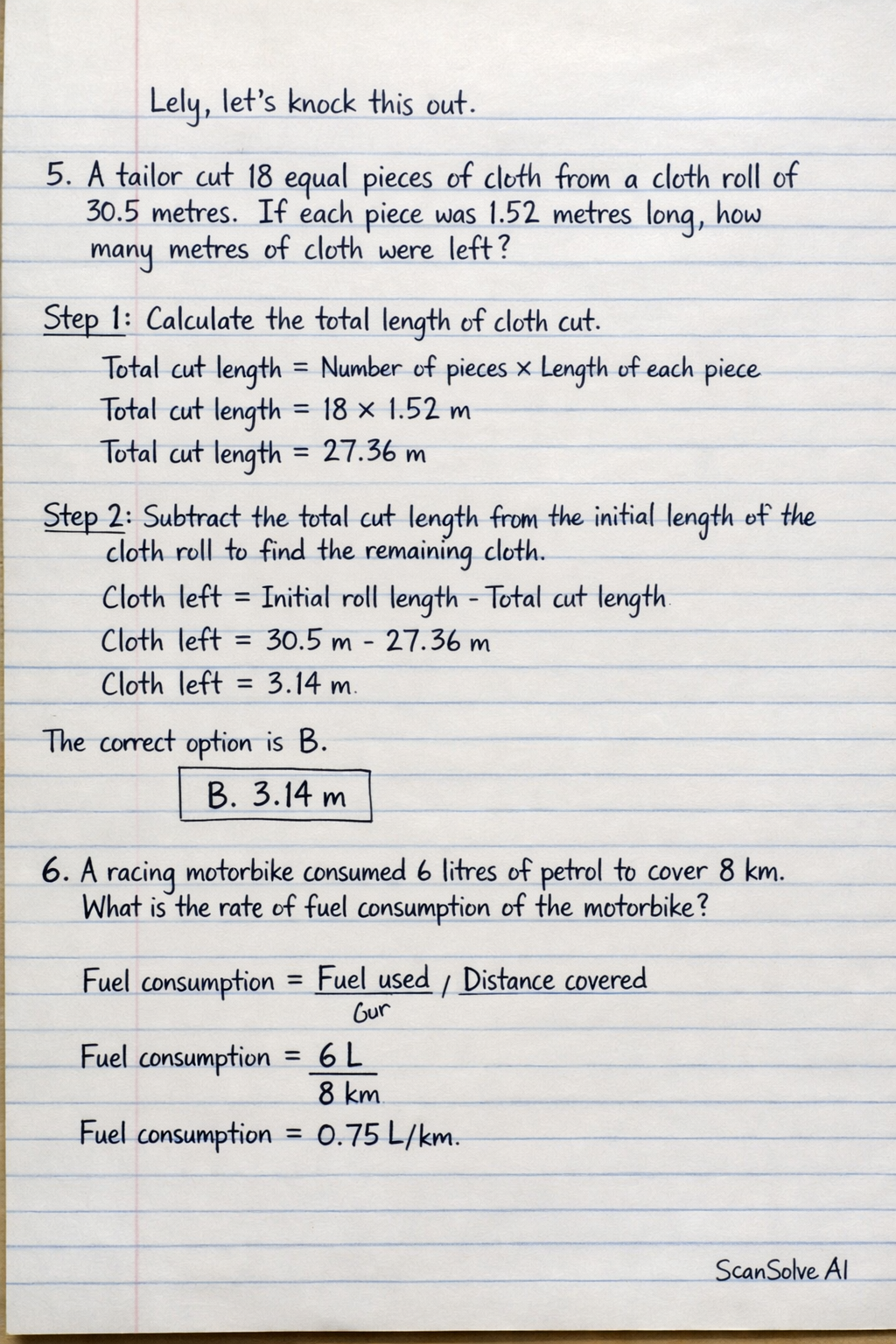
A tailor cut 18 equal pieces of cloth from a cloth roll of 30.5 metres. If each piece was 1.52 metres long, how many metres of cloth were left?
ScanSolve AI Answer
Answer
Step-by-step solution
8 steps5. A tailor cut 18 equal pieces of cloth from a cloth roll of 30.5 metres. If each piece was 1.52 metres long, how many metres of cloth were left?
Calculate the total length of cloth cut.
Subtract the total cut length from the initial length of the cloth roll to find the remaining cloth.
The correct option is B.
6. A racing motorbike consumed 6 litres of petrol to cover 8 km. What is the rate of fuel consumption of the motorbike?
Calculate the fuel consumption rate in litres per kilometer.
The options are given in litres, implying the question asks for the total fuel consumed for a specific distance that results in one of the options.
Let's check if doubling the distance leads to one of the options.
If the motorbike covers , the fuel consumed would be:This matches option C.
The correct option is C.7. A square plot of land has an area of 56.32m. Use mathematical tables to determine the length of the plot.
The area of a square is given by the formula .
To find the length, we take the square root of the area.
Calculate the square root.
Rounding to three decimal places, the length is approximately 7.505 m.
Option A is 7.505 m. Although the unit is incorrect (it should be m for length), the numerical value matches our calculation. The other options are clearly incorrect.
The correct option is A (assuming a unit typo in the option).8. A diver recorded a depth of -42 metres below sea level. Later, he rose 18 metres. What was his new depth?
The initial depth is represented by a negative value since it's below sea level.
When the diver rises, we add the distance risen to the current depth.
The new depth is -24 m, which means 24 metres below sea level.
The correct option is B.
Try one yourself
A new problem that tests the same skill.
Still stuck on this one?
Ask a follow-up, and the answer starts from this question.
More Mathematics Questions
Handwritten Step-by-Step Solution
Get this as a handwritten image on WhatsApp — like a tutor wrote it for you.
Try on WhatsApp