

This history question requires analysis of historical events, causes, and consequences. The detailed answer below provides context, evidence, and a well-structured explanation.
ScanSolve AI Answer
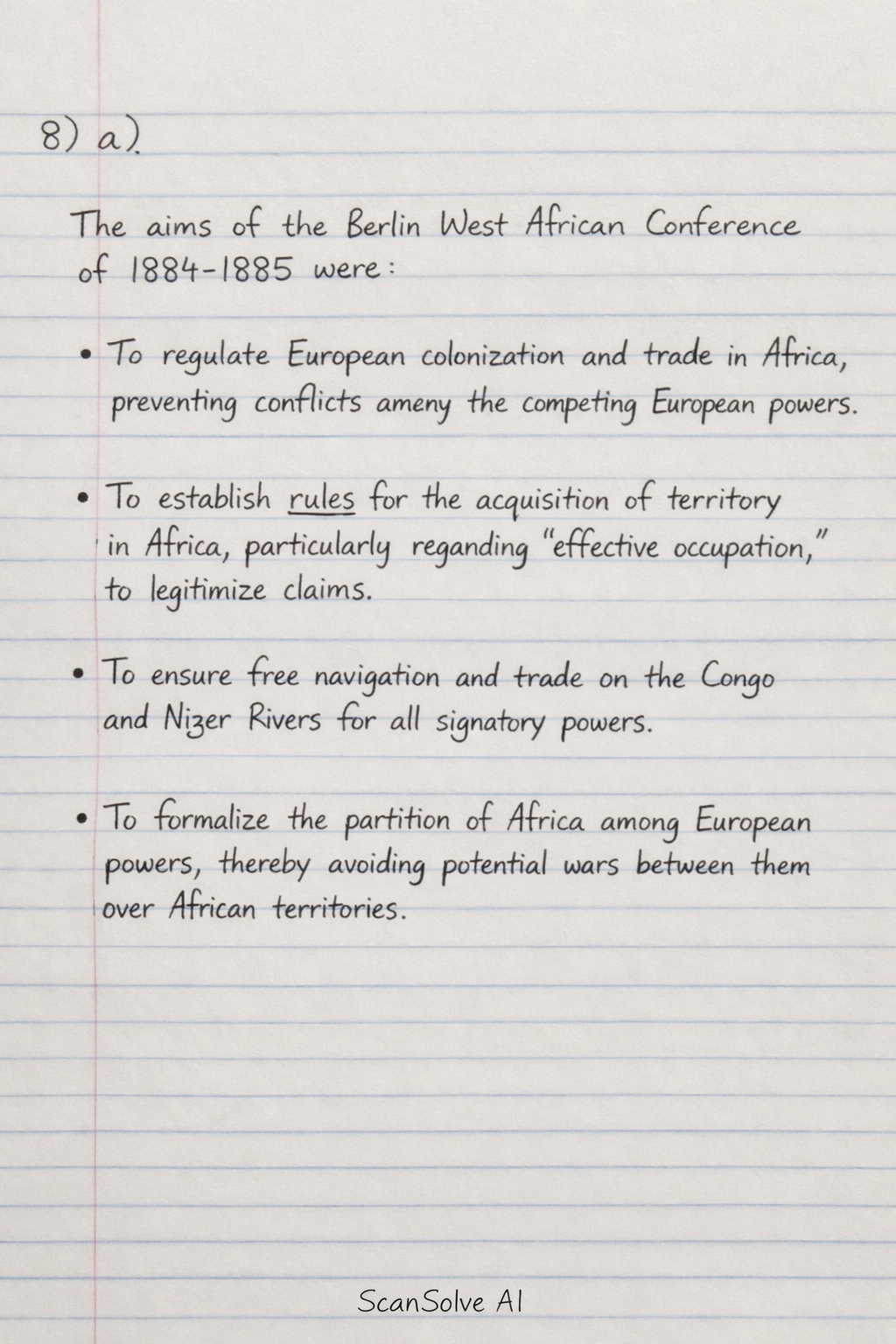
8) a) The aims of the Berlin West African Conference of 1884-1885 were: • To regulate European colonization and trade in Africa, preventing conflicts among the competing European powers. • To establish rules for the acquisition of territory in Africa, particularly regarding "effective occupation," to legitimize claims. • To ensure free navigation and trade on the Congo and Niger Rivers for all signatory powers. • To formalize the partition of Africa among European powers, thereby avoiding potential wars between them over African territories. b) The resolutions taken during the conference, formalized in the General Act of the Berlin Conference, included: • The Principle of Notification: Any power claiming new territory or establishing a protectorate on the African coast had to notify other signatory powers. • The Principle of Effective Occupation: Claims to territory had to be backed by actual presence and administration (e.g., military, police, or economic activity) to be considered valid. • Freedom of Navigation and Trade: The Congo and Niger River basins were declared neutral and open to free trade and navigation for all nations. • Suppression of Slavery: An agreement to work towards the suppression of slavery and the slave trade. • A general commitment to protect indigenous populations and missionaries, though this was often disregarded in practice. c) The negative effects of the conference were: • Arbitrary Borders: The conference drew artificial boundaries that ignored existing ethnic, linguistic, and cultural divisions, leading to future conflicts and instability within newly formed African states. • Loss of African Sovereignty: It legitimized the scramble for Africa, leading to the rapid colonization of the continent and the complete loss of independence and sovereignty for African states and societies. • Economic Exploitation: It paved the way for the systematic economic exploitation of African resources and labor for the benefit of European industries, hindering Africa's own development. • Cultural Disruption: Traditional African political, social, and economic structures were dismantled or severely disrupted, leading to the imposition of European systems and cultural norms.