
We read your photo as:
A) To find the value of x, we use the property of an arithmetic progression (A.P.) that the common difference between consecutive terms is constant.
ScanSolve AI Answer
Answers
2 partsStep-by-step solution
7 stepsHere's the solution to the question about the arithmetic progression:
Part a· 3 steps
To find the value of , we use the property of an arithmetic progression (A.P.) that the common difference between consecutive terms is constant.
Let the first three terms be , , and .
The common difference is given by .
Set up the equation for the common difference.
Simplify both sides of the equation.
Solve for .
The value of is .
Part b63
To find the sum of the terms of the progression, we first need to determine the terms, the common difference, and the number of terms.
Substitute into the expressions for the first three terms to find their values.
First term,
Second term,
Third term,Calculate the common difference, .
The common difference is 3.
Determine the number of terms, .
We are given that the last term, , is 18. The formula for the -th term of an A.P. is .
There are 6 terms in the progression.
Calculate the sum of the terms, .
The formula for the sum of an A.P. is .
The sum of the terms of the progression is .
Try one yourself
A new problem that tests the same skill.
Still stuck on this one?
Ask a follow-up, and the answer starts from this question.
More Mathematics Questions
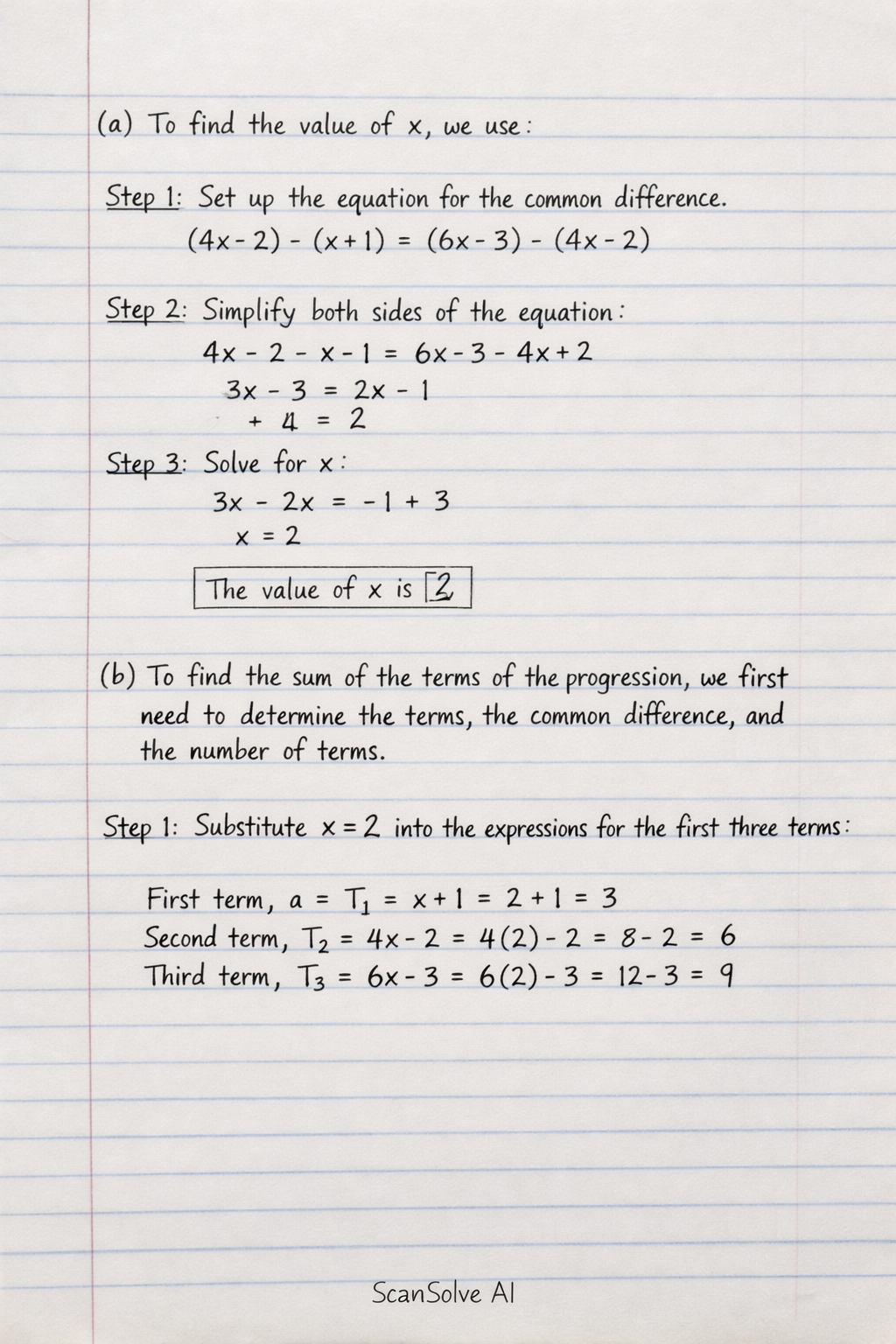
Handwritten Step-by-Step Solution
Get this as a handwritten image on WhatsApp — like a tutor wrote it for you.
Try on WhatsApp