

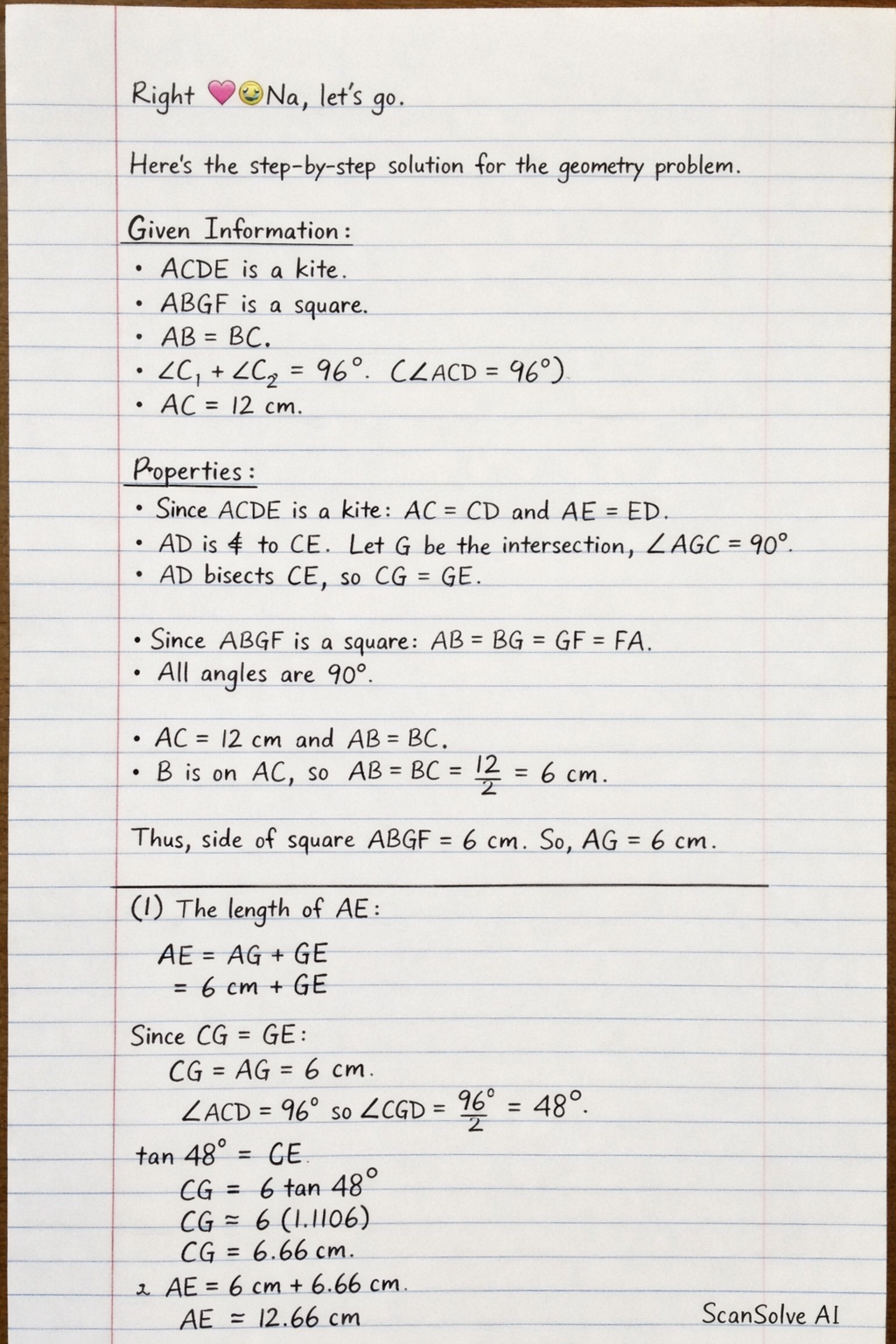
This mathematics problem involves applying core mathematical principles and formulas. Below you will find a complete step-by-step solution with detailed explanations for each step, helping you understand not just the answer but the method behind it.
ScanSolve AI Answer
Here's the step-by-step solution for the geometry problem. Given Information: ACDE is a kite. ABGF is a square. AB = BC. C_1 + C_2 = 96^. (This means ACD = 96^) AC = 12 cm. Properties derived from the given information and diagram: Since ACDE is a kite with AC=CD (single hash marks) and AE=ED (double hash marks), the diagonal AD is the axis of symmetry. AD is perpendicular to CE. Let G be the intersection point of AD and CE. So AGC = 90^. AD bisects CE, so CG = GE. Since ABGF is a square, all its sides are equal: AB = BG = GF = FA. All its angles are 90^. Since AC = 12 cm and AB = BC, and B is on AC, then AB = BC = (AC)/(2) = (12)/(2) = 6 cm. Therefore, the side length of the square ABGF is 6 cm. So AG = 6 cm. --- (1) the length of AE. Step 1: Calculate the length of CG. In right-angled ACG (since AD CE and G is the intersection): AC^2 = AG^2 + CG^2 (Pythagoras theorem) 12^2 = 6^2 + CG^2 144 = 36 + CG^2 CG^2 = 144 - 36 = 108 CG = sqrt(108) = sqrt(36 × 3) = 6sqrt(3) cm Step 2: Calculate the length of GE. In a kite, the diagonal that is the axis of symmetry (AD) bisects the other diagonal (CE). Since G is the intersection of AD and CE, CG = GE. GE = CG = 6sqrt(3) cm Step 3: Calculate the length of AE. In right-angled AGE (at G): AE^2 = AG^2 + GE^2 (Pythagoras theorem) AE^2 = 6^2 + (6sqrt(3))^2 AE^2 = 36 + (36 × 3) AE^2 = 36 + 108 AE^2 = 144 AE = sqrt(144) = 12 cm The length of AE is 12 cm. --- (2) the length of GF. Step 1: Use the properties of a square. ABGF is a square. All sides of a square are equal. From the given information and part (1), we know AB = 6 cm. GF = AB = 6 cm The length of GF is 6 cm. --- (3) the size of C_1 and C_2. Step 1: Calculate C_1 using trigonometry in ACG. In right-angled ACG (at G): (C_1) = OppositeHypotenuse = (AG)/(AC) (C_1) = (6)/(12) = (1)/(2) C_1 = 30^ Step 2: Calculate C_2 using the given sum. We are given C_1 + C_2 = 96^. 30^ + C_2 = 96^ C_2 = 96^ - 30^ = 66^ The size of C_1 is 30^ and C_2 is 66^. --- (4) the value of x. Step 1: Identify the type of quadrilateral ACDE. From the given information, AC = CD = 12 cm. From part (1), AE = ED = 12 cm. Since all four sides are equal (AC = CD = DE = EA = 12 cm), ACDE is a rhombus. Step 2: Use the properties of a rhombus. In a rhombus, opposite angles are equal, and adjacent angles are supplementary (add up to 180^). We are given ACD = C_1 + C_2 = 96^. The angle x is CDE. Since ACDE is a rhombus, ACD and CDE are adjacent angles. ACD + CDE = 180^ 96^ + x = 180^ x = 180^ - 96^ x = 84^ The value of x is 84^. Drop the next question.