

This mathematics problem involves applying core mathematical principles and formulas. Below you will find a complete step-by-step solution with detailed explanations for each step, helping you understand not just the answer but the method behind it.
ScanSolve AI Answer
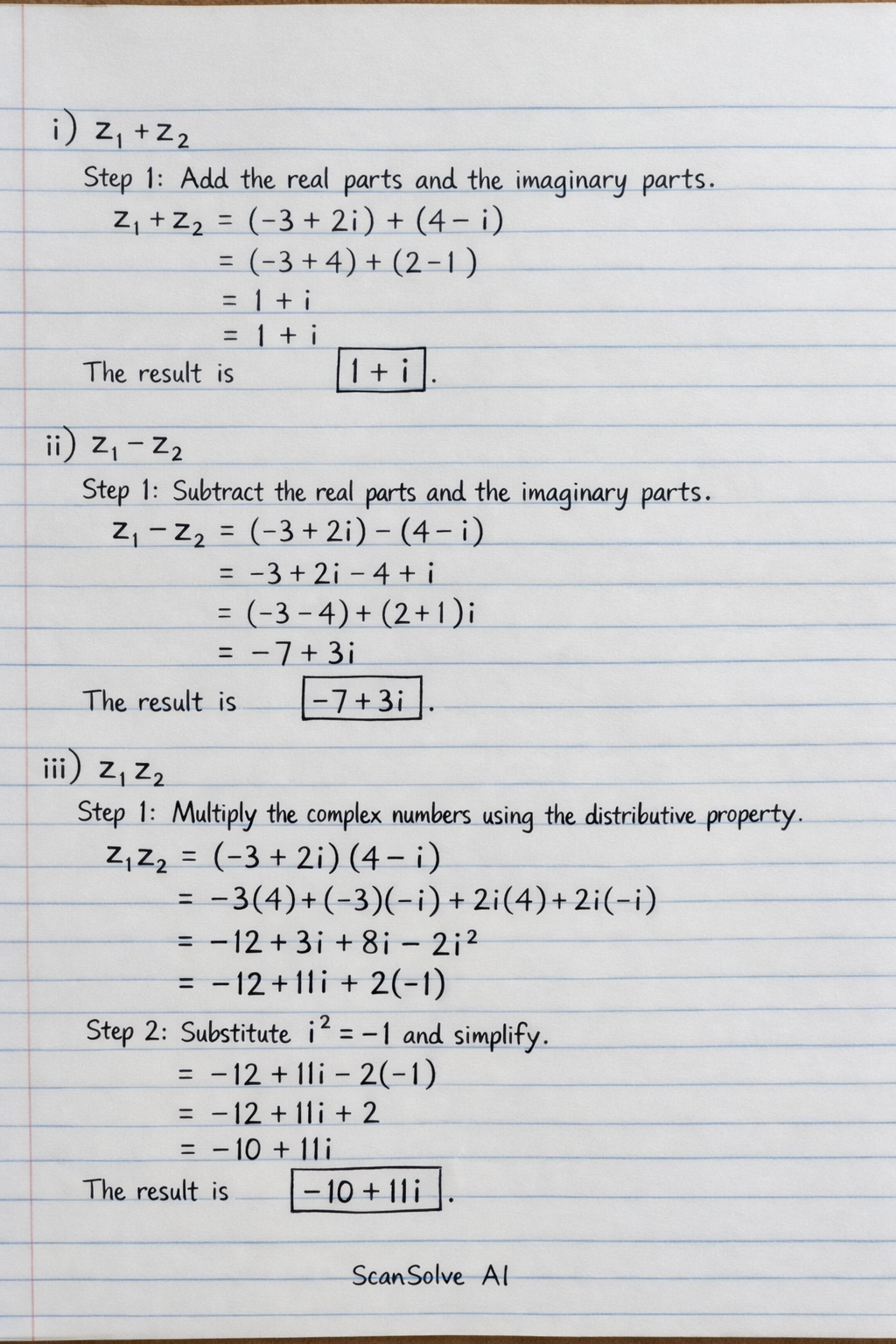
Let z_1 = -3 + 2i and z_2 = 4 - i. i) z_1 + z_2 Step 1: Add the real parts and the imaginary parts. z_1 + z_2 = (-3 + 2i) + (4 - i) = (-3 + 4) + (2 - 1)i = 1 + i The result is 1+i. ii) z_1 - z_2 Step 1: Subtract the real parts and the imaginary parts. z_1 - z_2 = (-3 + 2i) - (4 - i) = -3 + 2i - 4 + i = (-3 - 4) + (2 + 1)i = -7 + 3i The result is -7+3i. iii) z_1 z_2 Step 1: Multiply the complex numbers using the distributive property. z_1 z_2 = (-3 + 2i)(4 - i) = -3(4) + (-3)(-i) + 2i(4) + 2i(-i) = -12 + 3i + 8i - 2i^2 Step 2: Substitute i^2 = -1 and simplify. = -12 + 11i - 2(-1) = -12 + 11i + 2 = -10 + 11i The result is -10+11i. iv) (z_1)/(z_2) Step 1: Multiply the numerator and denominator by the conjugate of z_2. The conjugate of z_2 = 4-i is 4+i. (z_1)/(z_2) = (-3 + 2i)/(4 - i) × (4 + i)/(4 + i) Step 2: Expand the numerator. (-3 + 2i)(4 + i) = -12 - 3i + 8i + 2i^2 = -12 + 5i + 2(-1) = -14 + 5i Step 3: Expand the denominator. (4 - i)(4 + i) = 4^2 - i^2 = 16 - (-1) = 17 Step 4: Combine and express in Cartesian form. (-14 + 5i)/(17) = -(14)/(17) + (5)/(17)i The result is -(14)/(17) + (5)/(17)i. v) 2z_1 - 5z_2 Step 1: Multiply z_1 by 2 and z_2 by 5. 2z_1 = 2(-3 + 2i) = -6 + 4i 5z_2 = 5(4 - i) = 20 - 5i Step 2: Subtract the results. 2z_1 - 5z_2 = (-6 + 4i) - (20 - 5i) = -6 + 4i - 20 + 5i = (-6 - 20) + (4 + 5)i = -26 + 9i The result is -26+9i. vi) -z_1 - 2z_2 Step 1: Multiply z_1 by -1 and z_2 by -2. -z_1 = -(-3 + 2i) = 3 - 2i -2z_2 = -2(4 - i) = -8 + 2i Step 2: Add the results. -z_1 - 2z_2 = (3 - 2i) + (-8 + 2i) = (3 - 8) + (-2 + 2)i = -5 + 0i = -5 The result is -5. vii) (-z_1)(-z_2) Step 1: Multiply -z_1 and -z_2. This is equivalent to z_1 z_2. (-z_1)(-z_2) = (-(-3 + 2i))(-(4 - i)) = (3 - 2i)(-4 + i) = 3(-4) + 3(i) - 2i(-4) - 2i(i) = -12 + 3i + 8i - 2i^2 Step 2: Substitute i^2 = -1 and simplify. = -12 + 11i - 2(-1) = -12 + 11i + 2 = -10 + 11i The result is -10+11i. viii) 3z_1 + 2z_2 Step 1: Multiply z_1 by 3 and z_2 by 2. 3z_1 = 3(-3 + 2i) = -9 + 6i 2z_2 = 2(4 - i) = 8 - 2i Step 2: Add the results. 3z_1 + 2z_2 = (-9 + 6i) + (8 - 2i) = (-9 + 8) + (6 - 2)i = -1 + 4i The result is -1+4i. ix) i(z_1 + z_2) Step 1: Calculate z_1 + z_2. z_1 + z_2 = (-3 + 2i) + (4 - i) = 1 + i Step 2: Multiply the sum by i. i(z_1 + z_2) = i(1 + i) = i(1) + i(i) = i + i^2 Step 3: Substitute i^2 = -1 and simplify. = i - 1 = -1 + i The result is -1+i. x) (z_2)/(z_1) Step 1: Multiply the numerator and denominator by the conjugate of z_1. The conjugate of z_1 = -3+2i is -3-2i. (z_2)/(z_1) = (4 - i)/(-3 + 2i) × (-3 - 2i)/(-3 - 2i) Step 2: Expand the numerator. (4 - i)(-3 - 2i) = 4(-3) + 4(-2i) - i(-3) - i(-2i) = -12 - 8i + 3i + 2i^2 = -12 - 5i + 2(-1) = -14 - 5i Step 3: Expand the denominator. (-3 + 2i)(-3 - 2i) = (-3)^2 - (2i)^2 = 9 - 4i^2 = 9 - 4(-1) = 13 Step 4: Combine and express in Cartesian form. (-14 - 5i)/(13) = -(14)/(13) - (5)/(13)i The result is -(14)/(13) - (5)/(13)i. Last free one today — make it count tomorrow, or type /upgrade for unlimited.