
How did we get 8/10 ?
Mathematics
ScanSolve AI Answer
Step-by-step solution
4 stepsTo get from , we used the concept of equivalent fractions.
We wanted to add and .
To do this, both fractions need to have the same denominator. We found that the least common denominator (LCD) for 5 and 10 is 10.
We needed to convert into an equivalent fraction with a denominator of 10.
To change the denominator from 5 to 10, we multiply 5 by 2.
To keep the fraction equivalent, whatever we multiply the denominator by, we must also multiply the numerator by the same number.
So, we multiply the numerator 4 by 2 as well.
This gives us the equivalent fraction
This means is the same value as .
Was this helpful?
Still stuck on this one?
Ask a follow-up, and the answer starts from this question.
Got a different question?Ask your own question
More Mathematics Questions
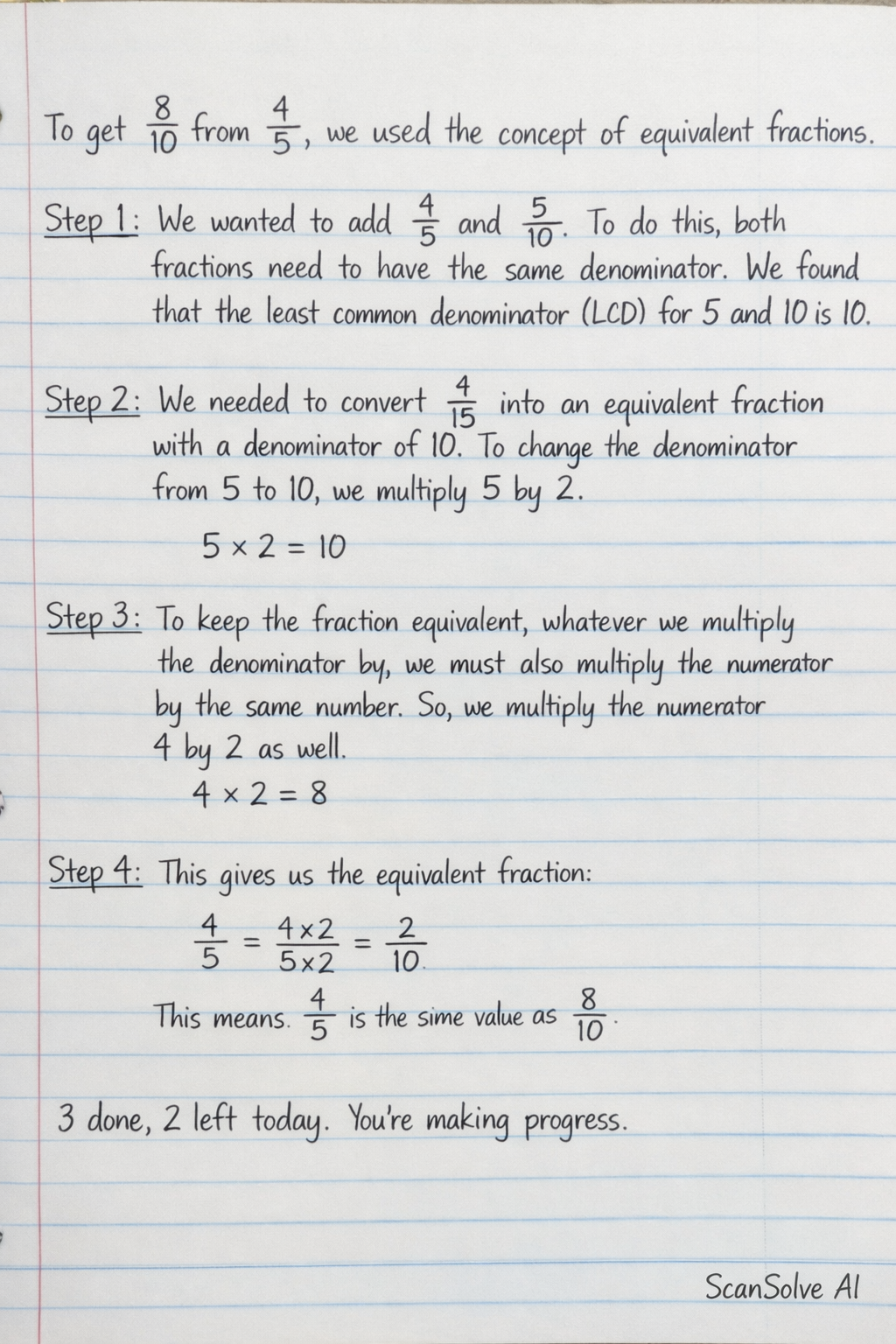
Handwritten Step-by-Step Solution
Get this as a handwritten image on WhatsApp — like a tutor wrote it for you.
Try on WhatsApp