We read your photo as:

Complete the tables of values for the following equations: c. y = x2 − 3, d. y = x2 − 5, e. y = 2x2 + 1, f. y = 2x2 − 1

Mathematics

ScanSolve AI Answer

Step-by-step solution

4 steps

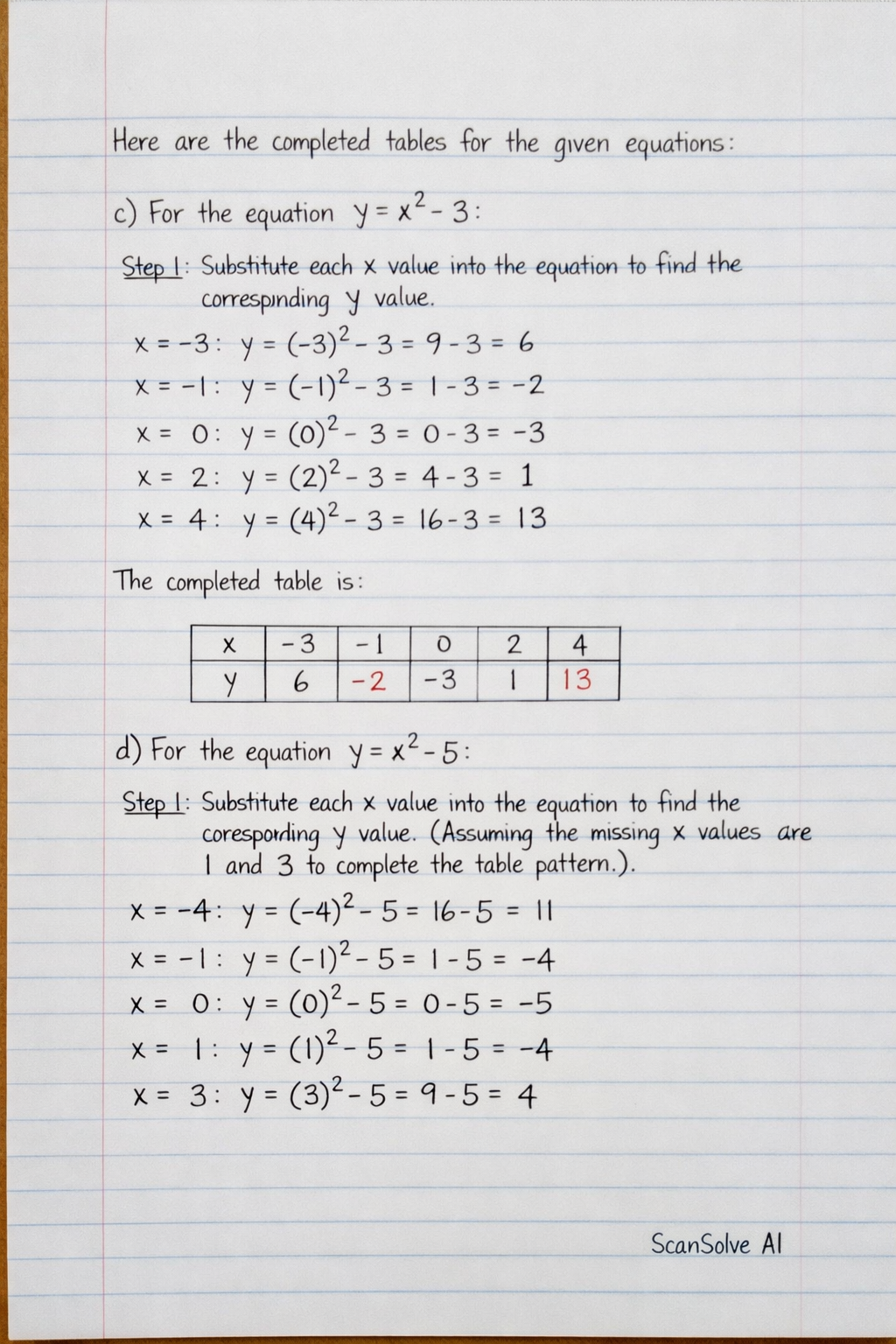
Here are the completed tables for the given equations:

Part c· 1 step

For the equation y=x2−3y = x^2 - 3

  1. Substitute each xx value into the equation to find the corresponding yy value.

    For x=−3x = -3: y=(−3)2−3=9−3=6y = (-3)^2 - 3 = 9 - 3 = 6
    For x=−1x = -1: y=(−1)2−3=1−3=−2y = (-1)^2 - 3 = 1 - 3 = -2
    For x=0x = 0: y=(0)2−3=0−3=−3y = (0)^2 - 3 = 0 - 3 = -3
    For x=2x = 2: y=(2)2−3=4−3=1y = (2)^2 - 3 = 4 - 3 = 1
    For x=4x = 4: y=(4)2−3=16−3=13y = (4)^2 - 3 = 16 - 3 = 13

    The completed table is:

    x−3−1024y6-2-3113\begin{array}{|c|c|c|c|c|c|} \hline x & -3 & -1 & 0 & 2 & 4 \\ \hline y & \textbf{6} & \textbf{-2} & \textbf{-3} & \textbf{1} & \textbf{13} \\ \hline \end{array}

Part d· 1 step

For the equation y=x2−5y = x^2 - 5

  1. Substitute each xx value into the equation to find the corresponding yy value.

    (Assuming the missing xx values are 1 and 3 to complete the table pattern.)
    For x=−4x = -4: y=(−4)2−5=16−5=11y = (-4)^2 - 5 = 16 - 5 = 11
    For x=−1x = -1: y=(−1)2−5=1−5=−4y = (-1)^2 - 5 = 1 - 5 = -4
    For x=0x = 0: y=(0)2−5=0−5=−5y = (0)^2 - 5 = 0 - 5 = -5
    For x=1x = 1: y=(1)2−5=1−5=−4y = (1)^2 - 5 = 1 - 5 = -4
    For x=3x = 3: y=(3)2−5=9−5=4y = (3)^2 - 5 = 9 - 5 = 4

    The completed table is:

    x−4−1013y11-4-5-44\begin{array}{|c|c|c|c|c|c|} \hline x & -4 & -1 & 0 & 1 & 3 \\ \hline y & \textbf{11} & \textbf{-4} & \textbf{-5} & \textbf{-4} & \textbf{4} \\ \hline \end{array}

Part e· 1 step

For the equation y=2x2+1y = 2x^2 + 1

  1. Substitute each xx value into the equation to find the corresponding yy value.

    For x=−6x = -6: y=2(−6)2+1=2(36)+1=72+1=73y = 2(-6)^2 + 1 = 2(36) + 1 = 72 + 1 = 73
    For x=−5x = -5: y=2(−5)2+1=2(25)+1=50+1=51y = 2(-5)^2 + 1 = 2(25) + 1 = 50 + 1 = 51
    For x=0x = 0: y=2(0)2+1=0+1=1y = 2(0)^2 + 1 = 0 + 1 = 1
    For x=5x = 5: y=2(5)2+1=2(25)+1=50+1=51y = 2(5)^2 + 1 = 2(25) + 1 = 50 + 1 = 51
    For x=6x = 6: y=2(6)2+1=2(36)+1=72+1=73y = 2(6)^2 + 1 = 2(36) + 1 = 72 + 1 = 73

    The completed table is:

    x−6−5056y735115173\begin{array}{|c|c|c|c|c|c|} \hline x & -6 & -5 & 0 & 5 & 6 \\ \hline y & \textbf{73} & \textbf{51} & \textbf{1} & \textbf{51} & \textbf{73} \\ \hline \end{array}

Part f· 1 step

For the equation y=2x2−1y = 2x^2 - 1

  1. Substitute each xx value into the equation to find the corresponding yy value.

    (Assuming the missing xx values are 1 and 2 to complete the table pattern.)
    For x=−2x = -2: y=2(−2)2−1=2(4)−1=8−1=7y = 2(-2)^2 - 1 = 2(4) - 1 = 8 - 1 = 7
    For x=−1x = -1: y=2(−1)2−1=2(1)−1=2−1=1y = 2(-1)^2 - 1 = 2(1) - 1 = 2 - 1 = 1
    For x=0x = 0: y=2(0)2−1=0−1=−1y = 2(0)^2 - 1 = 0 - 1 = -1
    For x=1x = 1: y=2(1)2−1=2(1)−1=2−1=1y = 2(1)^2 - 1 = 2(1) - 1 = 2 - 1 = 1
    For x=2x = 2: y=2(2)2−1=2(4)−1=8−1=7y = 2(2)^2 - 1 = 2(4) - 1 = 8 - 1 = 7

    The completed table is:

    x−2−1012y71-117\begin{array}{|c|c|c|c|c|c|} \hline x & -2 & -1 & 0 & 1 & 2 \\ \hline y & \textbf{7} & \textbf{1} & \textbf{-1} & \textbf{1} & \textbf{7} \\ \hline \end{array}
Was this helpful?

Still stuck on this one?

Ask a follow-up, and the answer starts from this question.

Got a different question?Ask your own question
Handwritten step-by-step solution preview

Handwritten Step-by-Step Solution

Get this as a handwritten image on WhatsApp — like a tutor wrote it for you.

Try on WhatsApp