
We read your photo as:
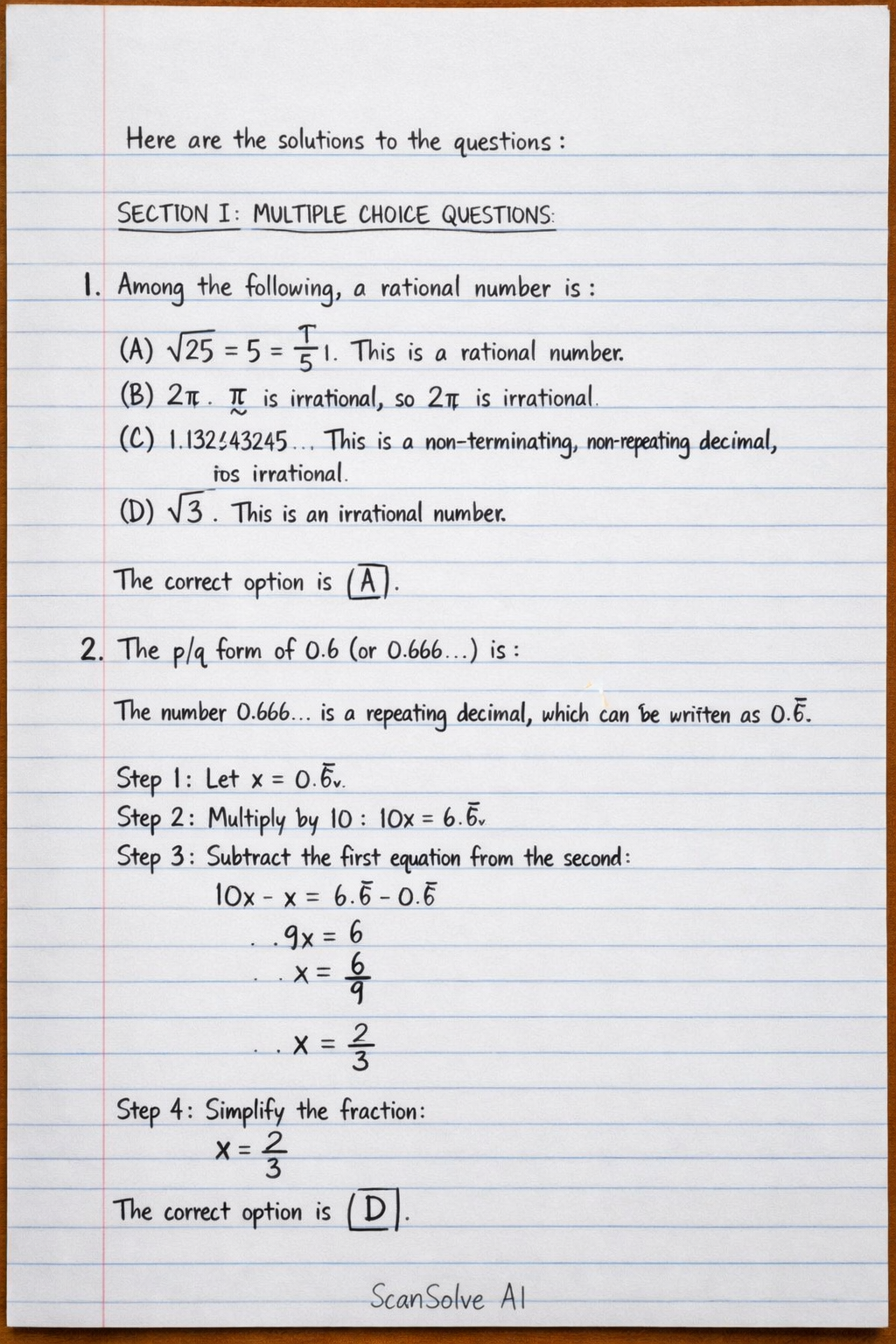
Among the following, a rational number is:
ScanSolve AI Answer
Answer
Step-by-step solution
16 stepsHere are the solutions to the questions:
SECTION I: MULTIPLE CHOICE QUESTIONS
1. Among the following, a rational number is:
A rational number can be expressed as a fraction where and are integers and .
- (A) . This is a rational number.
- (B) . is irrational, so is irrational.
- (C) 1.132343245.... This is a non-terminating, non-repeating decimal, so it's irrational.
- (D) . This is an irrational number.
The correct option is (A).
2. The p/q form of 0.6 (or 0.666...) is:
The number 0.666... is a repeating decimal, which can be written as .
Let .
Multiply by 10
.
Subtract the first equation from the second
Simplify the fraction
The correct option is (D).
3. The degree of the polynomial is:
The degree of a polynomial is the highest exponent of the variable in the polynomial.Identify the terms and their exponents
The terms are , , , and 10 (which is ).
The exponents are 7, 1, 1, and 0.
The highest exponent is 7.
The correct option is (D).
4. The zero of the polynomial is:
The zero of a polynomial is the value of for which .Set the polynomial equal to zero
Solve for
The correct option is (D).
5. The coordinates of origin are:
The origin is the point where the x-axis and y-axis intersect in a Cartesian coordinate system.
The coordinates of the origin are .The correct option is (C).
6. The number of dimensions a point has is:
A point is a fundamental concept in geometry that represents a specific location. It has no length, width, or height.
Therefore, a point has 0 dimensions.The correct option is (A).
7. The non-acute angle among the following is:
An acute angle is an angle that measures less than . A non-acute angle is an angle that measures or greater.- (A) : This is greater than , so it is an obtuse angle and thus non-acute.
- (B) : This is greater than , so it is an obtuse angle and thus non-acute.
- (C) : This is a zero angle, which is not non-acute in the context of being .
- (D) : This is less than , so it is an acute angle.
Both (A) and (B) are non-acute angles. Assuming the question expects a single answer, we select the first valid option.
The correct option is (A).
8. In the given figure, a pair of vertically opposite angles is:
Vertically opposite angles are formed when two lines intersect. They are the angles opposite each other at the intersection point.
From the figure, lines AC and BD intersect at O.
The pairs of vertically opposite angles are and (or ), and and .- (A) and : This is a pair of vertically opposite angles.
- (B) and : These are adjacent angles forming a linear pair.
- (C) and : These are adjacent angles forming a linear pair.
- (D) and : These are adjacent angles forming a linear pair.
The correct option is (A).
SECTION II: VERY SHORT ANSWER QUESTIONS
1. Simplify:
Use the distributive property (FOIL method)
Perform the multiplications
The expression cannot be simplified further as the square root terms are different.
2. What are binomials? Give an example.
A binomial is a polynomial that consists of exactly two terms. These terms are typically separated by an addition or subtraction sign.
Example: (Other examples include , , etc.)3. Find the value of when .
Substitute into the polynomial
Perform the calculations
The value of when is .
4. Name the part of a line which has two endpoints.
The part of a line which has two endpoints is called a .5. Define parallel lines.
Parallel lines are two distinct lines in a plane that and maintain a constant distance from each other.6. Define an obtuse angle.
An obtuse angle is an angle that measures .7. If one angle of a linear pair is , find the other angle.
A linear pair consists of two adjacent angles whose non-common sides form a straight line.
The sum of angles in a linear pair is .
Let the unknown angle be .
Solve for
The other angle is .
8. If and , what is your conclusion about lines and ?
If line is parallel to line , and line is parallel to line , then by the transitive property of parallel lines, .
Try one yourself
A new problem that tests the same skill.
Still stuck on this one?
Ask a follow-up, and the answer starts from this question.
More Mathematics Questions
Handwritten Step-by-Step Solution
Get this as a handwritten image on WhatsApp — like a tutor wrote it for you.
Try on WhatsApp