
This mathematics problem involves applying core mathematical principles and formulas. Below you will find a complete step-by-step solution with detailed explanations for each step, helping you understand not just the answer but the method behind it.
ScanSolve AI Answer
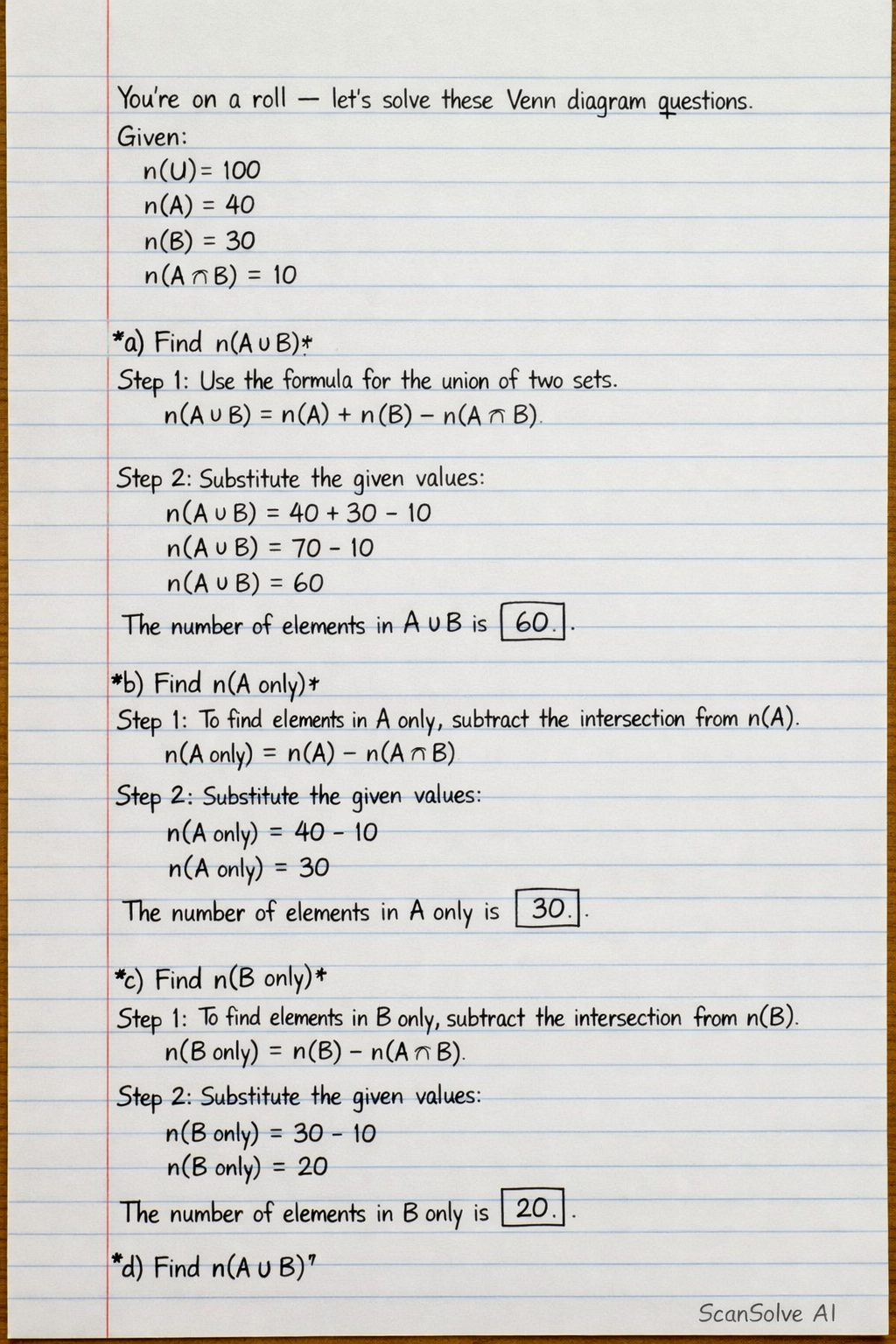
You're on a roll — let's solve these Venn diagram questions. Given: n(U) = 100 n(A) = 40 n(B) = 30 n(A B) = 10 a) Find n(A B) Step 1: Use the formula for the union of two sets. n(A B) = n(A) + n(B) - n(A B) Step 2: Substitute the given values. n(A B) = 40 + 30 - 10 n(A B) = 70 - 10 n(A B) = 60 The number of elements in A B is 60. b) Find n(A only) Step 1: To find elements in A only, subtract the intersection from n(A). n(A only) = n(A) - n(A B) Step 2: Substitute the given values. n(A only) = 40 - 10 n(A only) = 30 The number of elements in A only is 30. c) Find n(B only) Step 1: To find elements in B only, subtract the intersection from n(B). n(B only) = n(B) - n(A B) Step 2: Substitute the given values. n(B only) = 30 - 10 n(B only) = 20 The number of elements in B only is 20. d) Find n(A B)' Step 1: The complement of A B is found by subtracting n(A B) from the total number of elements in the universal set n(U). n(A B)' = n(U) - n(A B) Step 2: Substitute the values. We found n(A B) = 60 in part (a). n(A B)' = 100 - 60 n(A B)' = 40 The number of elements in (A B)' is 40. e) Find n(A' B') Step 1: Apply De Morgan's Law, which states that A' B' = (A B)'. n(A' B') = n((A B)') Step 2: This is the same value calculated in part (d). n(A' B') = 40 The number of elements in A' B' is 40. What's next?