
We read your photo as:
Find the angle CKD given the coordinates of A, C, D and the equation of line BD.
Mathematics
ScanSolve AI Answer
Step-by-step solution
3 stepsTo determine the size of , you'll need to find the gradients of the lines CK and KD.
Find the coordinates of point K.
- K is the intersection of the diagonals AC and BD.
- From question 3.2, you should have calculated the gradient of AC. Use this gradient and one of the points A or C to find the equation of line AC.
- The equation of line BD is given as .
- Solve the equations for line AC and line BD simultaneously to find the coordinates of K.
Calculate the gradients of CK and KD.
- Use the coordinates of C, K (from Step 1), and D to find and .
Use the formula for the angle between two lines.
- If and are the gradients of two lines, the angle between them is given by:
- Substitute and into this formula to find .
Was this helpful?
Still stuck on this one?
Ask a follow-up, and the answer starts from this question.
Got a different question?Ask your own question
More Mathematics Questions
QCalculate the angle of inclination of the line segment CD given the coordinates of the vertices A…QFind the angle between lines AB and AC given points A(0, 5), B(−3, 0), C(4, 0).QDetermine the angle ACB.QWhat is the angle marked from the following: find < ABDQFind the value of angle CAE (x) and angle BDC (y) in the given diagram, using the provided angle…
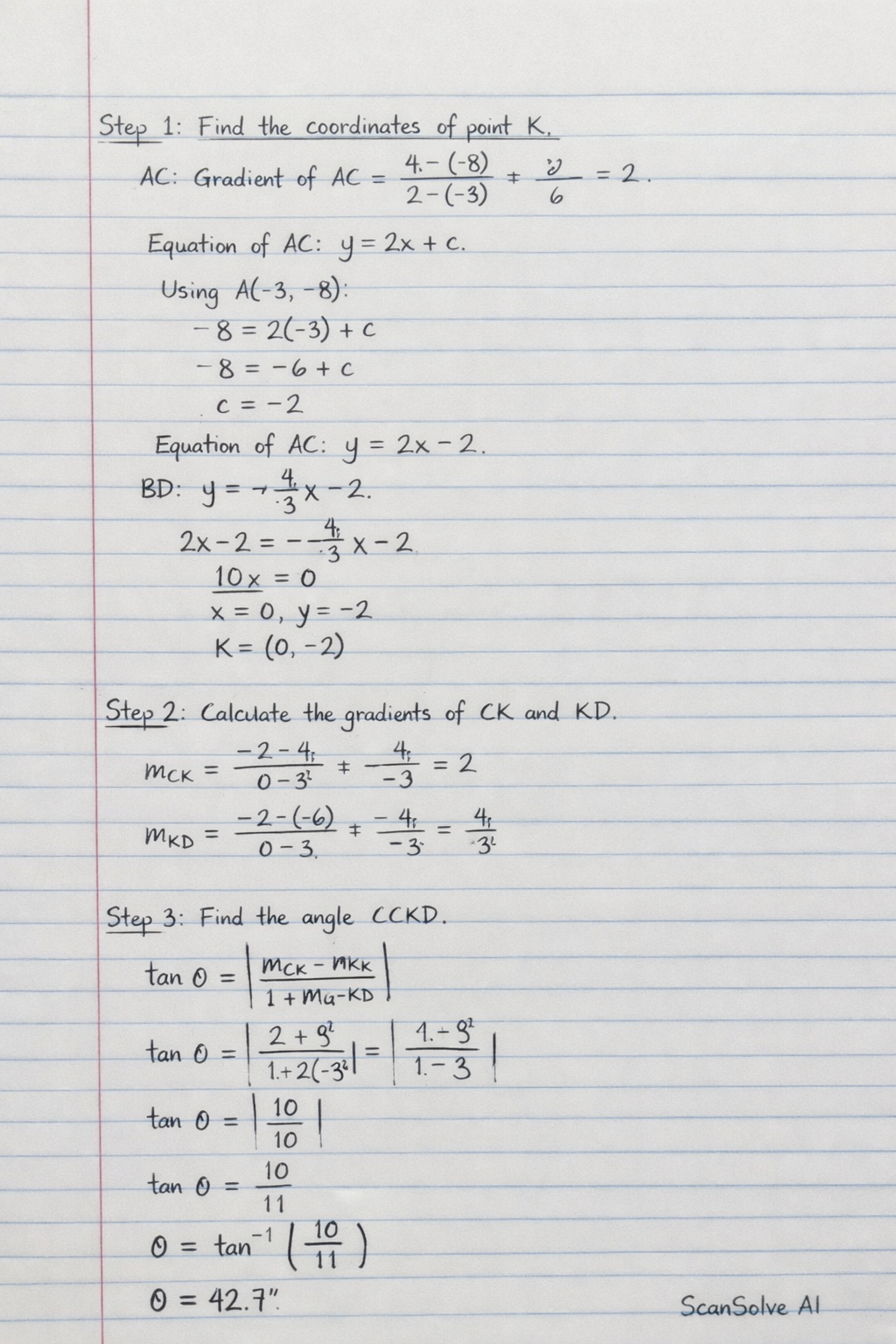
Handwritten Step-by-Step Solution
Get this as a handwritten image on WhatsApp — like a tutor wrote it for you.
Try on WhatsApp