
We read your photo as:
Apply the Alternate Segment Theorem.
ScanSolve AI Answer
Step-by-step solution
4 stepsApply the Alternate Segment Theorem.
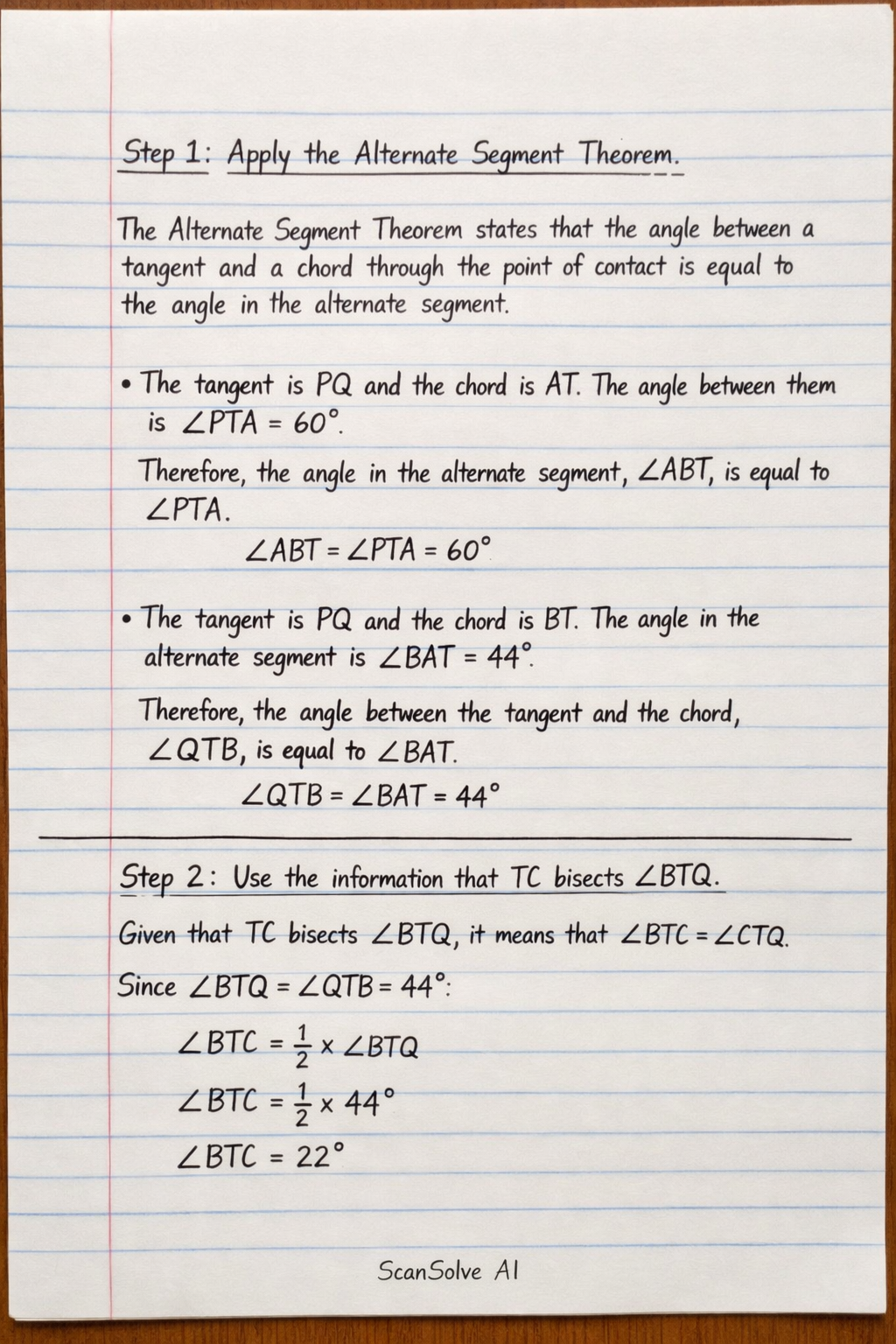
The Alternate Segment Theorem states that the angle between a tangent and a chord through the point of contact is equal to the angle in the alternate segment.
- The tangent is PQ and the chord is AT. The angle between them is . Therefore, the angle in the alternate segment, , is equal to .
- The tangent is PQ and the chord is BT. The angle in the alternate segment is . Therefore, the angle between the tangent and the chord, , is equal to .
Use the information that TC bisects .
Given that TC bisects , it means that .
Since :Apply the Exterior Angle Theorem to .
The line ABC is a straight line. This means that is an exterior angle to at vertex B.
The Exterior Angle Theorem states that an exterior angle of a triangle is equal to the sum of the two opposite interior angles.
For , the exterior angle at B is , and the opposite interior angles are and .Substitute the values we found:
Solve for .
Subtract from both sides:
Since is the same as , we have:
The final answer is
\boxed{\text{38^\circ}}.
Still stuck on this one?
Ask a follow-up, and the answer starts from this question.
More Mathematics Questions
Handwritten Step-by-Step Solution
Get this as a handwritten image on WhatsApp — like a tutor wrote it for you.
Try on WhatsApp