We read your photo as:

Apply the differentiation rule (d)/(dx)( x) = (1)/(x).

Mathematics

ScanSolve AI Answer

Step-by-step solution

21 steps

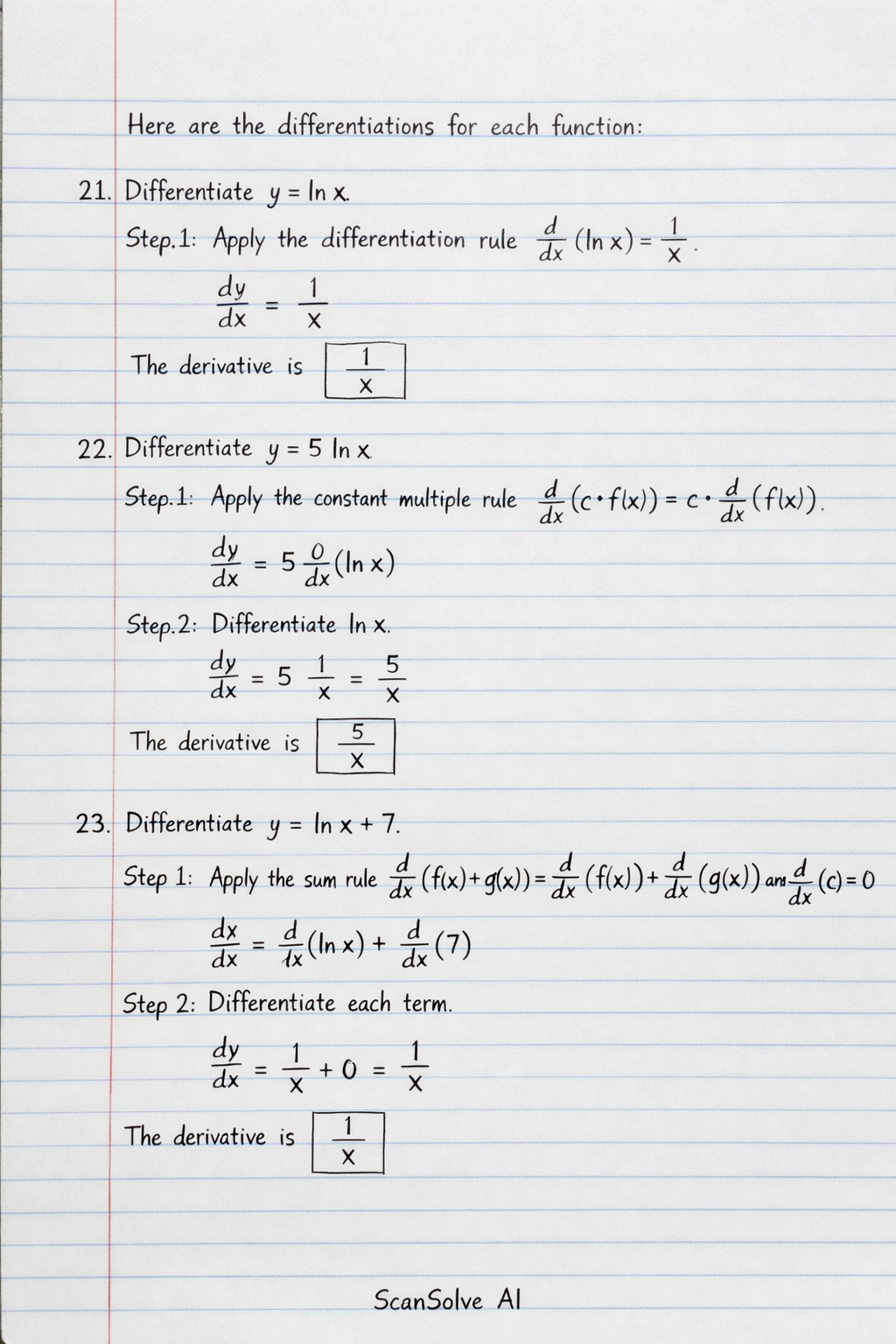
Here are the differentiations for each function:

21. Differentiate y=ln⁡xy = \ln x

  1. Apply the differentiation rule ddx(ln⁡x)=1x\frac{d}{dx}(\ln x) = \frac{1}{x}.

    dydx=1x\frac{dy}{dx} = \frac{1}{x}

    The derivative is 1x\boxed{\frac{1}{x}}.

    22. Differentiate y=5ln⁡xy = 5 \ln x

  2. Apply the constant multiple rule ddx(c⋅f(x))=c⋅ddx(f(x))\frac{d}{dx}(c \cdot f(x)) = c \cdot \frac{d}{dx}(f(x)).

    dydx=5ddx(ln⁡x)\frac{dy}{dx} = 5 \frac{d}{dx}(\ln x)
  3. Differentiate ln⁡x\ln x.

    dydx=5⋅1x=5x\frac{dy}{dx} = 5 \cdot \frac{1}{x} = \frac{5}{x}

    The derivative is 5x\boxed{\frac{5}{x}}.

    23. Differentiate y=ln⁡x+7y = \ln x + 7

  4. Apply the sum rule ddx(f(x)+g(x))=ddx(f(x))+ddx(g(x))\frac{d}{dx}(f(x) + g(x)) = \frac{d}{dx}(f(x)) + \frac{d}{dx}(g(x)) and the rule for a constant ddx(c)=0\frac{d}{dx}(c) = 0.

    dydx=ddx(ln⁡x)+ddx(7)\frac{dy}{dx} = \frac{d}{dx}(\ln x) + \frac{d}{dx}(7)
  5. Differentiate each term.

    dydx=1x+0=1x\frac{dy}{dx} = \frac{1}{x} + 0 = \frac{1}{x}

    The derivative is 1x\boxed{\frac{1}{x}}.

    24. Differentiate y=3ln⁡x−4y = 3 \ln x - 4

  6. Apply the difference rule and constant rules.

    dydx=ddx(3ln⁡x)−ddx(4)\frac{dy}{dx} = \frac{d}{dx}(3 \ln x) - \frac{d}{dx}(4)
  7. Differentiate each term.

    dydx=3⋅1x−0=3x\frac{dy}{dx} = 3 \cdot \frac{1}{x} - 0 = \frac{3}{x}

    The derivative is 3x\boxed{\frac{3}{x}}.

    25. Differentiate y=8ln⁡x+5y = 8 \ln x + 5

  8. Apply the sum rule and constant rules.

    dydx=ddx(8ln⁡x)+ddx(5)\frac{dy}{dx} = \frac{d}{dx}(8 \ln x) + \frac{d}{dx}(5)
  9. Differentiate each term.

    dydx=8⋅1x+0=8x\frac{dy}{dx} = 8 \cdot \frac{1}{x} + 0 = \frac{8}{x}

    The derivative is 8x\boxed{\frac{8}{x}}.

    26. Differentiate y=6ln⁡x−9y = 6 \ln x - 9

  10. Apply the difference rule and constant rules.

    dydx=ddx(6ln⁡x)−ddx(9)\frac{dy}{dx} = \frac{d}{dx}(6 \ln x) - \frac{d}{dx}(9)
  11. Differentiate each term.

    dydx=6⋅1x−0=6x\frac{dy}{dx} = 6 \cdot \frac{1}{x} - 0 = \frac{6}{x}

    The derivative is 6x\boxed{\frac{6}{x}}.

    27. Differentiate y=10ln⁡x+3y = 10 \ln x + 3

  12. Apply the sum rule and constant rules.

    dydx=ddx(10ln⁡x)+ddx(3)\frac{dy}{dx} = \frac{d}{dx}(10 \ln x) + \frac{d}{dx}(3)
  13. Differentiate each term.

    dydx=10⋅1x+0=10x\frac{dy}{dx} = 10 \cdot \frac{1}{x} + 0 = \frac{10}{x}

    The derivative is 10x\boxed{\frac{10}{x}}.

    28. Differentiate y=4ln⁡x+2ln⁡xy = 4 \ln x + 2 \ln x

  14. Simplify the expression.

    y=(4+2)ln⁡x=6ln⁡xy = (4+2) \ln x = 6 \ln x
  15. Differentiate the simplified expression.

    dydx=ddx(6ln⁡x)=6ddx(ln⁡x)\frac{dy}{dx} = \frac{d}{dx}(6 \ln x) = 6 \frac{d}{dx}(\ln x)
  16. Differentiate ln⁡x\ln x.

    dydx=6⋅1x=6x\frac{dy}{dx} = 6 \cdot \frac{1}{x} = \frac{6}{x}

    The derivative is 6x\boxed{\frac{6}{x}}.

    29. Differentiate y=9ln⁡x−3ln⁡xy = 9 \ln x - 3 \ln x

  17. Simplify the expression.

    y=(9−3)ln⁡x=6ln⁡xy = (9-3) \ln x = 6 \ln x
  18. Differentiate the simplified expression.

    dydx=ddx(6ln⁡x)=6ddx(ln⁡x)\frac{dy}{dx} = \frac{d}{dx}(6 \ln x) = 6 \frac{d}{dx}(\ln x)
  19. Differentiate ln⁡x\ln x.

    dydx=6⋅1x=6x\frac{dy}{dx} = 6 \cdot \frac{1}{x} = \frac{6}{x}

    The derivative is 6x\boxed{\frac{6}{x}}.

    30. Differentiate y=7ln⁡x+5y = 7 \ln x + 5

  20. Apply the sum rule and constant rules.

    dydx=ddx(7ln⁡x)+ddx(5)\frac{dy}{dx} = \frac{d}{dx}(7 \ln x) + \frac{d}{dx}(5)
  21. Differentiate each term.

    dydx=7⋅1x+0=7x\frac{dy}{dx} = 7 \cdot \frac{1}{x} + 0 = \frac{7}{x}

    The derivative is 7x\boxed{\frac{7}{x}}.

Was this helpful?

Still stuck on this one?

Ask a follow-up, and the answer starts from this question.

Got a different question?Ask your own question
Handwritten step-by-step solution preview

Handwritten Step-by-Step Solution

Get this as a handwritten image on WhatsApp — like a tutor wrote it for you.

Try on WhatsApp