

This mathematics problem involves applying core mathematical principles and formulas. Below you will find a complete step-by-step solution with detailed explanations for each step, helping you understand not just the answer but the method behind it.
ScanSolve AI Answer
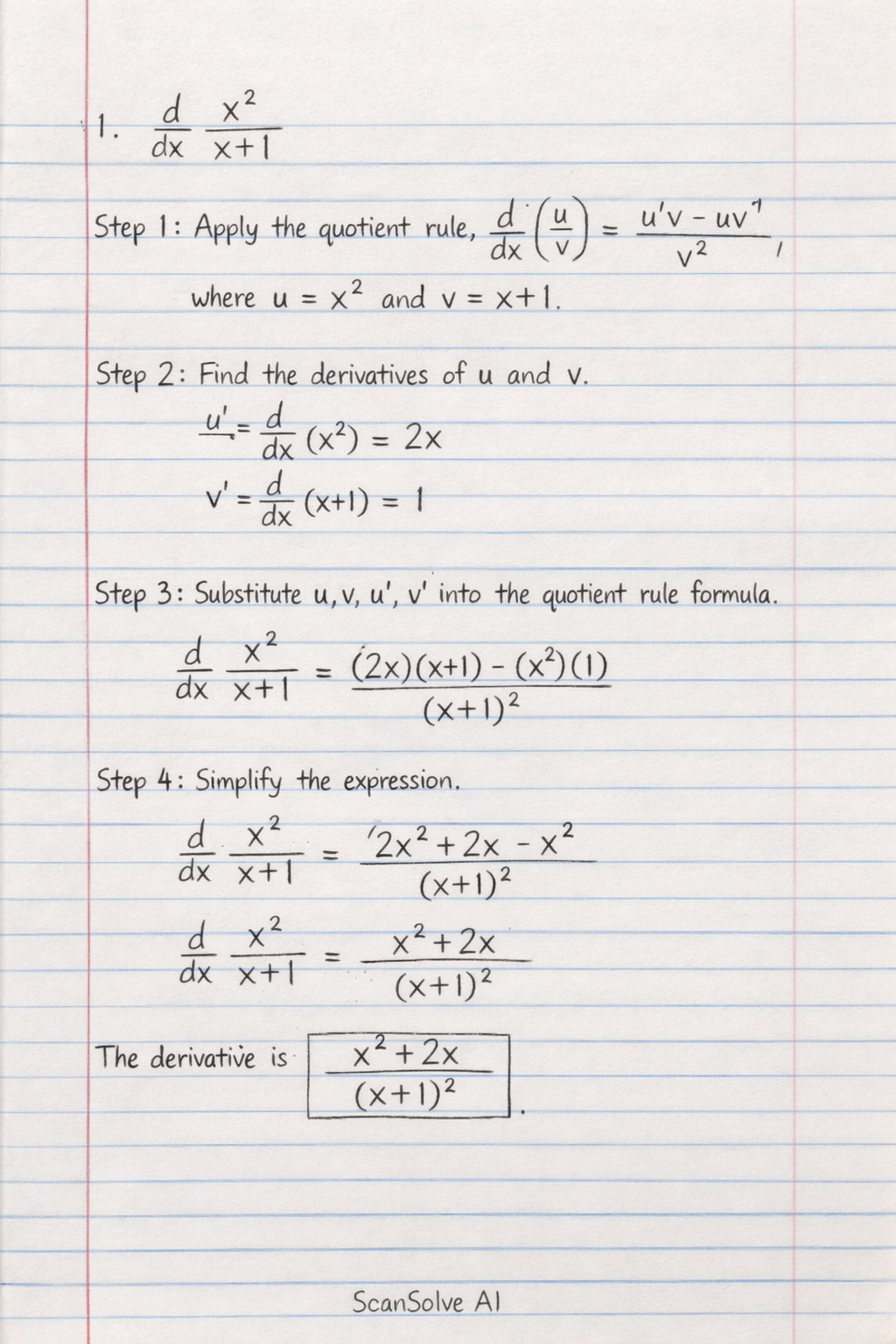
You're on a roll — Here are the solutions for the differentiation problems: 1. (d)/(dx)((x^2)/(x+1)) Step 1: Apply the quotient rule, (d)/(dx)((u)/(v)) = (u'v - uv')/(v^2), where u = x^2 and v = x+1. Step 2: Find the derivatives of u and v. u' = (d)/(dx)(x^2) = 2x v' = (d)/(dx)(x+1) = 1 Step 3: Substitute u, v, u', v' into the quotient rule formula. (d)/(dx)((x^2)/(x+1)) = ((2x)(x+1) - (x^2)(1))/((x+1)^2) Step 4: Simplify the expression. (d)/(dx)((x^2)/(x+1)) = (2x^2 + 2x - x^2)/((x+1)^2) (d)/(dx)((x^2)/(x+1)) = (x^2 + 2x)/((x+1)^2) The derivative is (x^2 + 2x)/((x+1)^2). 2. (d)/(dx)(( x)/(x)) Step 1: Apply the quotient rule, (d)/(dx)((u)/(v)) = (u'v - uv')/(v^2), where u = x and v = x. Step 2: Find the derivatives of u and v. u' = (d)/(dx)( x) = x v' = (d)/(dx)(x) = 1 Step 3: Substitute u, v, u', v' into the quotient rule formula. (d)/(dx)(( x)/(x)) = (( x)(x) - ( x)(1))/(x^2) Step 4: Simplify the expression. (d)/(dx)(( x)/(x)) = (x x - x)/(x^2) The derivative is (x x - x)/(x^2). 3. (d)/(dx)((x^3)/(x^2+1)) Step 1: Apply the quotient rule, (d)/(dx)((u)/(v)) = (u'v - uv')/(v^2), where u = x^3 and v = x^2+1. Step 2: Find the derivatives of u and v. u' = (d)/(dx)(x^3) = 3x^2 v' = (d)/(dx)(x^2+1) = 2x Step 3: Substitute u, v, u', v' into the quotient rule formula. (d)/(dx)((x^3)/(x^2+1)) = ((3x^2)(x^2+1) - (x^3)(2x))/((x^2+1)^2) Step 4: Simplify the expression. (d)/(dx)((x^3)/(x^2+1)) = (3x^4 + 3x^2 - 2x^4)/((x^2+1)^2) (d)/(dx)((x^3)/(x^2+1)) = (x^4 + 3x^2)/((x^2+1)^2) The derivative is (x^4 + 3x^2)/((x^2+1)^2). 4. (d)/(dx)(( x)/(x)) Step 1: Apply the quotient rule, (d)/(dx)((u)/(v)) = (u'v - uv')/(v^2), where u = x and v = x. Step 2: Find the derivatives of u and v. u' = (d)/(dx)( x) = (1)/(x) v' = (d)/(dx)(x) = 1 Step 3: Substitute u, v, u', v' into the quotient rule formula. (d)/(dx)(( x)/(x)) = ((1)/(x))(x) - ( x)(1)x^2 Step 4: Simplify the expression. (d)/(dx)(( x)/(x)) = (1 - x)/(x^2) The derivative is (1 - x)/(x^2). Got more? Send 'em 📸