Determine the area of the following, in some cases leave the answer in terms of x: (DO NOT MEASURE THE DIAGRAM)

Mathematics
Determine the area of the following, in some cases leave the answer in terms of x: (DO NOT MEASURE THE DIAGRAM)

ScanSolve AI Answer

Answer

\text{*x^2 units^2*}

Here are the solutions for the given geometry problem:

1.1 Determine the area of the following:

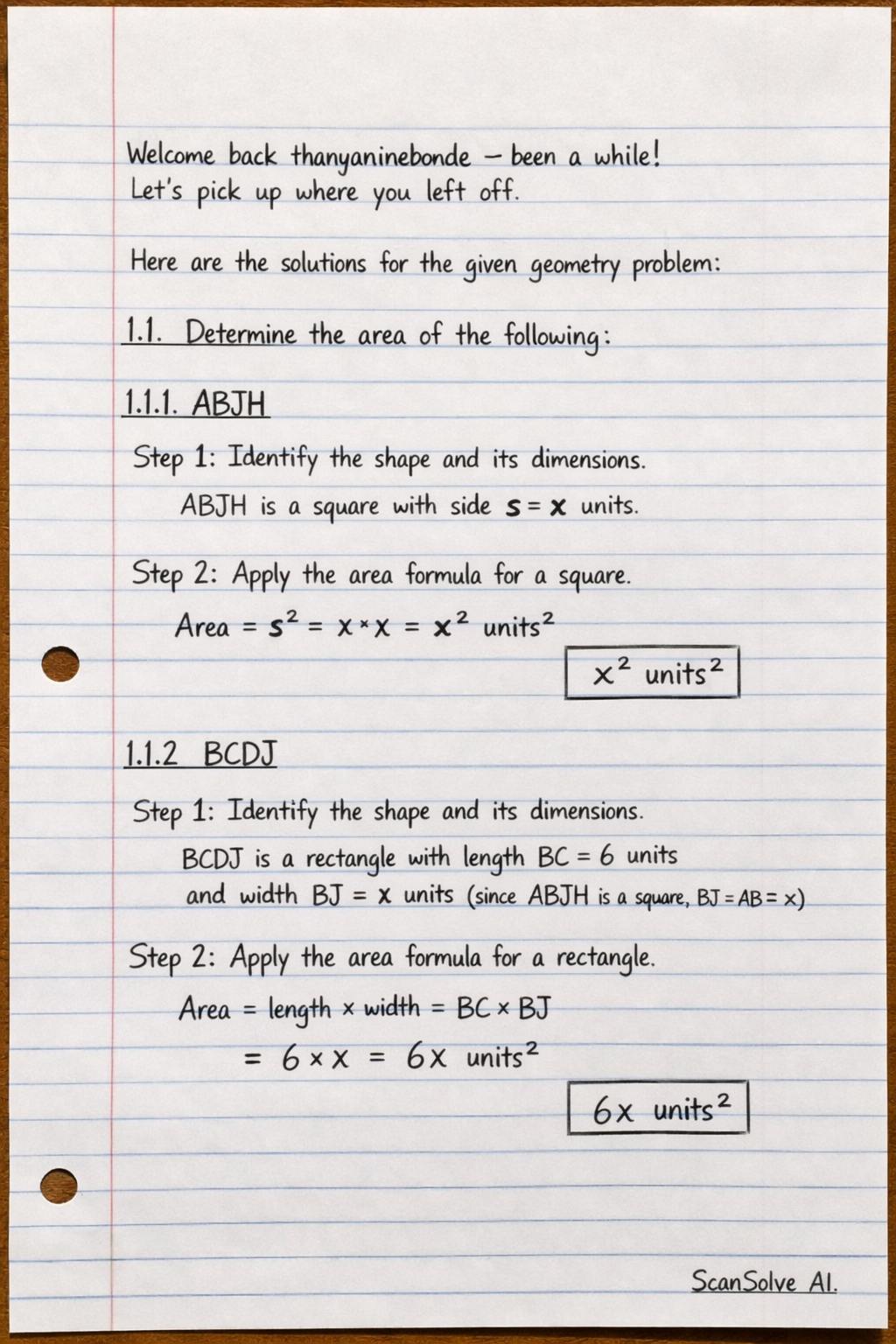
1.1.1 ABJH ABJH is a square with side length xx. Step 1: Identify the shape and its dimensions. ABJH is a square with side s=xs = x units. Step 2: Apply the area formula for a square. Area =s2=x×x=x2= s^2 = x \times x = x^2 units2^2. x2units2\boxed{*x^2 units^2*}

1.1.2 BCDJ BCDJ is a rectangle. Step 1: Identify the shape and its dimensions. BCDJ is a rectangle with length BC=6BC = 6 units and width BJ=xBJ = x units (since ABJH is a square, BJ=AB=xBJ = AB = x). Step 2: Apply the area formula for a rectangle. Area =length×width=BC×BJ=6×x=6x= length \times width = BC \times BJ = 6 \times x = 6x units2^2. 6xunits2\boxed{*6x units^2*}

1.1.3 DEFJ DEFJ is a rectangle. Step 1: Identify the shape and its dimensions. DEFJ is a rectangle. From the diagram, JD=BC=6JD = BC = 6 units. The total height CE=AG=AH+HG=x+4CE = AG = AH + HG = x + 4 units. Also, CE=CD+DECE = CD + DE. Since CD=BJ=xCD = BJ = x units, we have x+4=x+DEx + 4 = x + DE, which means DE=4DE = 4 units. Step 2: Apply the area formula for a rectangle. Area =length×width=JD×DE=6×4=24= length \times width = JD \times DE = 6 \times 4 = 24 units2^2. 24units2\boxed{*24 units^2*}

1.1.4 HJFG HJFG is a rectangle. Step 1: Identify the shape and its dimensions. HJFG is a rectangle with length JH=xJH = x units (since ABJH is a square, JH=AH=xJH = AH = x) and width HG=4HG = 4 units. Step 2: Apply the area formula for a rectangle. Area =length×width=JH×HG=x×4=4x= length \times width = JH \times HG = x \times 4 = 4x units2^2. 4xunits2\boxed{*4x units^2*}

1.2 Write in terms of xx, the length of:

1.2.1 AC Step 1: Identify the segments that make up AC. The length AC is the sum of segments AB and BC. Step 2: Substitute the given lengths. AC=AB+BC=x+6AC = AB + BC = x + 6 units. (x+6)units\boxed{*(x + 6) units*}

1.2.2 AG Step 1: Identify the segments that make up AG. The length AG is the sum of segments AH and HG. Step 2: Substitute the given lengths. AG=AH+HG=x+4AG = AH + HG = x + 4 units. (x+4)units\boxed{*(x + 4) units*}

Drop the next question! 📸

Was this helpful?

Need help with your own homework?

Get instant step-by-step solutions to any question. Free to start.

Ask Your Question
Handwritten step-by-step solution preview

Handwritten Step-by-Step Solution

Get this as a handwritten image on WhatsApp — like a tutor wrote it for you.

Try on WhatsApp

Still have questions?

Quick Answer

1.1 Determine the area of the following: 1.1.1 ABJH ABJH is a square with side length x.

Determine the area of the following, in some cases leave the answer in terms of x: (DO NOT MEASURE THE DIAGRAM)
Mathematics

This mathematics problem involves applying core mathematical principles and formulas. Below you will find a complete step-by-step solution with detailed explanations for each step, helping you understand not just the answer but the method behind it.

ScanSolve AI Answer
Here are the solutions for the given geometry problem: 1.1 Determine the area of the following: 1.1.1 ABJH ABJH is a square with side length x. Step 1: Identify the shape and its dimensions. ABJH is a square with side s = x units. Step 2: Apply the area formula for a square. Area = s^2 = x × x = x^2 units^2. x^2 units^2 1.1.2 BCDJ BCDJ is a rectangle. Step 1: Identify the shape and its dimensions. BCDJ is a rectangle with length BC = 6 units and width BJ = x units (since ABJH is a square, BJ = AB = x). Step 2: Apply the area formula for a rectangle. Area = length × width = BC × BJ = 6 × x = 6x units^2. 6x units^2 1.1.3 DEFJ DEFJ is a rectangle. Step 1: Identify the shape and its dimensions. DEFJ is a rectangle. From the diagram, JD = BC = 6 units. The total height CE = AG = AH + HG = x + 4 units. Also, CE = CD + DE. Since CD = BJ = x units, we have x + 4 = x + DE, which means DE = 4 units. Step 2: Apply the area formula for a rectangle. Area = length × width = JD × DE = 6 × 4 = 24 units^2. 24 units^2 1.1.4 HJFG HJFG is a rectangle. Step 1: Identify the shape and its dimensions. HJFG is a rectangle with length JH = x units (since ABJH is a square, JH = AH = x) and width HG = 4 units. Step 2: Apply the area formula for a rectangle. Area = length × width = JH × HG = x × 4 = 4x units^2. 4x units^2 1.2 Write in terms of x, the length of: 1.2.1 AC Step 1: Identify the segments that make up AC. The length AC is the sum of segments AB and BC. Step 2: Substitute the given lengths. AC = AB + BC = x + 6 units. (x + 6) units 1.2.2 AG Step 1: Identify the segments that make up AG. The length AG is the sum of segments AH and HG. Step 2: Substitute the given lengths. AG = AH + HG = x + 4 units. (x + 4) units Drop the next question! 📸