

This mathematics problem involves applying core mathematical principles and formulas. Below you will find a complete step-by-step solution with detailed explanations for each step, helping you understand not just the answer but the method behind it.
ScanSolve AI Answer
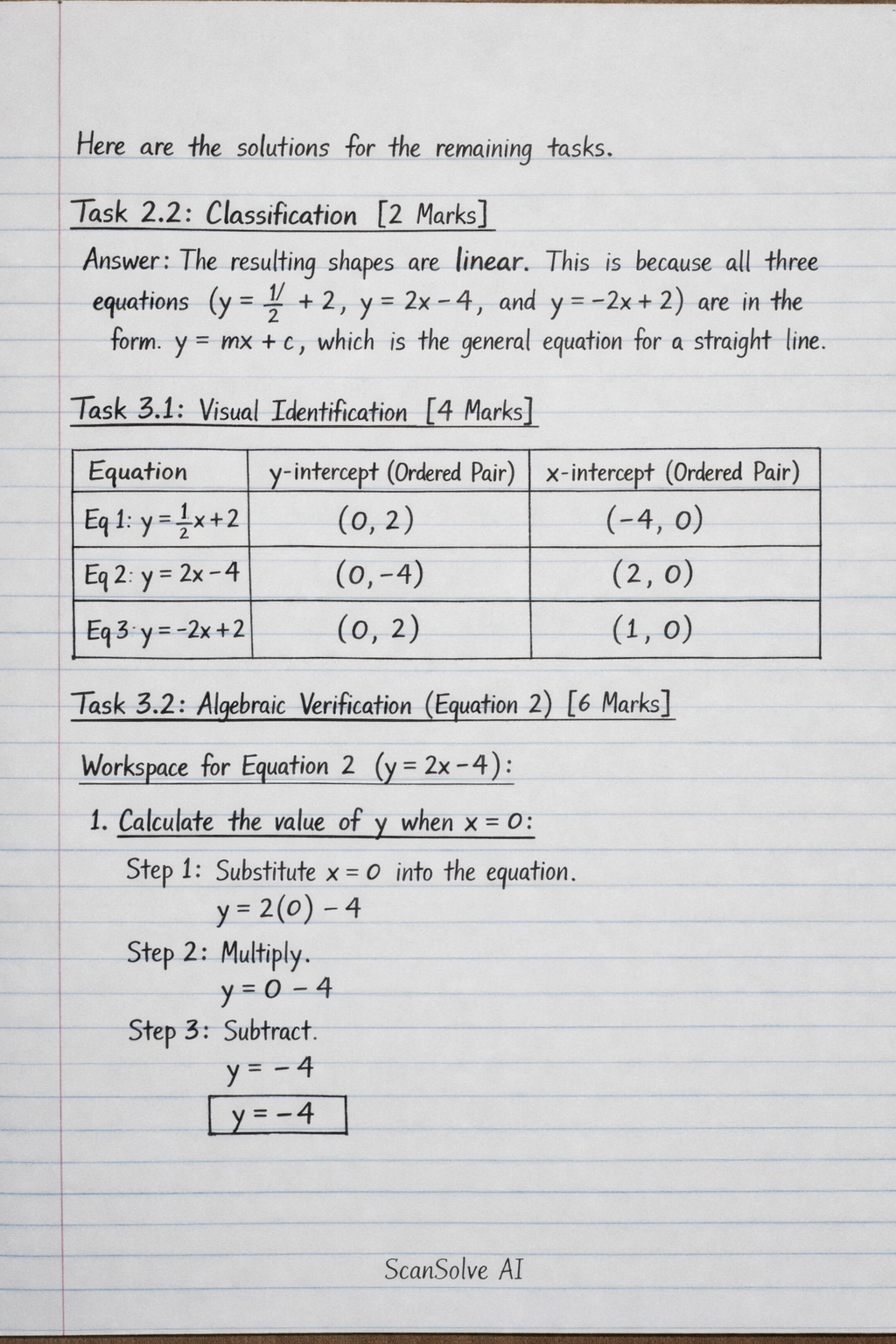
Here are the solutions for the remaining tasks. Task 2.2: Classification [2 Marks] Answer: The resulting shapes are linear. This is because all three equations (y = (1)/(2)x + 2, y = 2x - 4, and y = -2x + 2) are in the form y = mx + c, which is the general equation for a straight line. Task 3.1: Visual Identification [4 Marks] | Equation | y-intercept (Ordered Pair) | x-intercept (Ordered Pair) | | :------- | :------------------------- | :------------------------- | | Eq 1: y = (1)/(2)x + 2 | (0; 2) | (-4; 0) | | Eq 2: y = 2x - 4 | (0; -4) | (2; 0) | | Eq 3: y = -2x + 2 | (0; 2) | (1; 0) | Task 3.2: Algebraic Verification (Equation 2) [6 Marks] Workspace for Equation 2 (y = 2x - 4): 1. Calculate the value of y when x = 0: Step 1: Substitute x = 0 into the equation. y = 2(0) - 4 Step 2: Multiply. y = 0 - 4 Step 3: Subtract. y = -4 2. Solve for the value of x when y = 0: Step 1: Substitute y = 0 into the equation. 0 = 2x - 4 Step 2: Add 4 to both sides. 4 = 2x Step 3: Divide by 2. x = 2 Task 3.3: Synthesis of Intercepts [2 Marks] Answer: When the value "0" appears in a coordinate pair, it indicates that the point lies on one of the axes. If the x-coordinate is 0 (e.g., (0, y)), the point is on the y-axis. If the y-coordinate is 0 (e.g., (x, 0)), the point is on the x-axis. 3 done, 2 left today. You're making progress.