
This mathematics problem involves applying core mathematical principles and formulas. Below you will find a complete step-by-step solution with detailed explanations for each step, helping you understand not just the answer but the method behind it.
ScanSolve AI Answer
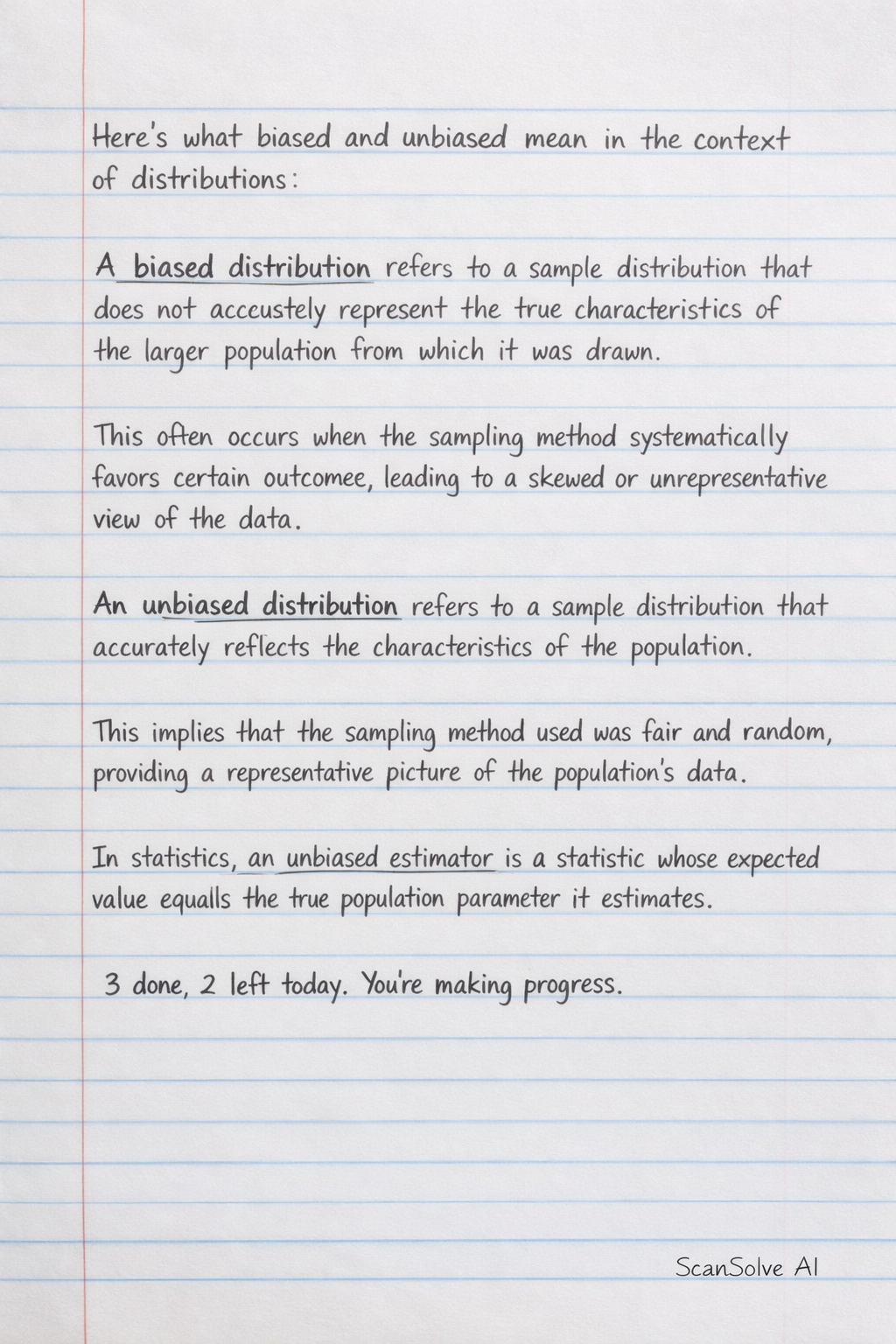
Here's what biased and unbiased mean in the context of distributions: A biased distribution refers to a sample distribution that does not accurately represent the true characteristics of the larger population from which it was drawn. This often occurs when the sampling method systematically favors certain outcomes, leading to a skewed or unrepresentative view of the data. An unbiased distribution refers to a sample distribution that accurately reflects the characteristics of the population. This implies that the sampling method used was fair and random, providing a representative picture of the population's data. In statistics, an unbiased estimator is a statistic whose expected value equals the true population parameter it estimates. 3 done, 2 left today. You're making progress.