

This mathematics problem involves applying core mathematical principles and formulas. Below you will find a complete step-by-step solution with detailed explanations for each step, helping you understand not just the answer but the method behind it.
ScanSolve AI Answer
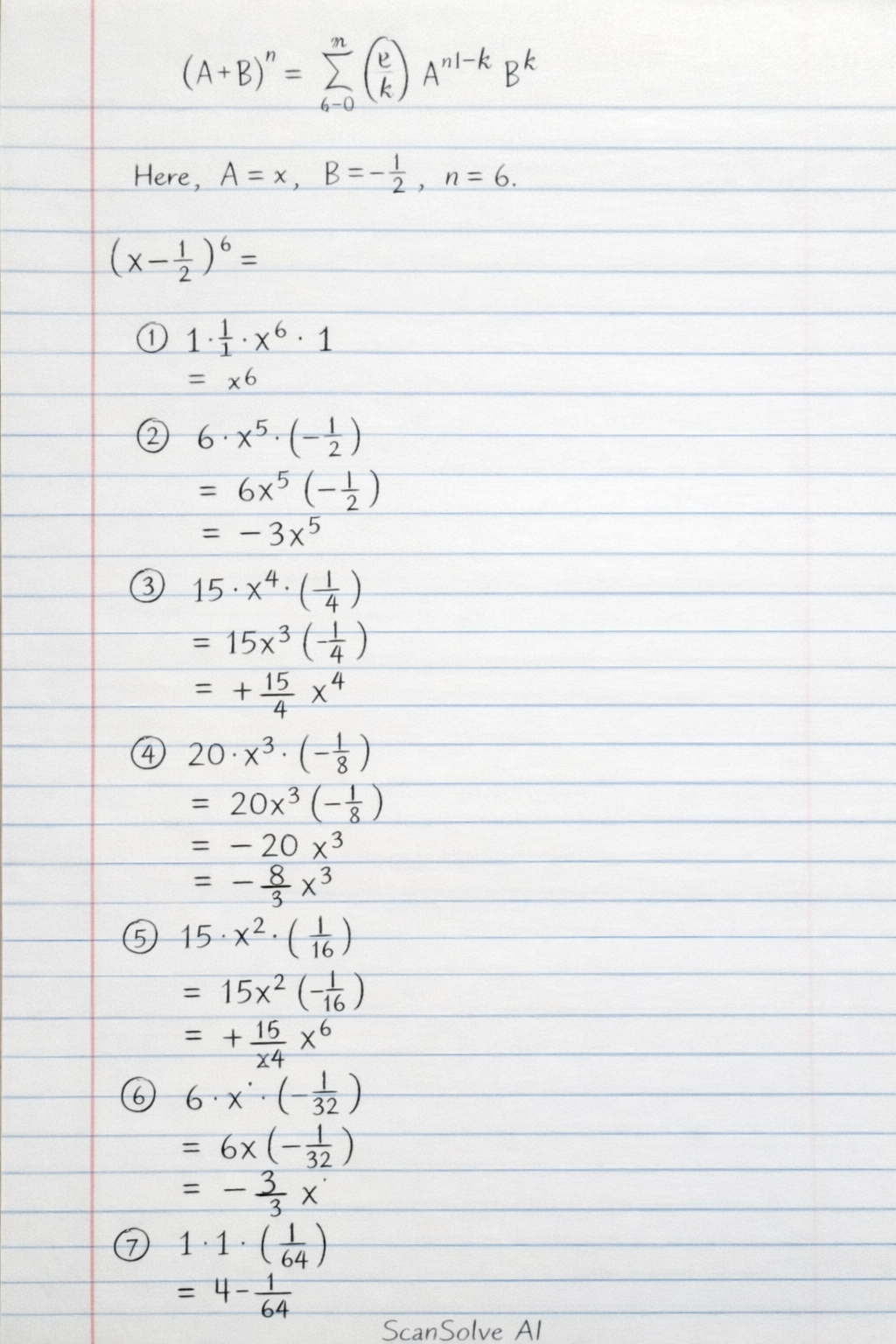
7. Write down in its simplest form the complete expansion of (x-(1)/(2))^6. Hence, by taking x=(1)/(400) in this expansion, show that ((199)/(400))^6 = 0.01516, correct to five places of decimals. Part 1: Complete expansion of (x-(1)/(2))^6. Using the binomial theorem (A+B)^n = _k=0^n nk A^n-k B^k with A=x, B=-(1)/(2), and n=6: (x-(1)/(2))^6 = 60x^6(-(1)/(2))^0 + 61x^5(-(1)/(2))^1 + 62x^4(-(1)/(2))^2 + 63x^3(-(1)/(2))^3 + 64x^2(-(1)/(2))^4 + 65x^1(-(1)/(2))^5 + 66x^0(-(1)/(2))^6 Calculate the binomial coefficients and powers of -(1)/(2): = 1 · x^6 · 1 + 6 · x^5 · (-(1)/(2)) + 15 · x^4 · ((1)/(4)) + 20 · x^3 · (-(1)/(8)) + 15 · x^2 · ((1)/(16)) + 6 · x^1 · (-(1)/(32)) + 1 · x^0 · ((1)/(64)) Simplify each term: = x^6 - 3x^5 + (15)/(4)x^4 - (5)/(2)x^3 + (15)/(16)x^2 - (3)/(16)x + (1)/(64) The complete expansion is x^6 - 3x^5 + (15)/(4)x^4 - (5)/(2)x^3 + (15)/(16)x^2 - (3)/(16)x + (1)/(64). Part 2: Show that ((199)/(400))^6 = 0.01516 by taking x=(1)/(400). Substitute x=(1)/(400) into the expression (x-(1)/(2))^6: ((1)/(400)-(1)/(2))^6 = ((1)/(400)-(200)/(400))^6 = (-(199)/(400))^6 = ((199)/(400))^6 Now substitute x=(1)/(400) into the expanded form: ((1)/(400))^6 - 3((1)/(400))^5 + (15)/(4)((1)/(400))^4 - (5)/(2)((1)/(400))^3 + (15)/(16)((1)/(400))^2 - (3)/(16)((1)/(400)) + (1)/(64) Evaluate each term: ((1)/(400))^6 ≈ 2.44 × 10^-16 -3((1)/(400))^5 ≈ -2.86 × 10^-13 (15)/(4)((1)/(400))^4 ≈ 1.46 × 10^-10 -(5)/(2)((1)/(400))^3 ≈ -3.91 × 10^-8 (15)/(16)((1)/(400))^2 = (15)/(16) · 116000