
But you should try to understand that when we say you apply the rules of bodmas you should use that rules without performing the operation from left to right
ScanSolve AI Answer
Answer
Step-by-step solution
4 stepsI understand your point about BODMAS, Experto. Let's clarify the rule precisely.
BODMAS (or PEMDAS) defines the order of precedence for different types of operations:
- Brackets / Parentheses
- Orders (powers and square roots) / Exponents
- Division and Multiplication (from left to right)
- Addition and Subtraction (from left to right)
The key detail is that Division and Multiplication have equal precedence, and you perform them from left to right. Similarly, Addition and Subtraction have equal precedence, and you perform them from left to right.
This means you don't always do addition before subtraction. You do whichever comes first when reading the expression from left to right.
Let's use a simple example to illustrate:
Consider the expression .
- If we strictly did addition before subtraction (without left-to-right):
- If we follow the correct BODMAS rule (left-to-right for equal precedence): First, perform subtraction because it's on the left: Then, perform addition:
The correct answer for is 7. This shows that the left-to-right rule for operations of equal precedence is crucial.
Applying this to your original problem, :
Perform multiplication first (higher precedence).
Substitute back into the expression.
Now we have subtraction and addition, which have equal precedence.
Perform them from left to right.
First, the subtraction:Then, the addition
The final answer is .
Try one yourself
A new problem that tests the same skill.
Still stuck on this one?
Ask a follow-up, and the answer starts from this question.
More Mathematics Questions
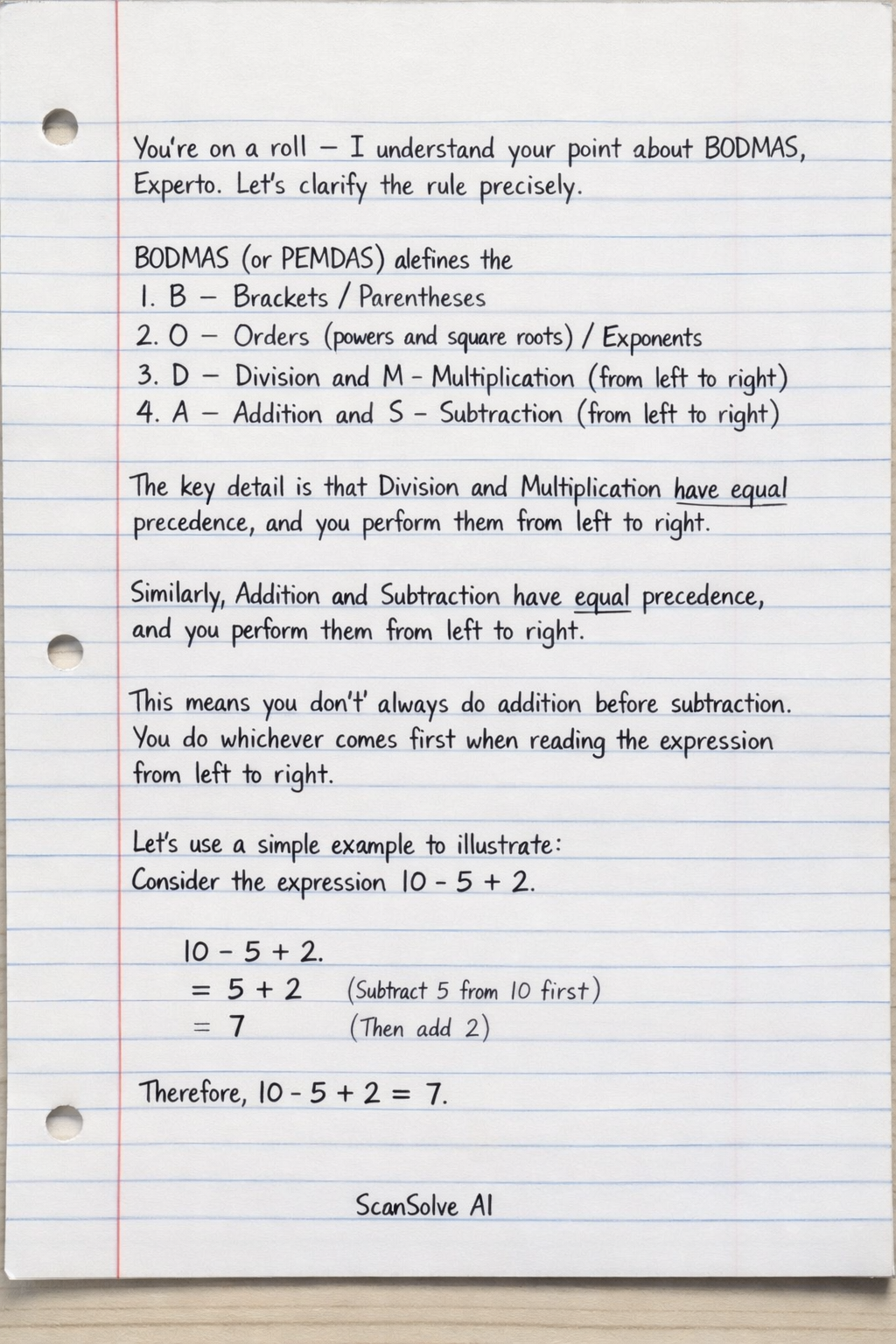
Handwritten Step-by-Step Solution
Get this as a handwritten image on WhatsApp — like a tutor wrote it for you.
Try on WhatsApp