
We read your photo as:
Calculate by using addition. Use the additive inverse of the integers in brackets.
ScanSolve AI Answer
Step-by-step solution
33 stepsHere are the solutions to your questions:
3. Calculate by using addition. Use the additive inverse of the integers in brackets.
Part a· 2 steps
Use the additive inverse of , which is 2.
Perform the addition.
The answer is .
Part b· 2 steps
Use the additive inverse of , which is .
Perform the addition.
The answer is .
Part c· 2 steps
Use the additive inverse of , which is .
Perform the addition.
The answer is .
Part d· 2 steps
Use the additive inverse of , which is 10.
Perform the addition.
The answer is .
Part e· 2 steps
Use the additive inverse of , which is 7.
Perform the addition.
The answer is .
Part f· 2 steps
Use the additive inverse of , which is .
Perform the addition.
The answer is .
Part g· 2 steps
Use the additive inverse of , which is .
Perform the addition.
The answer is .
Part h· 2 steps
Use the additive inverse of , which is 13.
Perform the addition.
The answer is .
Part h(i)· 17 steps
Use the additive inverse of , which is 15.
Perform the addition.
The answer is .
j)
Use the additive inverse of , which is 13.
Perform the addition.
The answer is .
k)
Use the additive inverse for each subtraction.
The additive inverse of is 1, and the additive inverse of is 5.
Perform the addition.
The answer is .
l)
Use the additive inverse for each subtraction.
The additive inverse of is 11, and the additive inverse of is 8.
Perform the addition.
The answer is .
4. A microwave oven increases the temperature of a piece of meat from to . What is the change in temperature?
Identify the initial and final temperatures.
Initial temperature ()
Final temperature ()Calculate the change in temperature using the formula .
Simplify the expression.
Subtracting a negative number is equivalent to adding its positive counterpart.
The change in temperature is .
5. Mrs Mojapelo cooks chicken pieces and puts the dish in the freezer. The freezer lowers the temperature from to . What is the temperature range?
Identify the highest and lowest temperatures.
Highest temperature
Lowest temperatureCalculate the temperature range by subtracting the lowest temperature from the highest temperature.
Simplify the expression.
The temperature range is .
6. Mr Sobekwa's bank statement shows an amount of . If he previously had in his bank account, how much does he need to put back so that he once again has in his account?
Determine the current balance and the desired final balance.
Current balance
Desired final balanceCalculate the amount needed to reach the desired final balance from the current balance.
Simplify the expression.
Subtracting a negative amount is equivalent to adding a positive amount.
Mr Sobekwa needs to put back .
Still stuck on this one?
Ask a follow-up, and the answer starts from this question.
More Mathematics Questions
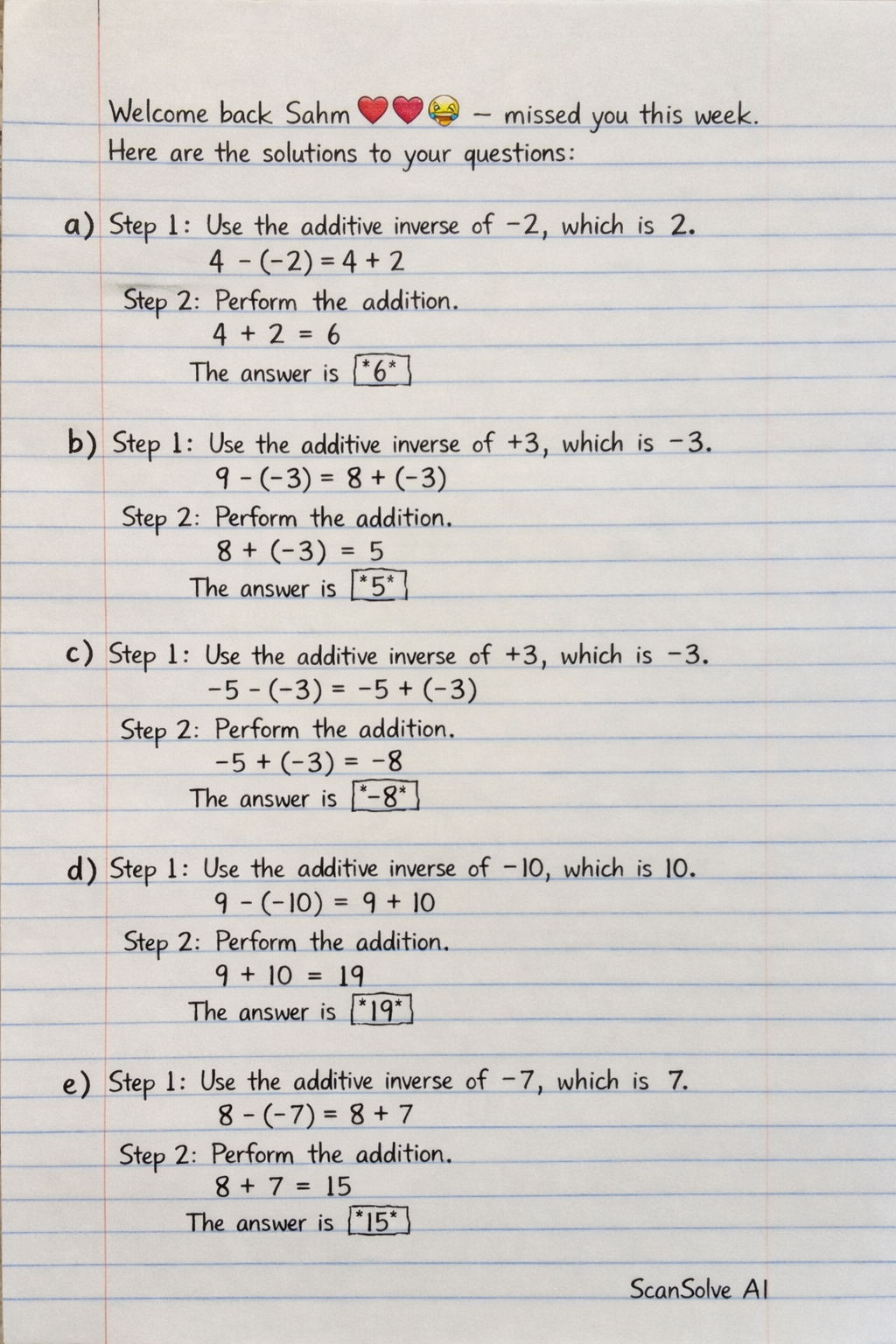
Handwritten Step-by-Step Solution
Get this as a handwritten image on WhatsApp — like a tutor wrote it for you.
Try on WhatsApp