
We read your photo as:
Determine the centre and radius of the second circle.
ScanSolve AI Answer
Answer
Step-by-step solution
4 stepsDetermine the centre and radius of the second circle.
The equation of the second circle is given by .
Comparing this to the general form of a circle , we have:
The coordinates of the centre are .
Centre .The radius is given by .
The centre of the circle is and the radius is .
Calculate the coordinates of A.
The common chord AB has the equation .
Point A is an intersection of this line and the second circle .
Substitute into the circle equation:This gives two possible x-coordinates: or .
If , then . This gives the point .
If , then . This gives the point .From the problem description, the first circle touches the y-axis at point B. The point lies on the y-axis. Therefore, B is .
Since A and B are the intersection points, A must be the other point.
The coordinates of A are .Show the equation of the circle centred at M.
The first circle is centred at M and touches the x-axis at C and the y-axis at B.
From Step 2, we found B is .
Since the circle touches the y-axis at , its radius must be .
Also, the y-coordinate of the centre M must be 1.
Since the circle touches the x-axis at C, and from the diagram C is on the negative x-axis, the x-coordinate of the centre M must be .
So, the centre M is and the radius is .The equation of a circle with centre and radius is .
Substituting M and :This matches the required equation.
Show the given equation for the tangent line.
The straight line is a tangent to the circle with centre M, which is $x^2 + y^
Try one yourself
A new problem that tests the same skill.
Still stuck on this one?
Ask a follow-up, and the answer starts from this question.
More Mathematics Questions
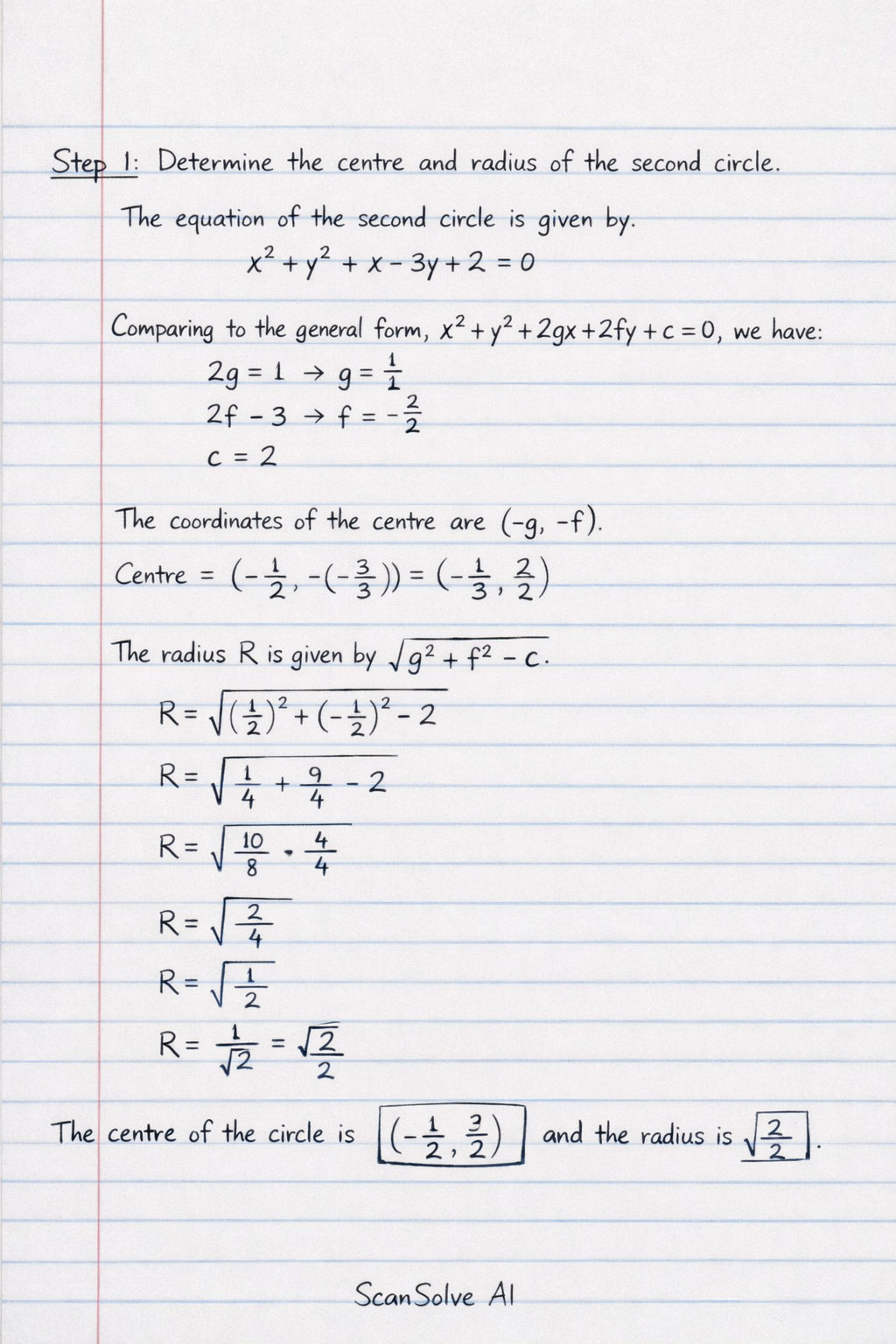
Handwritten Step-by-Step Solution
Get this as a handwritten image on WhatsApp — like a tutor wrote it for you.
Try on WhatsApp