
We read your photo as:
Challenge! I have tens, ones and tenths. My digits are next-door numbers and they add up to 9. What number am I?
ScanSolve AI Answer
Step-by-step solution
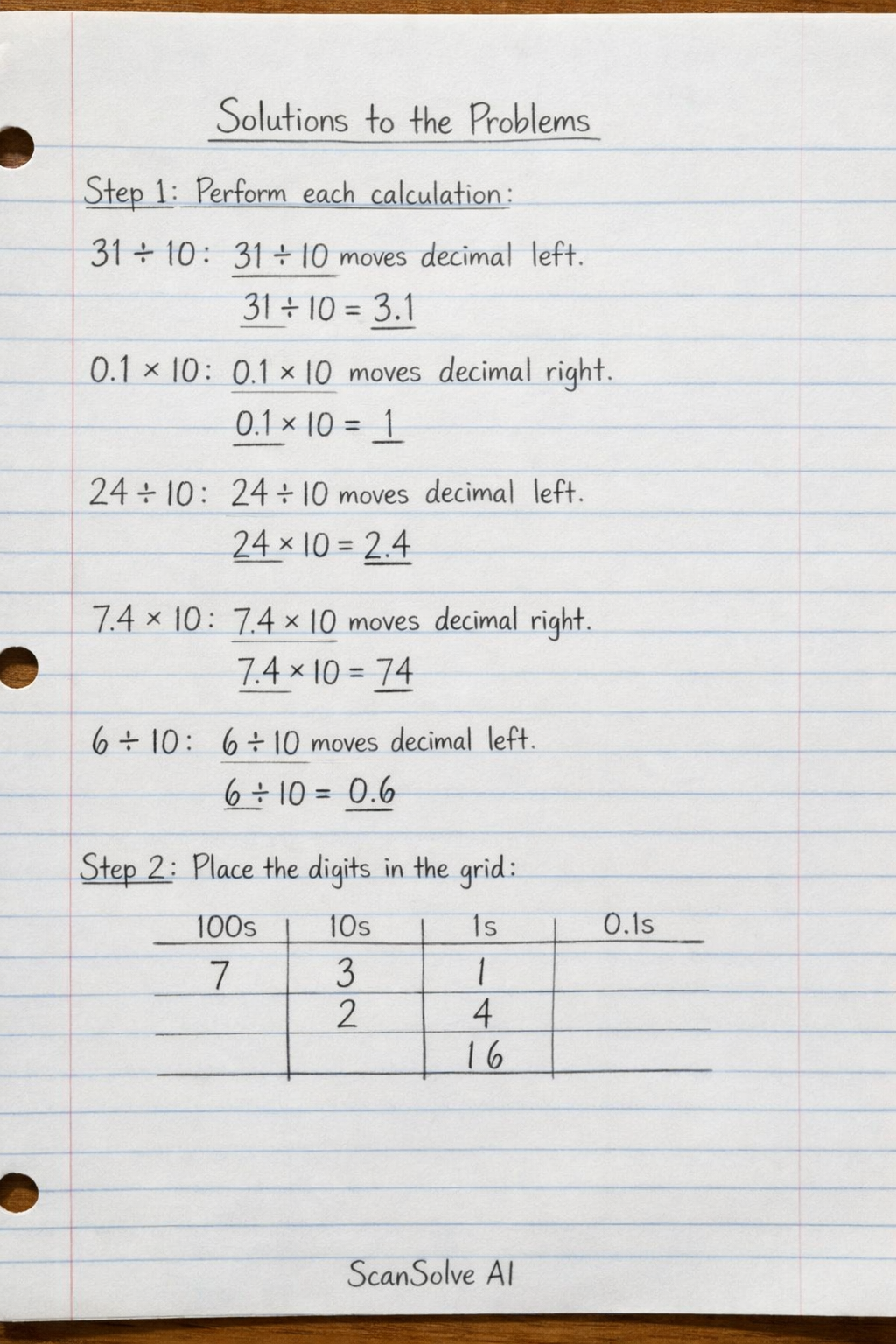
5 stepsHere are the solutions to the problems:
Look at the calculations. Write each answer on the grid.
Perform each calculation.
- For : Dividing by 10 moves the decimal point one place to the left.
- For : Multiplying by 10 moves the decimal point one place to the right.
- For : Dividing by 10 moves the decimal point one place to the left.
- For : Multiplying by 10 moves the decimal point one place to the right.
- For : Dividing by 10 moves the decimal point one place to the left.
Place the digits of each result into the correct columns (100s, 10s, 1s, 0.1s) in the grid.
Calculation 100s 10s 1s 0.1s 0 0 3 1 0 0 1 0 0 0 2 4 0 7 4 0 0 0 0 6 9 Challenge! I have tens, ones and tenths. My digits are next-door numbers and they add up to 9. What number am I?
Identify the properties of the digits.
The number has three digits: a tens digit (), a ones digit (), and a tenths digit ().
The digits are "next-door numbers," meaning they are consecutive integers (e.g., 1, 2, 3 or 5, 4, 3).
The sum of the digits is 9: .Find the set of three consecutive integers that sum to 9.
Let the middle digit be . The three consecutive digits can be represented as , , and .
Their sum is .
Set the sum equal to 9:So, the three digits are , , and . The digits are 2, 3, and 4.
Arrange the digits (2, 3, 4) into a number $T O . t$ such that they are "next-door numbers."
There are two possible arrangements where the digits are consecutive in order:
- Option 1 (Ascending order): Tens digit = 2, Ones digit = 3, Tenths digit = 4. This forms the number 23.4. Check: . The digits 2, 3, 4 are next-door numbers.
- Option 2 (Descending order): Tens digit = 4, Ones digit = 3, Tenths digit = 2. This forms the number 43.2. Check: . The digits 4, 3, 2 are next-door numbers.
Since the question asks "What number am I?" (singular), and in primary school mathematics, consecutive numbers are often presented in ascending order by default, we will provide the ascending option.
The number is .
Still stuck on this one?
Ask a follow-up, and the answer starts from this question.
Handwritten Step-by-Step Solution
Get this as a handwritten image on WhatsApp — like a tutor wrote it for you.
Try on WhatsApp