
We read your photo as:
Determine the common difference, the general formula, and the rule for the given arithmetic sequence: 5, 9, 13, 17, 21.
ScanSolve AI Answer
Step-by-step solution
3 stepsHere are the solutions to the problems:
Part 5.1· 1 step
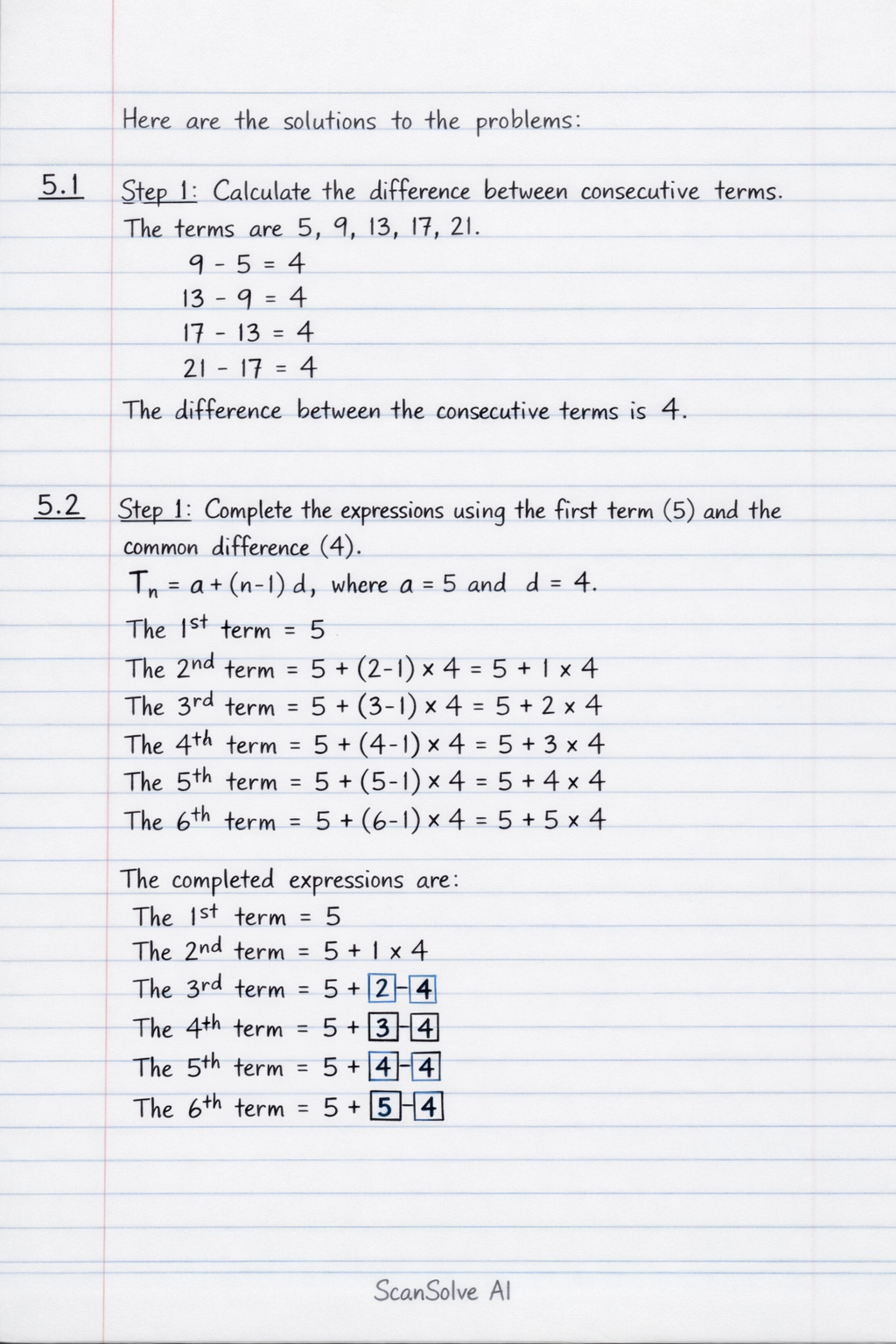
Calculate the difference between consecutive terms.
The terms are 5, 9, 13, 17, 21.
The difference between the consecutive terms is 4.
Part 5.2· 1 step
Complete the expressions using the first term (5) and the common difference (4).
The general form for an arithmetic sequence is , where is the first term and is the common difference. Here, and .
The 1st term = 5
The 2nd term =
The 3rd term =
The 4th term =
The 5th term =
The 6th term =The completed expressions are:
The 1st term = 5
The 2nd term =
The 3rd term =
The 4th term =
The 5th term =
The 6th term =
Part 5.3· 1 step
Describe the rule for finding a term in any position.
The rule for finding a term in any position in this sequence is to start with the first term (5), then add the product of the common difference (4) and one less than the term's position.
This can be written as , where is the term at position .
Still stuck on this one?
Ask a follow-up, and the answer starts from this question.
More Mathematics Questions
Handwritten Step-by-Step Solution
Get this as a handwritten image on WhatsApp — like a tutor wrote it for you.
Try on WhatsApp