
We read your photo as:
Define complementary, supplementary, vertically opposite, corresponding, and alternate angles. Also, explain the term 'parallel angle'.
ScanSolve AI Answer
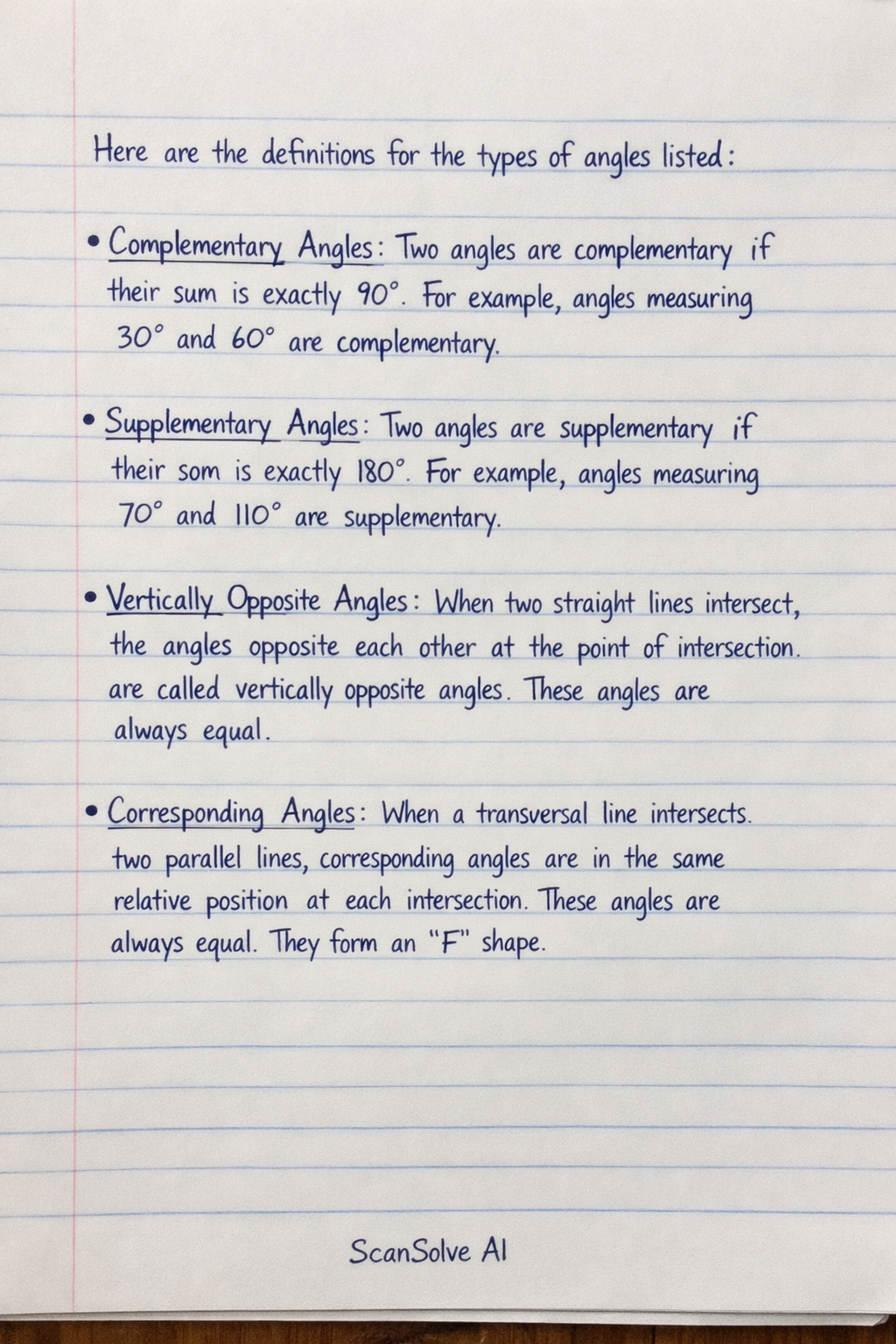
Here are the definitions for the types of angles listed:
-
Complementary Angles: Two angles are complementary if their sum is exactly . For example, angles measuring and are complementary.
-
Supplementary Angles: Two angles are supplementary if their sum is exactly . For example, angles measuring and are supplementary.
-
Vertically Opposite Angles: When two straight lines intersect, the angles opposite each other at the point of intersection are called vertically opposite angles. These angles are always equal.
-
Corresponding Angles: When a transversal line intersects two parallel lines, corresponding angles are in the same relative position at each intersection. These angles are always equal. They form an "F" shape.
-
Alternate Angles: When a transversal line intersects two parallel lines, alternate angles are on opposite sides of the transversal and between the parallel lines (alternate interior angles) or outside the parallel lines (alternate exterior angles). Both types of alternate angles are always equal. They form a "Z" shape.
-
Parallel Angle: This term is not standard. It likely refers to angles formed when a transversal intersects parallel lines, such as corresponding angles, alternate interior angles, alternate exterior angles, and consecutive interior angles (also known as co-interior angles). These relationships define how angles behave when lines are parallel.
Still stuck on this one?
Ask a follow-up, and the answer starts from this question.
More Mathematics Questions
Handwritten Step-by-Step Solution
Get this as a handwritten image on WhatsApp — like a tutor wrote it for you.
Try on WhatsApp