
We read your photo as:
Complete the fractions to make them equal. For example, 2/4 = 4/8.
ScanSolve AI Answer
Here are the solutions to the problems:
1. Complete the fractions to make them equal.
a) (Given)
b) To get from 5 to 10, we multiply by 2. So, we multiply the numerator 3 by 2.
c) To get from 6 to 12, we multiply by 2. So, we multiply the numerator 2 by 2.
d) To get from 7 to 21, we multiply by 3. So, we multiply the numerator 6 by 3.
e) To get from 4 to 2, we divide by 2. So, we divide the numerator 2 by 2.
f) To get from 15 to 5, we divide by 3. So, we divide the numerator 9 by 3.
g) To get from 6 to 18, we multiply by 3. So, we multiply the numerator 5 by 3.
h) To get from 9 to 18, we multiply by 2. So, we multiply the numerator 7 by 2.
i) To get from 22 to 11, we divide by 2. So, we divide the numerator 6 by 2.
j) To get from 25 to 100, we multiply by 4. So, we multiply the numerator 20 by 4.
2. What happens to the numerator and denominator? Extend the pattern down three more equivalent fractions.
In both cases, to find an equivalent fraction, both the numerator and the denominator are multiplied by the same non-zero number.
a) The pattern is to multiply both the numerator and denominator by 2 each time.
b) The pattern is to multiply both the numerator and denominator by 3 each time.
Still stuck on this one?
Ask a follow-up, and the answer starts from this question.
More Mathematics Questions
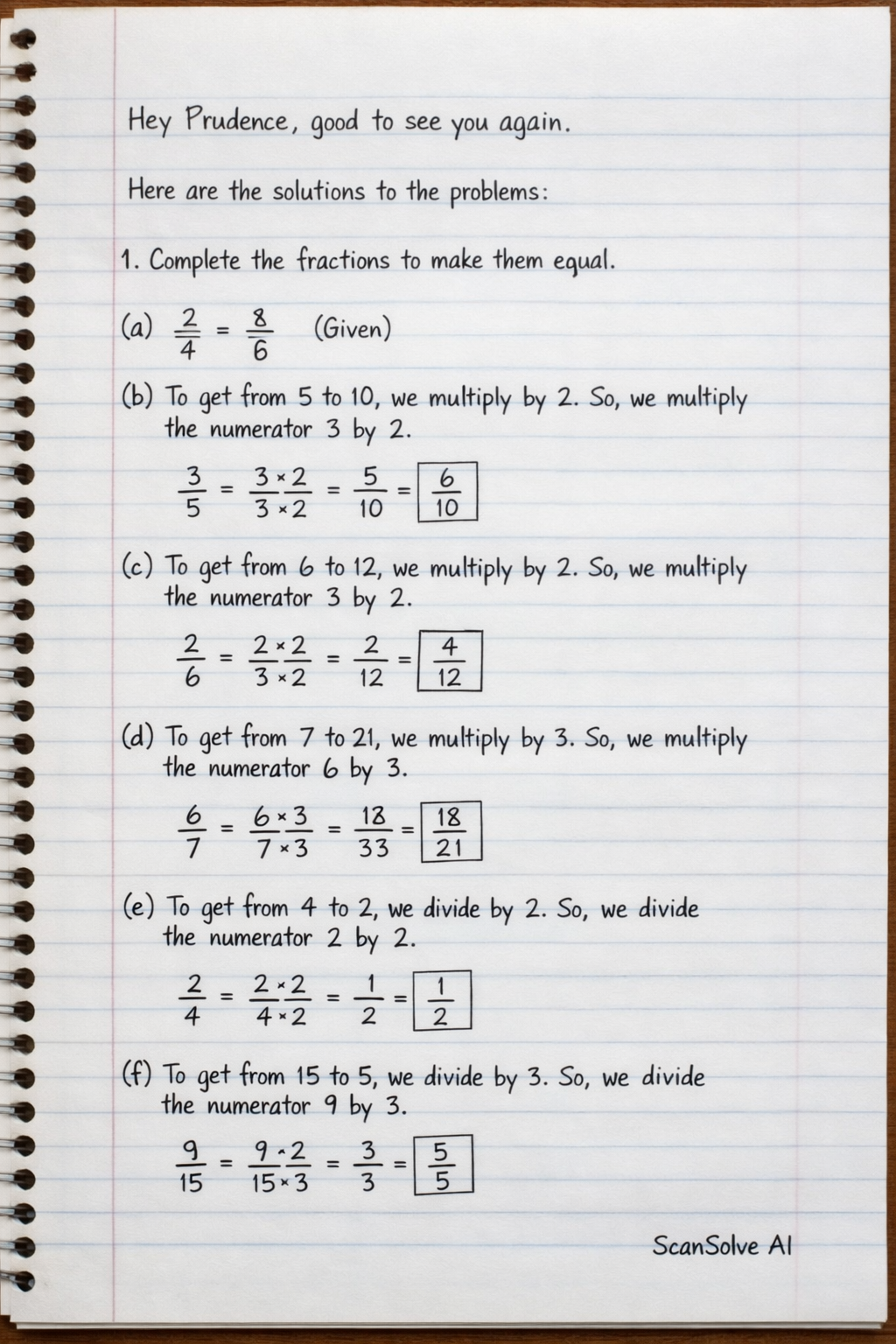
Handwritten Step-by-Step Solution
Get this as a handwritten image on WhatsApp — like a tutor wrote it for you.
Try on WhatsApp