
We read your photo as:
Complete the table and calculate F - E + V for each geometric solid. What do you notice? Look at Euler's formula. This equation shows us the number of vertices, faces and edges 8−7+1=2. Is this a polyhedron. Why or why not?
ScanSolve AI Answer
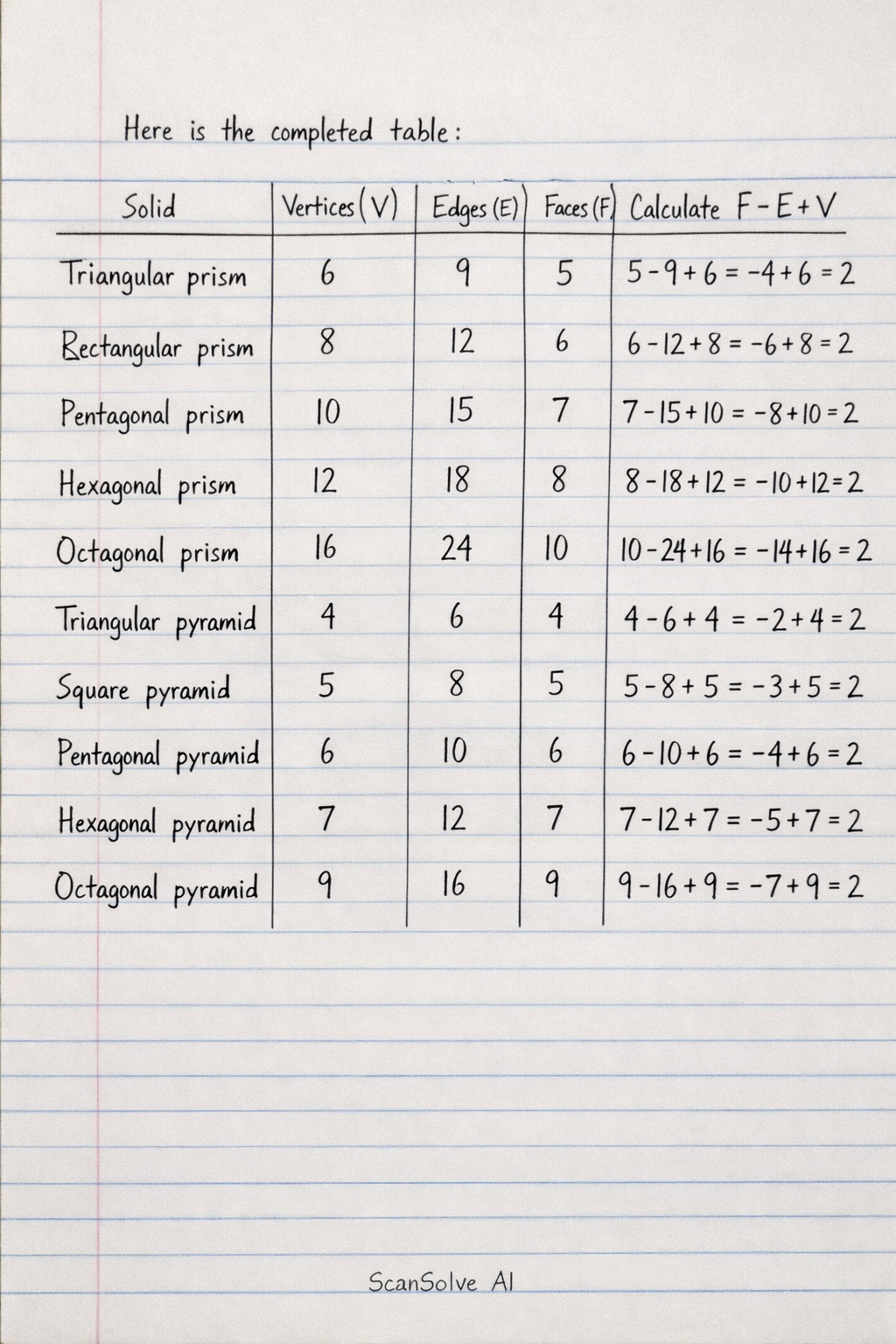
Here is the completed table:
| Solid | Vertices (V) | Edges (E) | Faces (F) | Calculate F - E + V |
|---|---|---|---|---|
| Triangular prism | 6 | 9 | 5 | |
| Rectangular prism | 8 | 12 | 6 | |
| Pentagonal prism | 10 | 15 | 7 | |
| Hexagonal prism | 12 | 18 | 8 | |
| Octagonal prism | 16 | 24 | 10 | |
| Triangular pyramid | 4 | 6 | 4 | |
| Square pyramid | 5 | 8 | 5 | |
| Pentagonal pyramid | 6 | 10 | 6 | |
| Hexagonal pyramid | 7 | 12 | 7 | |
| Octagonal pyramid | 9 | 16 | 9 |
What do you notice?
For all the polyhedra in the table, the calculation always equals 2. This is known as Euler's formula for polyhedra.
Problem solving:
Look at Euler's formula. This equation shows us the number of vertices, faces and edges . Is this a polyhedron? Why or why not?
No, this is not a polyhedron.
A polyhedron must have at least 4 vertices. The given values (F=8, E=7, V=1) imply only 1 vertex, which is not possible for a polyhedron. A solid with only one vertex is typically a cone, which is not a polyhedron because it has a curved surface, not flat faces.
Still stuck on this one?
Ask a follow-up, and the answer starts from this question.
More Mathematics Questions
Handwritten Step-by-Step Solution
Get this as a handwritten image on WhatsApp — like a tutor wrote it for you.
Try on WhatsApp