

This computer science problem involves algorithmic thinking and programming concepts. The solution below explains the approach, logic, and implementation step by step.
ScanSolve AI Answer
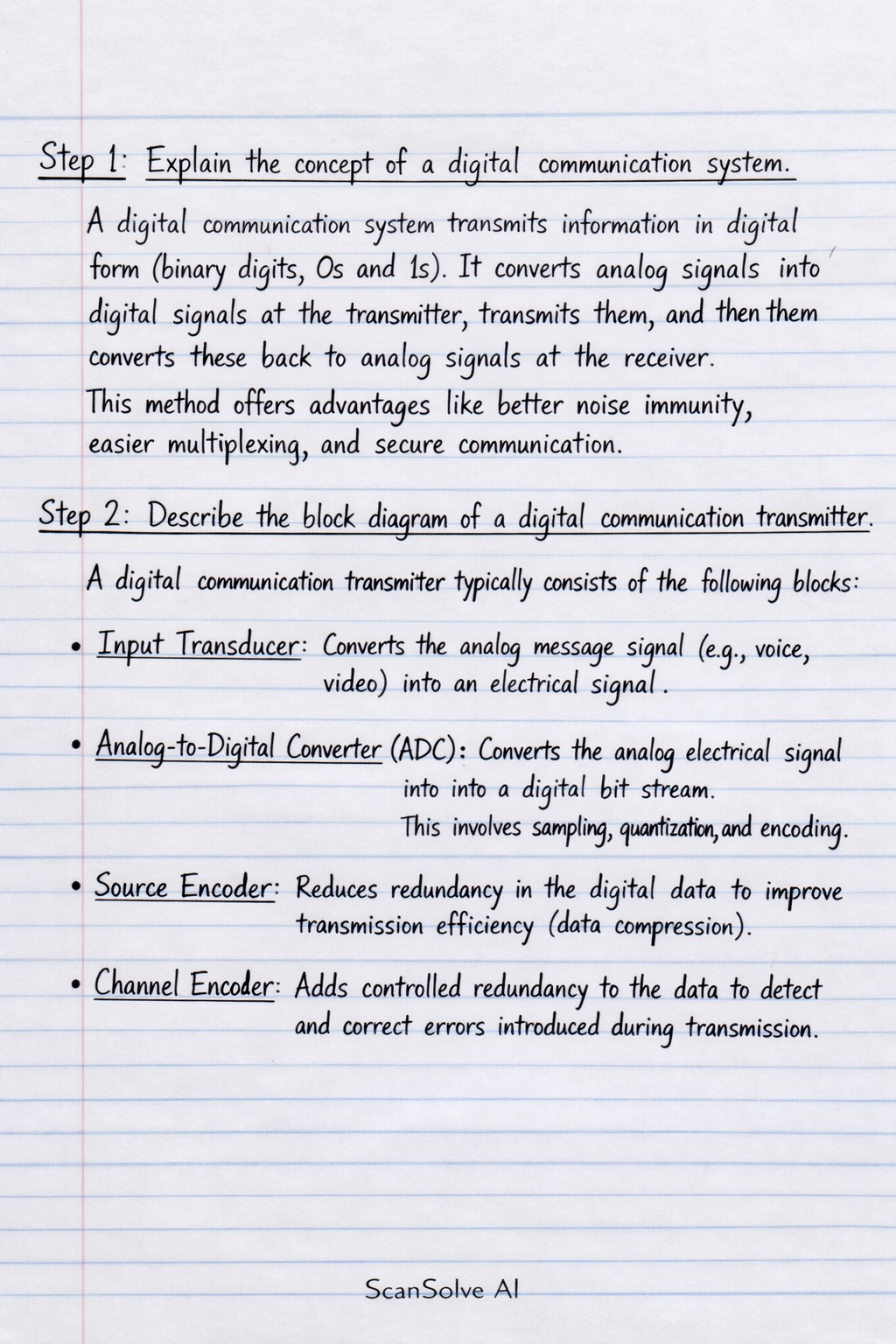
Step 1: Explain the concept of a digital communication system. A digital communication system transmits information in digital form (binary digits, 0s and 1s). It converts analog signals into digital signals at the transmitter, transmits them, and then converts them back to analog signals at the receiver. This method offers advantages like better noise immunity, easier multiplexing, and secure communication. Step 2: Describe the block diagram of a digital communication transmitter. A digital communication transmitter typically consists of the following blocks: • Input Transducer: Converts the analog message signal (e.g., voice, video) into an electrical signal. • Analog-to-Digital Converter (ADC): Converts the analog electrical signal into a digital bit stream. This involves sampling, quantization, and encoding. • Source Encoder: Reduces redundancy in the digital data to improve transmission efficiency (data compression). • Channel Encoder: Adds controlled redundancy to the data to detect and correct errors introduced during transmission. • Modulator: Converts the digital bit stream into an analog waveform suitable for transmission over the physical channel (e.g., radio waves, optical fiber). This involves techniques like ASK, FSK, PSK. • Channel: The physical medium through which the modulated signal travels (e.g., air, cable). Step 3: Describe the block diagram of a digital communication receiver. A digital communication receiver typically consists of the following blocks: • Channel: Receives the transmitted signal, which may be corrupted by noise and interference. • Demodulator: Recovers the digital bit stream from the received analog waveform. • Channel Decoder: Uses the added redundancy to detect and correct errors in the received bit stream. • Source Decoder: Reconstructs the original digital data from the compressed data. • Digital-to-Analog Converter (DAC): Converts the digital bit stream back into an analog electrical signal. • Output Transducer: Converts the electrical signal back into the original message format (e.g., sound, image). The concept of a digital communication system involves converting information into a digital format for transmission and then back to its original form at the destination, leveraging digital processing for robustness and efficiency. Digital communication system explained with transmitter and receiver block descriptions. Step 4: Explain Pulse Code Modulation (PCM). Pulse Code Modulation (PCM) is a method used to digitally represent sampled analog signals. It is the standard form of digital audio in computers and various other digital communication systems. PCM involves three main processes: sampling, quantization, and encoding. Step 5: Describe the block diagram of a PCM system. A PCM system consists of a transmitter and a receiver. PCM Transmitter Blocks: • Sampler: Takes discrete samples of the analog input signal at regular intervals. The sampling rate must be at least twice the highest frequency component of the analog signal (Nyquist rate). • Quantizer: Converts the continuous range of sample values into a finite set of discrete values. Each sample is approximated to the nearest quantization level. • Encoder: Assigns a unique binary code (e.g., 0s and 1s) to each quantized level. This converts the discrete amplitude values into a digital bit stream. • Line Coder: Converts the binary data into a suitable waveform for transmission over the channel. PCM Receiver Blocks: • Line Decoder: Recovers the binary data from the received waveform. • Decoder: Converts the binary codes back into discrete amplitude levels. • Reconstruction Filter (Low-Pass Filter): Smooths out the discrete amplitude levels to reconstruct an approximation of the original analog signal. Step 6: Describe the working process of PCM. 1. Sampling: The continuous analog signal is sampled at regular intervals. According to the Nyquist theorem, the sampling frequency (f_s) must be at least twice the maximum frequency (f_m) of the analog signal (f_s 2f_m) to avoid aliasing. 2. Quantization: Each sampled value, which is still analog, is then approximated to the nearest predefined discrete amplitude level. The number of quantization levels determines the resolution and the amount of quantization error (noise). More levels mean better accuracy but require more bits for encoding. 3. Encoding: Each quantized level is assigned a unique binary code. For example, if there are L quantization levels, then _2 L bits are required to represent each level. This process converts the discrete amplitude values into a digital bit stream (sequence of 0s and 1s). 4. Transmission: The encoded digital signal is then transmitted over the communication channel. 5. Decoding: At the receiver, the incoming digital bit stream is decoded back into the discrete amplitude levels. 6. Reconstruction: A low-pass filter (reconstruction filter) is used to smooth out these discrete levels, converting them back into an analog signal that closely approximates the original input signal. The working process of PCM transforms an analog signal into a digital format by sampling, quantizing, and encoding, allowing for robust digital transmission and subsequent reconstruction. Pulse Code Modulation (PCM) explained with its working process and block descriptions. Step 7: Explain the concept of a cellular communication system. A cellular communication system is a wireless communication network that divides a geographical area into smaller regions called cells. Each cell is served by a base station (transceiver) that handles communication with mobile devices within its area. The primary concept behind cellular systems is frequency reuse, where the same set of frequencies can be used in non-adjacent cells, significantly increasing the system's capacity compared to a single large transmitter. This allows a large number of users to communicate simultaneously over a wide area. Step 8: Describe a suitable diagram for a cellular communication system. A suitable diagram would show a hexagonal grid representing multiple cells. • Cells: Each hexagon represents a cell, covering a specific geographical area. • Base Stations (BS): Located at the center or corners of each cell, these are transceivers that communicate with mobile devices within their cell. • Mobile Stations (MS): Represented by mobile phones or other devices moving within and between cells. • Mobile Switching Center (MSC): A central hub that connects all base stations, manages calls, handles handoffs between cells, and interfaces with the public switched telephone network (PSTN). • Frequency Reuse Pattern: Different sets of frequencies are assigned to adjacent cells to avoid interference, while the same frequencies are reused in cells that are sufficiently far apart. For example, a 7-cell reuse pattern might be shown, where cells with the same frequency set are separated by a certain distance. Step 9: Explain the working of a cellular communication system. When a mobile device makes a call, it communicates with the nearest base station. The base station then relays the call to the Mobile Switching Center (MSC). The MSC manages the call setup, routing, and termination. As a mobile device moves from one cell to another, the call is seamlessly transferred from the current base station to the new one, a process called handoff or handover. This ensures continuous communication without interruption. The frequency reuse concept is crucial: by assigning different frequency channels to adjacent cells and reusing the same channels in non-adjacent cells, the system maximizes the utilization of the limited radio spectrum and supports a large number of users. The cellular communication system enables widespread mobile connectivity by dividing service areas into cells, allowing efficient frequency reuse and seamless handoffs between cells. Cellular communication system explained with its concept and diagram description. Step 10: Explain a satellite communication system. A satellite communication system uses artificial satellites as relays to transmit signals between widely separated points on Earth. It enables global communication, broadcasting, and navigation services. The system typically consists of one or more earth stations (ground stations) and a communication satellite in orbit. The satellite receives signals from an earth station (uplink), amplifies and processes them, and then retransmits them to another earth station (downlink). Step 11: Describe the block diagram of a satellite communication system. A satellite communication system block diagram includes: Earth Station (Transmitter Side): • Input Data: The information to be transmitted. • Modulator: Modulates the input data onto a carrier wave. • Up-converter: Converts the modulated signal to a higher frequency for uplink transmission. • High Power Amplifier (HPA): Amplifies the signal to a sufficient power level for transmission to the satellite. • Antenna: Transmits the signal towards the satellite. Satellite (Transponder): • Receive Antenna: Receives the uplink signal from the earth station. • Low Noise Amplifier (LNA): Amplifies the weak received signal while adding minimal noise. • Down-converter: Converts the signal to a lower frequency for processing and downlink transmission. • Demodulator/Modulator (optional): For regenerative transponders, the signal is demodulated, processed, and then remodulated. For bent-pipe transponders, it's just amplified and frequency shifted. • High Power Amplifier (HPA): Amplifies the signal for downlink transmission. • Transmit Antenna: Transmits the processed signal back to Earth. Earth Station (Receiver Side): • Receive Antenna: Receives the downlink signal from the satellite. • Low Noise Amplifier (LNA): Amplifies the weak received signal. • Down-converter: Converts the signal to a lower frequency for processing. • Demodulator: Demodulates the signal to recover the original data. • Output Data: The recovered information. Step 12: Describe frequency allocation in satellites. Frequency allocation refers to the assignment of specific frequency bands for different types of satellite services (e.g., fixed satellite service, mobile satellite service, broadcasting satellite service). The International Telecommunication Union (ITU) regulates these allocations globally. • Uplink Frequency: The frequency used for transmitting signals from an earth station to the satellite. • Downlink Frequency: The frequency used for transmitting signals from the satellite to an earth station. • Commonly used frequency bands include: • C-band: Uplink around 5.9-6.4 GHz, Downlink around 3.7-4.2 GHz. Prone to terrestrial interference but less affected by rain fade. • Ku-band: Uplink around 14 GHz, Downlink around 11-12 GHz. Higher power, smaller antennas, but more susceptible to rain fade. • Ka-band: Uplink around 27-31 GHz, Downlink around 17-21 GHz. Offers very high bandwidth but is highly susceptible to rain fade. Step 13: Describe spacing in satellites. Satellite spacing primarily refers to the angular separation between geostationary satellites in orbit. Geostationary satellites orbit at an altitude of approximately 35,786 km above the equator, appearing stationary relative to a point on Earth. • To prevent interference between adjacent satellites operating on the same or similar frequencies, a minimum angular separation is required. • The ITU typically mandates a minimum spacing of 2 degrees for C-band and Ku-band satellites in geostationary orbit. This separation ensures that the earth station antennas can distinguish between signals from different satellites and minimize co-channel interference. • For Ka-band, smaller spacing might be possible due to narrower beamwidths, but rain fade becomes a more significant factor. • Proper spacing is crucial for efficient utilization of the geostationary arc and to maintain the quality of satellite communication services. A satellite communication system uses orbiting satellites as relays for global communication, with specific frequency bands allocated for uplink and downlink, and careful angular spacing of satellites to prevent interference. Satellite communication system explained with block diagram description, frequency allocation, and spacing.