
We read your photo as:
Construct an equilateral triangle of side 5 cm and its circumscribed circle, and calculate the total surface area.
ScanSolve AI Answer
Answer
Step-by-step solution
14 stepsPart a· 4 steps
To construct an equilateral triangle of side 5 cm
Draw a line segment PQ of length 5 cm using a ruler.
Place the compass point at P and open it to a radius of 5 cm.
Draw an arc above the line segment PQ.
Place the compass point at Q and, with the same radius of 5 cm, draw another arc that intersects the first arc.
Label the intersection point R.
Draw straight lines from P to R and from Q to R using a ruler.
Triangle PQR is the equilateral triangle with sides of 5 cm.
Part b
To construct the circumscribed circle of triangle PQR
Construct the perpendicular bisector of side PQ.
To do this, place the compass point at P, open it to more than half the length of PQ, and draw arcs above and below PQ. Repeat this from point Q with the same compass opening. Draw a straight line connecting the two points where the arcs intersect. This is the perpendicular bisector of PQ.
Construct the perpendicular bisector of side QR using the same method as in Step 1.
The point where the two perpendicular bisectors intersect is the circumcenter of the triangle.
Label this point O.
Place the compass point at O and open it to the distance OP (or OQ or OR, as these distances will be equal).
Draw a circle. This circle passes through all three vertices P, Q, and R, and is the circumscribed circle.
20.
To calculate the total surface area of a closed cylinder, use the formula:where is the radius and is the height.
Identify the given values.
Diameter cm
Height cm
Calculate the radius .
The radius is half of the diameter:
Substitute the values into the surface area formula.
Calculate the area of the two circular bases ().
Calculate the lateral surface area ().
Add the areas to find the total surface area.
The total surface area of the cylinder is .
Try one yourself
A new problem that tests the same skill.
Still stuck on this one?
Ask a follow-up, and the answer starts from this question.
More Mathematics Questions
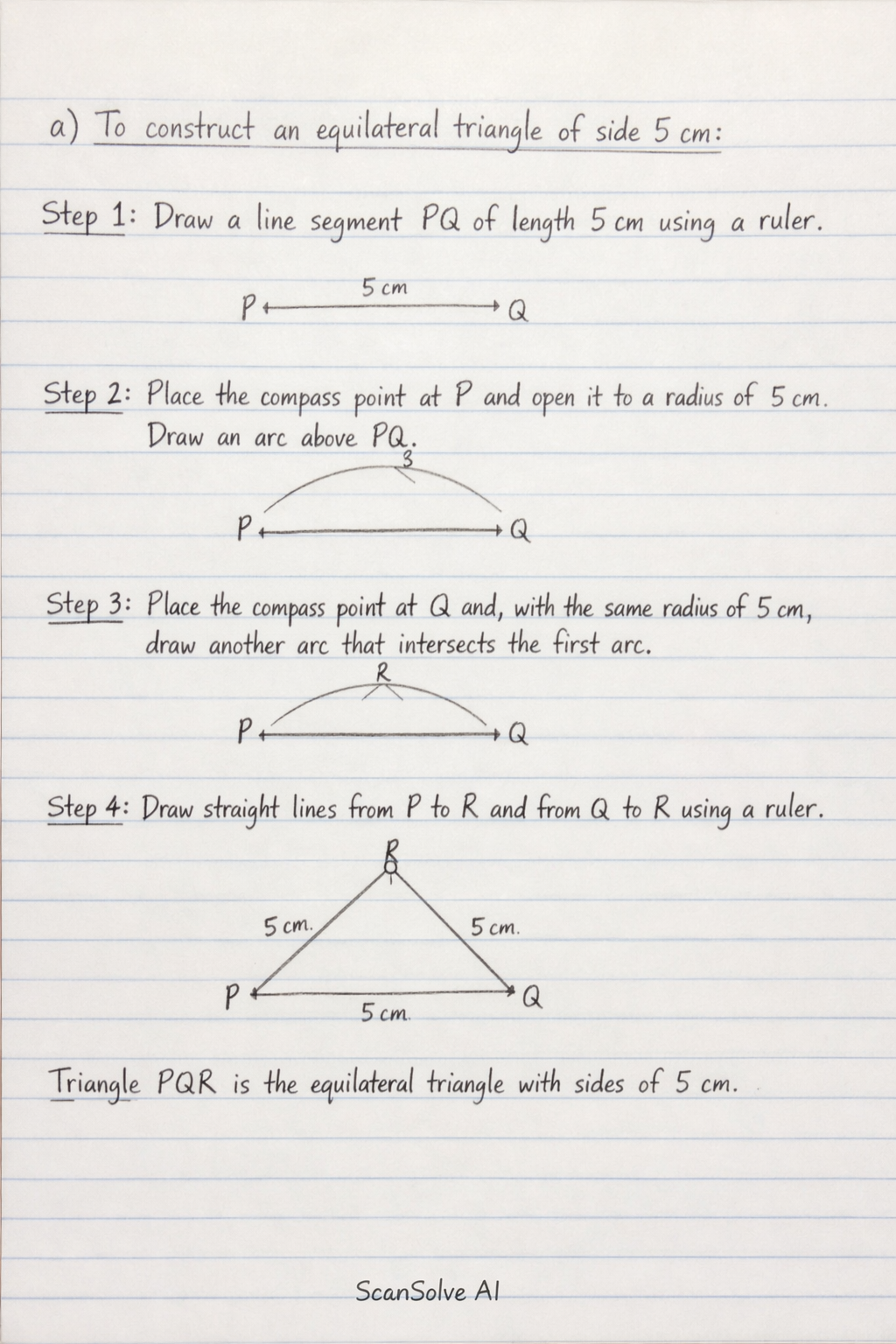
Handwritten Step-by-Step Solution
Get this as a handwritten image on WhatsApp — like a tutor wrote it for you.
Try on WhatsApp